




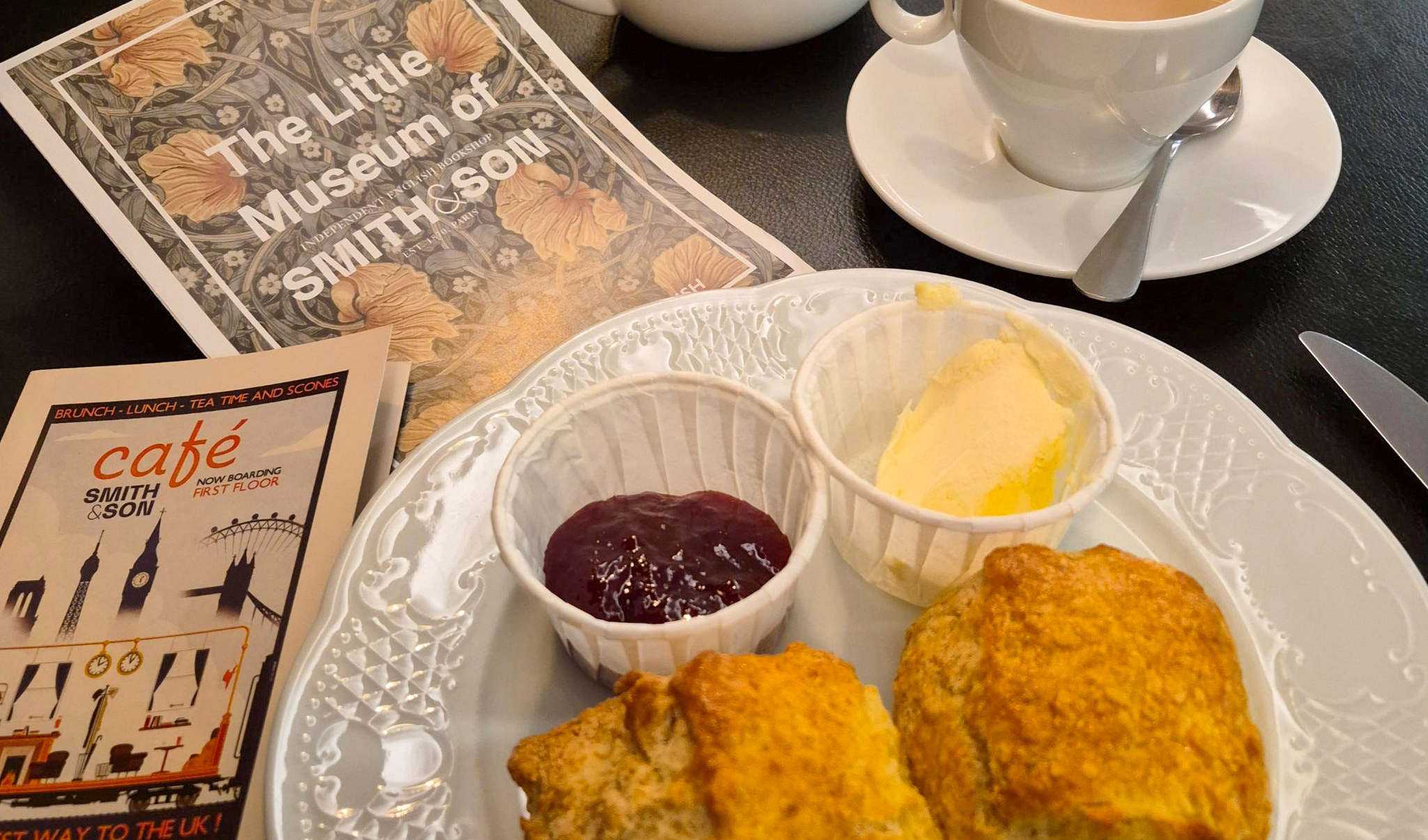
 Scones, strawberry-violet jam and clotted cream at Smith & Son in Paris. Books and food — perfect. (Photo: Marita van der Vyver)
 No matter how much I love spending the festive season with our adult children and our noisy French family, the suppressed introvert in me needs bits of silence, exile and cunning (borrowing James Joyce’s phrase) to recharge my social batteries. That’s why I fled the family to spend a freezing day on my own in Paris between Christmas and New Year, playing flâneuse, walking the city, finding surprises around every corner.
Moving among crowds of people but not obliged to talk to anyone, I could eavesdrop on conversations to my heart’s content, watch fascinating creatures — the way they dress, walk, talk — and quietly reflect on whatever I saw, heard, felt. The perfect antidote to festive season overload.
Besides, as a writer and reader I’m never lonely in Paris. Too many unforgettable stories are set here, too many authors and literary characters accompany me while I stroll through the streets and linger in the parks.
I enter the city from the Metro St-Michel on a midwinter Sunday morning and as I ascend the stairs all my senses are stirred. The sight of the glittering grey river rolling along under a bleak sky, the buttery odour of fresh croissants, the icy air biting my skin, making my nose run and my eyes fill with tears. Maybe it’s not only the cold that drives me to tears, but also the ringing bells of the recently renovated Notre Dame cathedral, such a massive, ancient sound, enveloping me like a cloak against the cold.
Those bells have been clanging for so many centuries and now they seem to be tolling just for me, drawing me closer, across the Pont St-Michel, along the right bank of the river, the two magnificent towers looming in front of me. I wasn’t planning a visit to the cathedral, but the whole point of playing flâneuse (or flâneur) is not to plan anything, to go wherever my eyes or ears or nose lead me.
I ignore the long queue of tourists waiting at a side entrance, walk straight to the guards behind a barrier at the main entrance. Their duty is to allow the faithful to attend the Sunday morning mass, and to my astonishment they wave me through, no questions asked. I’m wearing a rather nice camel-coloured coat from a thrift store, with a green silk scarf I was gifted and a new leather handbag, so perhaps I resemble a Parisian Catholic of a certain age who regularly attends mass?
The possibility amuses me, but I manage to resist the temptation. I have a single day in the city and I want to see as much as my eyes can take in while the light lasts – in December it gets dark at five in the afternoon – rather than sit through a mass. Even a mass in Quasimodo’s home. From the very first time I saw the Notre Dame more than 40 years ago, I’ve regarded it as the territory of Victor Hugo’s Hunchback. That’s the power of Parisian stories.
I cross the river again to walk on the left bank past Place St-Michel, wondering as so often before which café was the one that Hemingway described in the first chapter of A Moveable Feast. The café where he found some warmth and a coffee to sit and write (and later some alcohol too, being Hemingway) and then became entranced by a girl with black hair cut sharply and diagonally across her cheek.
I veer away from the river and find myself in Rue de Seine, the place where Grenouille gets his first whiff of the unique odour of a red-haired girl whom he ends up murdering in Patrick Süskind’s Perfume, a novel I reread in the past month and wrote about on Substack (Looking for the scents of life, 11 December 2025). Still fleeing the freezing wind blowing along the Seine, I make my way along Rue du Four, as if the name (which means oven) could help to keep me warm, and on the spur of the moment I swerve right to walk through Rue de Grenelle.
This is where I meet up with the protagonists of Muriel Barbery’s The Elegance of the Hedgehog – the clever concièrge called Renée, the precocious child Paloma and the Japanese businessman Kakuro Ozu – all living in the same luxurious apartment building. I had to interview Barbery about this novel many years ago at the Franschhoek Literary Festival, and I thought I’d long since forgotten these characters, but suddenly they are with me again, here on their home ground.
While I’m still enjoying this unexpected reunion, I swing back towards the river, in the direction of the Musée d’Orsay where there is a temporary exhibition of John Singer Sargent’s Paris paintings that I would’ve loved to see. I tried in vain to buy a ticket online, but it was booked out. I walk past the museum anyway, noticing that the queues are even longer than at Notre Dame, feeling almost sorry for the frozen tourists, and duck into a warm café behind the museum to sip a café allongé as a consolation prize.
And to my surprise Dr Samuel Jean de Pozzi comes to join me, in his striking scarlet robe as the young Sargent painted him in 1881, for his first portrait submitted to the Royal Academy. This attractive society surgeon, pioneer gynaecologue and notorious womaniser was the subject of Julian Barnes’ The Man in the Red Coat, and a detail of Sargent’s sensual painting was used on the shiny jacket of a hardcover edition I treasure. I don’t know if Dr Pozzi at home, as the painting is titled, is part of the dazzling exhibition in the Orsay, but all at once I don’t mind so terribly that I’m missing the show. Dr Pozzi at my table, in my vivid imagination, is probably as good as it gets.
After my tête à tête with Pozzi, I cross the river once again to ramble on the right bank, through the bare wintery Tuileries Garden, where I am even more surprised to meet one of my own fictional creations. I suppose I should’ve expected to bump into Willem Prins, a disillusioned South African author who spends four days obsessively wandering through Paris in the novel You Lost Me (Misverstand in Afrikaans) that my partner and I recently finished translating into French. And since the French title was published on Amazon shortly before this trip to Paris, Willem’s Parisian odyssey is still fresh in my mind – especially his lonely walk on the Sunday morning after the terror attacks of 13 November 2015.
So Willem accompanies me for a while, a sad and silent companion, until I remember that Hemingway’s The Moveable Feast became an unexpected best seller in France in the aftermath of those terror attacks. The French title, Paris est une fête, was regarded as a symbol of defiance and of Parisians’ determination to celebrate life. I wish Willem could’ve known that when he walked through the city on that sad Sunday morning.
/file/attachments/2986/marita-books_752336_b60705ebbb9162ab09328afbbf288dbe.jpg "Books, and thoughts of them and their authors, accompany a writer through the street of Paris. (Photo: Marita van der Vyver)")
At the Egyptian obelisk on Place de la Concorde I lose sight of Willem Prins as my attention drifts to yet another book. Somewhere around here was the infamous Hotel X where George Orwell worked as a dishwasher, an experience he described so impressively in his 1933 memoir, Down and Out in Paris and London.
And by now I’m in Rue de Rivoli, parallel to the river and the Louvre, on my way to two favourite English bookstores. The beautiful Librairie Galignani is unfortunately closed on a Sunday, but Smith & Son, established in 1870 as a bookshop, lending library and tea room, is open. And after all this walking I’m hungry enough to head straight up the stairs to the tea room on the first floor, where I treat myself to scones with clotted cream and strawberry-violet jam.
Not a typical Parisian treat, but if you’ve lived in France for as long as I have, you can be forgiven for preferring an English snack in an English tea room to the Parisian delicacies of the famous Angelina café in the same street. The bonus is that you skip another ridiculously long line of tourists waiting to enter the revered Angelina. Besides, in Smith & Son I can find food for thought as well as sustenance for the body; after enjoying my scones and cream I spend at least an hour among the bookshelves, finally leaving with three desirable novels.
For the rest of the day I carry this cosmopolitan trinity of literary companions with me through Paris: the Lebanese-American author Rabih Alameddine’s The True True Story of Raja the Gullible (and his Mother) which has just won the National Book Award for fiction; the Polish Nobel Prize winner Olga Tokarczuk’s Flights (because I’ve never read her and I think it’s time); and the young Dutch writer Yael van der Wouden’s debut novel, The Safekeep, which quite a few of my reading friends have been raving about.
I walk more than 18 kilometres on this Sunday, skirting the Museum of Romantic Life in Rue Chaptal (where George Sand used to hang out), strolling in the vicinity of the Carnavalet Museum in Rue de Sévigny (where I was amazed by a recreation of Marcel Proust’s bedroom a couple of years ago), gliding past the glamorous Place des Vosges featuring Victor Hugo’s home, now also a museum. And I realise, over and over, that Paris is not only a moveable feast, it is also a literary feast.
If you’re a reader you might go hungry, physically, because you can’t afford a restaurant meal or prefer to spend your limited budget on books rather than food (mea culpa), but your mind and your imagination certainly won’t starve. And if you’re a writer, well, I can’t help thinking of Liverpool football fans belting out their beloved anthem: You’ll never walk alone.
Sound of the week
/file/attachments/2986/church-1522023_1280_143789_db8793f2aba6ab2092319fcbd35eff55.jpg "The bells of Notre Dame. (Photo: Hans from Pixabay)<br>")
Those pealing bells of the Notre Dame. It wasn’t Quasimodo ringing them, but it might have been.
Taste of the week
/file/attachments/2986/marita-cheese_318111_23ec6992a32315faa018de20c2224e36.jpg "Bleu de Termignon, an extremely rare blue cheese. (Photo: Marita van der Vyver)")
After decades in France, I’m delighted to still discover fabulous cheeses I didn’t even know existed. For our Christmas Eve meal in the Savoie region we bought an extremely rare blue cheese, handmade by fewer than eight producers in the mountains around the village of Termignon. It is called Bleu de Termignon, with colours ranging from a very pale yellow to a dark green-blue – sometimes all in the same slice, as you can see in the picture above – and a delicate crumbly texture.
Touch of the week
/file/attachments/2986/meprise_141764_d7486c16707810f223f69f9644d8835b.jpg "(Photos: Marita van der Vyver)")
And after decades of writing, I’m still as thrilled as a debut writer each time I hold a copy of a new book in my hands. Last week it was Méprises, the French translation of You Lost Me/Misverstand. If I ever get blasé about this feeling, I’ll know it’s time to stop writing. DM
Read more of Marita Van der Vyver’s Substack pieces here.