



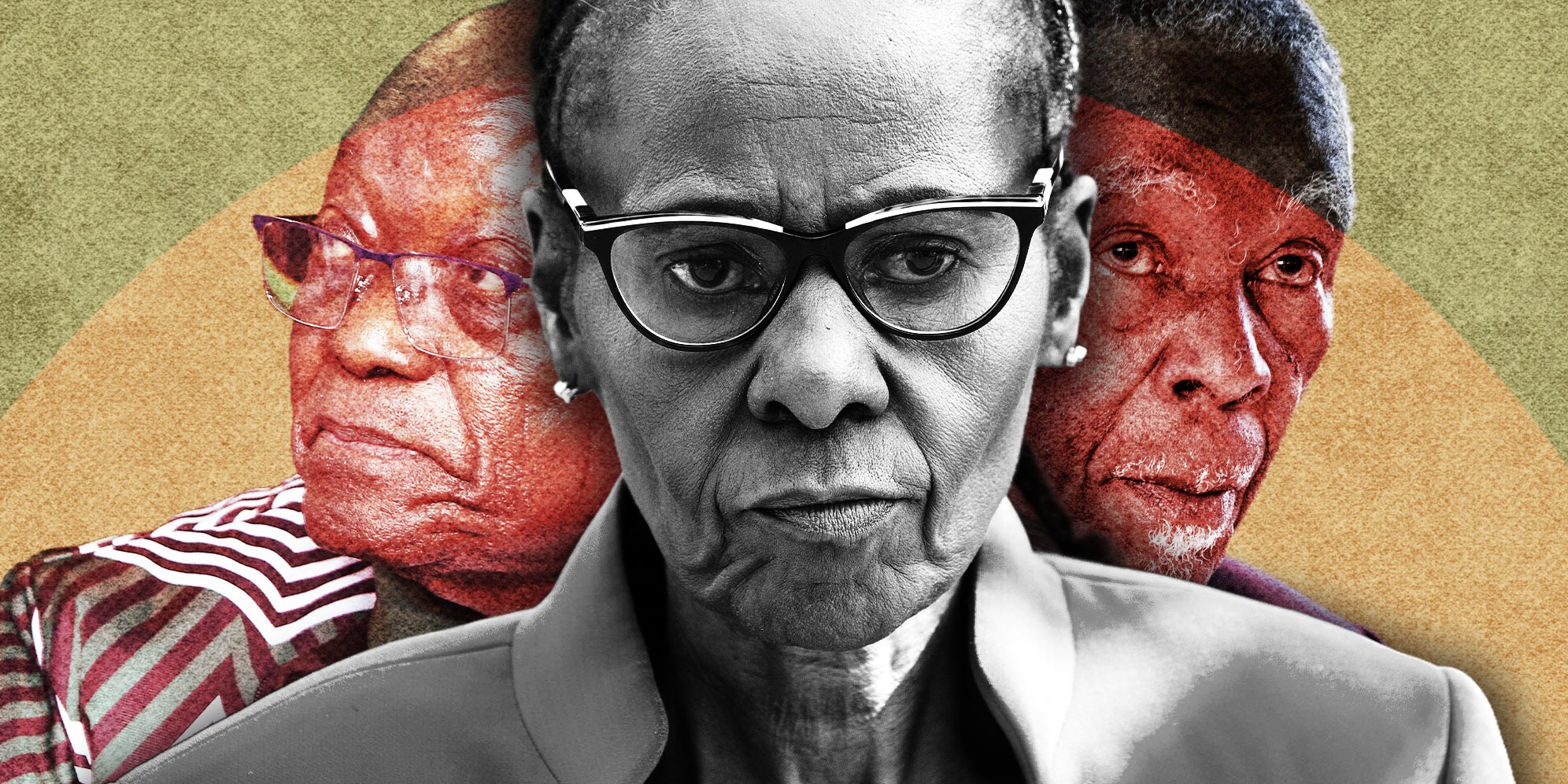
 Illustrative Image: Retired Justice Sisi Khampepe. (Photo: Gallo Images / Alet Pretorius) | Former president Jacob Zuma. (Photo: Gallo Images / Siyabonga Sokhela) | Former president Thabo Mbeki. (Photo: Gallo Images / Per-Anders Pettersson) | (By Daniella Lee Ming Yesca)
‘Spurious, vexatious, scurrilous and even malevolent” is how advocate Ishmael Semenya, the chief evidence leader of the Khampepe Judicial Commission of Inquiry into the delayed prosecution of Truth and Reconciliation Commission (TRC) cases, has described an application by former president Jacob Zuma for the recusal of the chair.
Zuma was the first to file an initial objection (which was later dismissed) to Semenya’s appointment. Now he has targeted respected Judge Sisi Khampepe.
The commission was established shortly after settlement discussions in April 2025 between President Cyril Ramaphosa and Lukhanyo Calata, son of Fort Calata, one of the “Cradock Four” murdered by apartheid security police in 1985.
Mbeki jumps on the bandwagon
Former president Thabo Mbeki subsequently filed his own application for Khampepe’s recusal and the two complaints are being treated as overlapping.
Mbeki’s complaint is supported by former ministers Ronnie Kasrils, Brigitte Mabandla, Thoko Didiza and Charles Nqakula.
Read more: Lukhanyo Calata called for justice and the NPA answered
Mbeki was known to support apartheid-era prosecutions but ANC officials and Cabinet members were reportedly opposed to this, including Jackie Selebi who was part of the 37 ANC leaders refused amnesty by the TRC. Selebi enjoyed Mabandla’s support as minister of justice at the time.
On 7 February 2007, shortly after Adriaan Vlok, the former apartheid minister of law and order, Police Commissioner Johan Van Der Merwe and others were charged for the attempted murder of Reverend Frank Chikane in 1989, Mabandla wrote to Vusi Pikoli, National Prosecuting Authority (NPA) head at the time, stating her “surprise” at the development.
Vlok received a 10-year suspended sentence in a plea deal that resulted in former colleagues and fellow Cabinet members, escaping the prospect of a full trial and more revelations about what the government at the time knew about atrocities committed by state actors.
Alleged collusion
Calata has accused the NPA of deliberately delaying the process of charging apartheid-era criminals who did not apply for or failed to receive amnesty at the TRC.
Specific guidelines for financial reparations to victims as well as a list of more than 300 perpetrators who should have been prosecuted, were included in the final recommendations of the TRC 2003 report.
One of the accusations by many – including Calata in his high court application – is that there was an alleged agreement, or pact, between apartheid-era leaders and the ANC to conceal crimes.
Zuma and Mbeki, as well as Mabandla, Kasrils, Nqakula and Didiza, will have to answer to these allegations before the Khampepe Commission to disprove the accusation of interference.
Should the commission’s integrity be brought into question or it fails to get off the ground, Zuma, Mbeki and the others can claim they do not need to account; that the commission is “flawed” and that its findings are not to be trusted.
Landmark judgment
It was a landmark judgment in the Johannesburg High Court in April 2025 that altered the playing field and opened the door to prosecutions.
The court found that the State can prosecute suspects because apartheid was a crime against humanity. It also ruled that there was no time limit on these prosecutions.
The Khampepe Commission was established soon afterwards in May 2025 by presidential proclamation to investigate, among other matters, political interference and obstruction in the post-TRC prosecution of apartheid-era crimes.
Fellow commissioners are Judge Frans Kgomo and human rights lawyer, advocate Andrea Gabriel.
Alleged misconduct
Zuma also argues that Khampepe should be investigated by the Judicial Service Commission (JSC) for “misconduct”, while also requesting an extension from the commission to file his responses. He has done this twice.
The misconduct accusation relates to alleged “secret advice” Khampepe provided to Semenya during an application by Zuma and his political project, the uMkhonto Wesizwe party, for Semenya to recuse himself.
Semenya said this had been an “egregious insult” and that Zuma failed to understand the proceedings. Commissions, he noted, were inquisitorial in nature, not adversarial, “necessitating frequent and regular interaction between the commissioners (including the chairperson) and the evidence leaders”.
These interactions were not “secret”, he maintained, and were “proper and necessary to assist the commission in establishing evidence and making factual findings”.
Zuma’s twisted logic
It is Zuma’s argument that Khampepe, who has several degrees, including from Harvard, and was a Constitutional Court judge, should recuse herself as chair on three grounds:
First, that she was a member of the TRC and its Amnesty Committee and was also the Deputy National Director of Public Prosecutions (DNDPP) under advocate Bulelani Ngcuka.
Then there was the “secret advice” accusation as well as the argument that because Khampepe was a member of the Constitutional Court panel that delivered adverse judgments against Zuma, she harboured “personal animosity” towards him.
Khampepe’s impressive career not only includes her involvement with the TRC and its Amnesty Committee in 1995, but also serving as DNDPP from 1998 to 1999, and appointments to the high, labour and labour appeal courts as well as the Constitutional Court where she served until her retirement in October 2021.
She has also served on special commissions and official observer groups in Zimbabwe and Uganda.
Between April 2005 and February 2006, Mbeki appointed Khampepe as chairperson of the commission of inquiry into the mandate and location of the Directorate of Special Operations.
‘The law at all costs’
Khampepe, said Zuma, had penned the majority ruling dispatching him to the Estcourt Correctional Centre in July 2021 for contempt of court for failing to appear at the Zondo Commission of Inquiry into State Capture.
This, he argued, counted against her.
Read more: Final order – ConCourt rules Jacob Zuma must appear and answer questions at Zondo Commission
Semenya argued in his responding affidavit on behalf of the commission that while Khampepe was one of the Constitutional Court judges who ruled on Zuma’s contempt-of-court matter related to the Zondo Commission, she was part of a panel of judges.
Khampepe had read out the judgment ordering Zuma to serve jail time, opening with: “It is indeed the lofty and lonely work of the judiciary, impervious to public commentary and political rhetoric, to uphold, protect and apply the Constitution and the law at any and all costs.”
Malevolent action
With regard to delays, Semenya argued that Zuma had known “or ought to have known as early as May 29, 2025, that Justice Khampepe would be the chairperson”.
Had Zuma’s application been made in good faith (bona fide), he would have brought it at that time, said Semenya.
“Instead the former president had initially requested extensions to file a response to the Rule 3.3 Notice, indicating his acquiescence in her appointment and effectively pre-empting the challenge he now brings.”
Zuma’s suggestion that Khampepe should be referred to the JSC for misconduct was “startling” since Zuma himself could approach the JSC, added Semenya.
The former president’s relief asking for her “partial” recusal at some point was also “irrational because any impairment on the chairperson’s ability to preside over the commission would necessitate her recusal from the whole commission”.
Zuma’s grounds were therefore “insufficient and unfounded”.
With regard to Khampepe’s presence on the bench of the Apex court, Semenya said the correct legal position was that “the fact that a panel member gave a decision adverse to a person appearing at the proceedings is not a basis for seeking her recusal”.
The fact that a judicial officer previously appeared for a party in a different matter, or was associated with the NDPP 27 years ago, was also not a basis for her removal, he contended.
The TRC had a mandate entirely different from that of the current commission, Semenya added, which was concerned with matters that occurred after 2003, years after Khampepe left the NPA. DM