




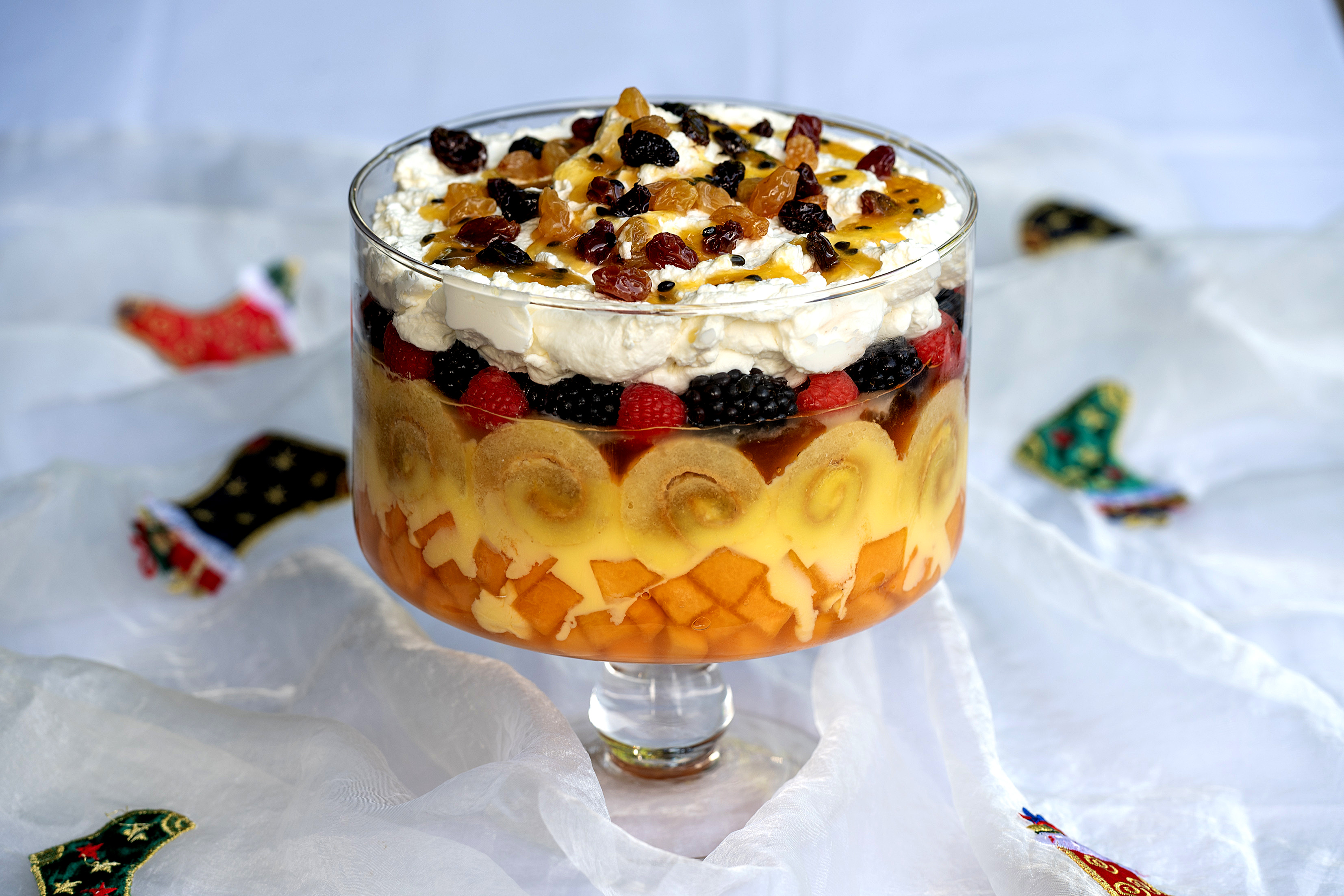
 South African Summer Trifle, by Tony Jackman. (Photo: David Harrison)
 Fish and baby fowl are the centrepieces of this family Christmas spread, but even though the pastry-wrapped salmon trout is likely to win you a round of applause, our South African Summer Trifle may still be the showstopper.
Snoek pâté quenelles with pickled radish
/file/attachments/2986/Untitled_Panorama-1_895729_576bee5b54e8090b026e5ae665425aab.jpg "Snoek pâté quenelles with pickled radish. (Photo: David Harrison)")
Use shop-bought smoked snoek for this pâté. Pickled radishes can be bought from a farm stall, or improvise with Asian pickled ginger from the Asian aisle of a supermarket.
Ingredients
250 g smoked snoek, shredded
250 g cream cheese
3 Tbsp fresh cream
Juice of half a lemon
½ tsp smoked paprika
Salt to taste
Black pepper to taste
1 Tbsp pickled radish, drained, or Asian pickled ginger
Crackers or melba toast, to serve
Parsley sprigs for garnish
Method
Shred the snoek into a bowl and add the cream cheese.
Add the cream, lemon juice, paprika, salt and black pepper and stir well to combine.
Refrigerate until it’s time to serve.
Serve quenelles (shaped with two dessert spoons) of the pâté with crackers and pickle on the side and a sprig of parsley.
Bacon-wrapped baby chicken in dill butter with poached baby leeks
/file/attachments/2986/Untitled_Panorama-12_680676_f58d4ce782525b1c97ee794c0d1e9c5a.jpg "Bacon-wrapped baby chicken in dill butter with poached baby leeks. (Photo: David Harrison)")
Rather than add anise herbs (in this case dill) to the salmon en croute, which might seem an obvious choice, we decided to use it in this baby chicken dish instead.
Two petit poussins serve four people as an intermediary course. Multiply the recipe if serving more than four.
We sourced the baby chickens from Lazena Free Range Poultry in Somerset West.
Ingredients
2 baby chickens (aka petit poussin)
8 rashers of streaky bacon
⅓ cup salted butter and more to grease the oven pan
A handful of dill fronds, very finely chopped
8 baby leeks
250 ml chicken stock
100 ml Pernod pastis aperitif
8 or so dill fronds for the leeks
Salt and black pepper to taste
Dill fronds for garnish
Method
Preheat an oven to 180°C.
Melt the butter in a small pot on a low heat and stir in the chopped dill. Turn off the heat.
Brush the insides and outsides of the birds with the dill butter.
Season the baby chickens lightly with salt and black pepper and place them on a buttered oven tray.
Roast for 25 to 30 minutes or until the juices run clear when a skewer is inserted.
Meanwhile, slice the leeks in half lengthwise. Mix the chicken stock and Pernod in a pan on a moderate heat and, when it starts to bubble, add the leeks and dill fronds. Season lightly with salt and black pepper simmer until they’re tender.
Let the chickens rest for five minutes when removing them from the oven, then slice them in half so that two chickens serve four people.
Serve garnished with dill.
Salmon trout en croûte with green asparagus and baby beetroot
/file/attachments/2986/Untitled_Panorama-9_997749_d9464413097c781fdceafc2acc4b106a.jpg "Salmon trout en croûte with green asparagus and baby beetroot. (Photo: David Harrison)")
Red and green are the colours of Christmas, and the supporting acts for this showpiece salmon trout “Wellington” are beetroot and asparagus in those festive hues.
I bought our salmon trout from Wild Peacock Foods in Stellenbosch, who sourced it from Lourensford Trout Farm in Somerset West. Wild Peacock expertly butterflied it for me. They also supplied restaurant-quality butter puff pastry from Perfect Puff.
I cheated with the beetroot, buying pre-cooked baby beetroot from Woolworths and tossing it through a dressing of aged balsamic vinegar and olive oil.
Though the pastry-clad fish is a showpiece, it is not very difficult to make — you’ll see.
Ingredients
200 g whole salmon trout, filleted but skin-on, and butterflied by the supplier
1 kg 100% butter puff pastry
250 g portabellini mushrooms, stems removed
3 Tbsp salted butter
Salt and black pepper to taste
1 egg, beaten
For the asparagus:
250 g fresh green asparagus
3 Tbsp lemon juice
3 Tbsp olive oil
Salt and black pepper to taste
For the baby beetroot:
500 g cooked baby beetroot
3 Tbsp aged balsamic vinegar
2 Tbsp extra virgin olive oil
Salt and black pepper to taste
Method
/file/attachments/2986/salmon-plated_489341_f8540041686e9578ff971fb1fc6bec42.jpg "The salmon en croûte, plated up with beetroot and asparagus. (Photo: David Harrison)")
When you buy the fish, ask the supplier to fillet and butterfly it for you, leaving the tail on, but removing the head and spine. The picture illustrates why you want the tail fin on.
Remove the mushroom stems and discard. Half the mushrooms and cook them in melted butter on a moderate heat until they release their juice and those juices cook away. Season lightly with salt and black pepper while they cook.
Leave the mushrooms to cool, then remove them to a work surface and chop them very finely.
Lay out the fish on a clean work surface and spread it out in its butterflied beauty.
Season the flesh lightly with salt and black pepper. Spoon the cooked mushrooms along each side of the spine, as it were.
Fold the fish over.
On another clean work surface, roll out the pastry and assess the area of the pastry according to the length of the pastry. Obviously it needs to be wider than the length of the trout.
Place the fish from one edge of the pastry to the other, with enough pastry to its right to more than cover the fish when rolled over it, but leaving the tail fin free.
Smooth the pastry in any parts that seem uneven.
Using extra pastry, cut thin strips longer than the width of the fish and drape them over as in the photograph, tucking them underneath and pressing the strips down to attach to the pastry below. Place a twist of tin foil around the tail fin to prevent it from burning in the oven.
Place the fish on an oil-sprayed oven tray and refrigerate to chill it well for an hour or more.
When ready to bake, preheat the oven to 200°C.
Remove the fish from the fridge.
Beat the egg and brush the pastry all over.
Bake in the preheated 200°C oven for 30 to 35 minutes NOT on the fan setting. All ovens behave differently so check from 25 minutes onwards to be sure the pastry does not burn.
For the asparagus:
Snap the ends off (they will snap at the point at which the end of the spear becomes woody). Using a small, sharp knife, peel off the scales.
Heat water to boiling point in a pot and add the spears. Cook at a moderate bubble for just over a minute, then drain through a colander and drop them in a bath of ice cold water for the colour to set. Drain.
Before serving, mix lemon juice and olive oil in a bowl, season with salt and black pepper, and toss the asparagus spears in it.
For the baby beetroot:
Drain the beetroot and cut them into chunks as in the photograph. Mix the dressing ingredients together in a bowl and toss the beetroot in it.
Serve a slice of the salmon trout en croute with baby beetroot and green asparagus on the side.
No-mayo potato salad
/file/attachments/2986/potsalad_626771_ac6e12bb17dc85233130eb371c7aec6b.jpg "No-mayo baby potato salad. (Photo: David Harrison)")
Ideally, make this a day ahead as it is better the next day, with all the flavours having developed in the refrigerator.
There’s no mayonnaise in this, with the accent instead being on the perky flavours of red onion, wholegrain mustard, lemon and capers, in a base of olive oil.
Ingredients
1 kg baby potatoes, washed but not peeled, and sliced in half
3 Tbsp capers, drained
½ cup wholegrain mustard
⅓ cup finely chopped parsley
1 medium red onion, halved and sliced thinly
½ cup extra virgin olive oil
1 tsp garlic powder
Juice of ½ a lemon
Salt and black pepper to taste
Method
Boil the potatoes for about 15 minutes but don’t let them become too soft. Drain and leave them to cool in a colander. Refrigerate for an hour.
Remove from the fridge and slice in half, without peeling.
Put the potatoes in a bowl and add all the other ingredients.
Toss using two wooden or silicone spatules or spoons, carefully.
Transfer to an attractive salad bowl. There’s no need to garnish — just ensure that some of the red onion and capers are at the top.
South African Summer Trifle
/file/attachments/2986/davidharrison-summer-trifle_417546_d89e439d7f8cc64eb7b77becbba9e579.jpg "South African Summer Trifle, by Tony Jackman. (Photo: David Harrison)")
Spanspek, hanepoot and dried fruit make this a sunny, cheerful and distinctly South African summer trifle.
Ingredients
1 whole spanskek (cantaloupe)
½ cup hanepoot fortified wine
⅓ cup icing sugar
1 shop-bought Swiss roll
1 litre of thick custard, either homemade or bought
1 packet of orange jelly, made to the packet instructions and set in the fridge
1 litre of cream, whipped until very thick
6 Tbsp brandy
½ cup icing sugar
1 cup blackberries
1 cup raspberries
1 cup each pitted raisins and golden sultanas
1 small can of granadilla pulp (about 110g)
Method
Peel the spanspek and slice it in half. Cut each half into long strips about 2 cm thick. Cut the strips into small 1cm dice. Add them to a bowl and stir in the hanepoot and icing sugar. Refrigerate for 3 or 4 hours or overnight.
Make the jelly according to the packet instructions and put it in the fridge to set for four hours or more.
Macerate the raisins and sultanas in ⅓ cup pf hanepoot for an hour or two.
When ready to assemble, choose a large trifle bowl.
Strain the spanspek dice in a colander with a bowl underneath it to catch the liquor. (You could use it when making cocktails.)
Place the strained spanspek cubes at the bottom of the bowl.
Pour the custard over the spanspek.
Slice the Swiss roll into slim rounds and place them side-on around the edge of the bowl, as illustrated, and more in the centre.
Spoon clumps of the set jelly over the Swiss roll. It will break up, and that’s fine.
Place the blackberries and raspberries around the edge so that they will be visible, and the rest in the middle.
Add most of the macerated raisins and sultanas on top of the fresh berries in the middle. Retain some to drizzle on top of the trifle.
Whip the cream very stiff, add the brandy and ½ cup icing sugar and beat again.
Spoon the cream on top.
Don’t do anything else for now other than putting the trifle in the fridge until shortly before you’re ready to serve it.
Just before serving, drizzle the granadilla pulp on top of the cream, then spoon over the remaining macerated raisins and sultanas. DM
Daily Maverick paid for all ingredients including those from Wild Peacock.Fish and baby fowl are the centrepieces of this family Christmas spread, but even though the pastry-wrapped salmon trout is likely to win you a round of applause, our South African Summer Trifle may still be the showstopper.
Snoek pâté quenelles with pickled radish
Use shop-bought smoked snoek for this pâté. Pickled radishes can be bought from a farm stall, or improvise with Asian pickled ginger from the Asian aisle of a supermarket.
Ingredients
250 g smoked snoek, shredded
250 g cream cheese
3 Tbsp fresh cream
Juice of half a lemon
½ tsp smoked paprika
Salt to taste
Black pepper to taste
1 Tbsp pickled radish, drained, or Asian pickled ginger
Crackers or Melba toast, to serve
Parsley sprigs for garnish
Method
Shred the snoek into a bowl and add the cream cheese.
Add the cream, lemon juice, paprika, salt and black pepper and stir well to combine.
Refrigerate until it’s time to serve.
Serve quenelles (shaped with two dessert spoons) of the pâté with crackers and pickle on the side and a sprig of parsley.
Bacon-wrapped baby chicken in dill butter with poached baby leeks
Rather than add anise herbs (in this case dill) to the salmon en croûte, which might seem an obvious choice, we decided to use it in this baby chicken dish instead.
Two petit poussins serve four people as an intermediary course. Multiply the recipe if serving more than four.
We sourced the baby chickens from Lazena Free Range Poultry in Somerset West.
Ingredients
2 baby chickens (aka petit poussin)
8 rashers of streaky bacon
⅓ cup salted butter and more to grease the oven pan
A handful of dill fronds, very finely chopped
8 baby leeks
250 ml chicken stock
100 ml Pernod pastis aperitif
8 or so dill fronds for the leeks
Salt and black pepper to taste
Dill fronds for garnish
Method
Preheat an oven to 180°C.
Melt the butter in a small pot on a low heat and stir in the chopped dill. Turn off the heat.
Brush the insides and outsides of the birds with the dill butter.
Season the baby chickens lightly with salt and black pepper and place them on a buttered oven tray.
Roast for 25 to 30 minutes or until the juices run clear when a skewer is inserted.
Meanwhile, slice the leeks in half lengthwise. Mix the chicken stock and Pernod in a pan on a moderate heat and, when it starts to bubble, add the leeks and dill fronds. Season lightly with salt and black pepper simmer until they’re tender.
Let the chickens rest for five minutes when removing them from the oven, then slice them in half so that two chickens serve four people.
Serve garnished with dill.
Salmon trout en croûte with green asparagus and baby beetroot
Red and green are the colours of Christmas, and the supporting acts for this showpiece salmon trout “Wellington” are beetroot and asparagus in those festive hues.
I bought our salmon trout from Wild Peacock Foods in Stellenbosch, who sourced it from Lourensford Trout Farm in Somerset West. Wild Peacock expertly butterflied it for me. They also supplied restaurant-quality butter puff pastry from Perfect Puff.
I cheated with the beetroot, buying pre-cooked baby beetroot from Woolworths and tossing it through a dressing of aged balsamic vinegar and olive oil.
Though the pastry-clad fish is a showpiece, it is not very difficult to make — you’ll see.
Ingredients
200 g whole salmon trout, filleted but skin-on, and butterflied by the supplier
1 kg 100% butter puff pastry
250 g portabellini mushrooms, stems removed
3 Tbsp salted butter
Salt and black pepper to taste
1 egg, beaten
For the asparagus:
250 g fresh green asparagus
3 Tbsp lemon juice
3 Tbsp olive oil
Salt and black pepper to taste
For the baby beetroot:
500 g cooked baby beetroot
3 Tbsp aged balsamic vinegar
2 Tbsp extra virgin olive oil
Salt and black pepper to taste
Method
When you buy the fish, ask the supplier to fillet and butterfly it for you, leaving the tail on, but removing the head and spine. The picture illustrates why you want the tail fin on.
Remove the mushroom stems and discard. Half the mushrooms and cook them in melted butter on a moderate heat until they release their juice and those juices cook away. Season lightly with salt and black pepper while they cook.
Leave the mushrooms to cool, then remove them to a work surface and chop them very finely.
Lay out the fish on a clean work surface and spread it out in its butterflied beauty.
Season the flesh lightly with salt and black pepper. Spoon the cooked mushrooms along each side of the spine, as it were.
Fold the fish over.
On another clean work surface, roll out the pastry and assess the area of the pastry according to the length of the pastry. Obviously it needs to be wider than the length of the trout.
Place the fish from one edge of the pastry to the other, with enough pastry to its right to more than cover the fish when rolled over it, but leaving the tail fin free.
Smooth the pastry in any parts that seem uneven.
Using extra pastry, cut thin strips longer than the width of the fish and drape them over as in the photograph, tucking them underneath and pressing the strips down to attach to the pastry below. Place a twist of tin foil around the tail fin to prevent it from burning in the oven.
Place the fish on an oil-sprayed oven tray and refrigerate to chill it well for an hour or more.
When ready to bake, preheat the oven to 200°C.
Remove the fish from the fridge.
Beat the egg and brush the pastry all over.
Bake in the preheated 200°C oven for 30 to 35 minutes NOT on the fan setting. All ovens behave differently so check from 25 minutes onwards to be sure the pastry does not burn.
For the asparagus:
Snap the ends off (they will snap at the point at which the end of the spear becomes woody). Using a small, sharp knife, peel off the scales.
Heat water to boiling point in a pot and add the spears. Cook at a moderate bubble for just over a minute, then drain through a colander and drop them in a bath of ice cold water for the colour to set. Drain.
Before serving, mix lemon juice and olive oil in a bowl, season with salt and black pepper, and toss the asparagus spears in it.
For the baby beetroot:
Drain the beetroot and cut them into chunks as in the photograph. Mix the dressing ingredients together in a bowl and toss the beetroot in it.
Serve a slice of the salmon trout en croute with baby beetroot and green asparagus on the side.
No-mayo potato salad
Ideally, make this a day ahead as it is better the next day, with all the flavours having developed in the refrigerator.
There’s no mayonnaise in this, with the accent instead being on the perky flavours of red onion, wholegrain mustard, lemon and capers, in a base of olive oil.
Ingredients
1 kg baby potatoes, washed but not peeled, and sliced in half
3 Tbsp capers, drained
½ cup wholegrain mustard
⅓ cup finely chopped parsley
1 medium red onion, halved and sliced thinly
½ cup extra virgin olive oil
1 tsp garlic powder
Juice of ½ a lemon
Salt and black pepper to taste
Method
Boil the potatoes for about 15 minutes but don’t let them become too soft. Drain and leave them to cool in a colander. Refrigerate for an hour.
Remove from the fridge and slice in half, without peeling.
Put the potatoes in a bowl and add all the other ingredients.
Toss using two wooden or silicone spatules or spoons, carefully.
Transfer to an attractive salad bowl. There’s no need to garnish — just ensure that some of the red onion and capers are at the top.
South African Summer Trifle
Spanspek, hanepoot and dried fruit make this a sunny, cheerful and distinctly South African summer trifle.
Ingredients
1 whole spanskek (cantaloupe)
½ cup hanepoot fortified wine
⅓ cup icing sugar
1 shop-bought Swiss roll
1 litre of thick custard, either homemade or bought
1 packet of orange jelly, made to the packet instructions and set in the fridge
1 litre of cream, whipped until very thick
6 Tbsp brandy
½ cup icing sugar
1 cup blackberries
1 cup raspberries
1 cup each pitted raisins and golden sultanas
1 small can of granadilla pulp (about 110g)
Method
Peel the spanspek and slice it in half. Cut each half into long strips about 2 cm thick. Cut the strips into small 1cm dice. Add them to a bowl and stir in the hanepoot and icing sugar. Refrigerate for 3 or 4 hours or overnight.
Make the jelly according to the packet instructions and put it in the fridge to set for four hours or more.
Macerate the raisins and sultanas in ⅓ cup pf hanepoot for an hour or two.
When ready to assemble, choose a large trifle bowl.
Strain the spanspek dice in a colander with a bowl underneath it to catch the liquor. (You could use it when making cocktails.)
Place the strained spanspek cubes at the bottom of the bowl.
Pour the custard over the spanspek.
Slice the Swiss roll into slim rounds and place them side-on around the edge of the bowl, as illustrated, and more in the centre.
Spoon clumps of the set jelly over the Swiss roll. It will break up, and that’s fine.
Place the blackberries and raspberries around the edge so that they will be visible, and the rest in the middle.
Add most of the macerated raisins and sultanas on top of the fresh berries in the middle. Retain some to drizzle on top of the trifle.
Whip the cream very stiff, add the brandy and ½ cup icing sugar and beat again.
Spoon the cream on top.
Don’t do anything else for now other than putting the trifle in the fridge until shortly before you’re ready to serve it.
Just before serving, drizzle the granadilla pulp on top of the cream, then spoon over the remaining macerated raisins and sultanas. DM
Daily Maverick paid for all ingredients including those from Wild Peacock.