



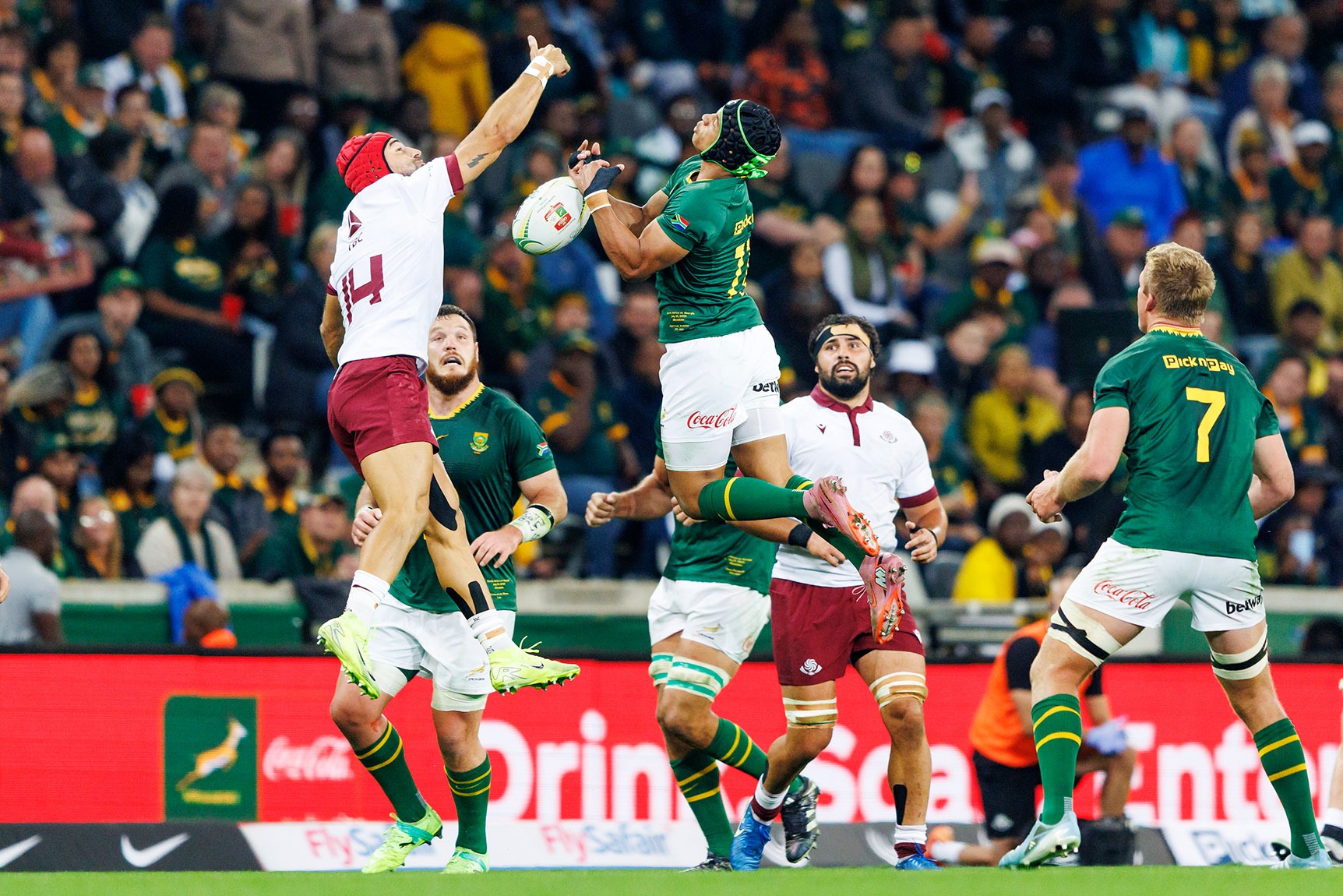
 Bok wing Kurt-Lee Arendse competes for the high ball with Georgia’s Akaki Tabutsadze in Nelspruit in 2025. Contestable kicks will be one of the subjects under discussion at the Shape of the Game conference. (Photo: Dirk Kotze / Gallo Images)
World Rugby’s Shape of the Game conference, which will be held in Europe over the course of the 2026 Six Nations, has the potential to alter the course of the game’s history.
The inaugural Nations Championship – which kicks off this July – has been hailed as the first step towards a global season, and if common sense prevails, the hemispheres will align at club and international level in the coming years, and player welfare will be prioritised.
/file/attachments/orphans/TL_2253773_700573.jpg "Bok scrumhalf Grant Williams behind a dominant scrum against the All Blacks at Ellis Park on 31 August 2024. (Photo: Gordon Arons / Gallo Images)")
World Rugby will also discuss proposed law changes that aim to boost fan engagement and commercial growth.
In recent years, the governing body has taken steps to de-power set pieces such as the scrum, with the aim of speeding up the contest and decreasing the amount of “dead time”.
The jury is still out as to whether these changes have been good for the game and – as Rassie Erasmus recently suggested – whether they may compromise the sport as well as the commercial product in the long run.
Shortly after flagging these concerns at an informal media briefing in Cape Town, the Springbok coach delved into the issues and what he called “the unintended consequences” in a three-part podcast series, released on his Rassie+ YouTube channel.
Similar concerns have been raised overseas, following an announcement that the Super Rugby Pacific tournament will trial several law variations with the aim of speeding up the contest and improving the spectacle.
The decision to award a free kick rather than a scrum after an accidental offside offence has raised a few eyebrows.
As the Bok coaches have observed, this law change may lead to an increase in the number of kicks rather than a decrease in dead time – as teams in possession use the free kick to launch a high bomb for their outside backs to chase.
This could be a clear example of an unintended consequence, and it’s worth noting that Australian and New Zealand administrators have been pushing to reduce the number of kicks in the game over the past few seasons.
Objectively speaking, it gives one further cause to wonder where the game is heading.
/file/attachments/orphans/2221801977_634637.jpg "Bok fullback Aphelele Fassi goes up for a high ball against the Barbarians at Cape Town Stadium last year. (Photo: Grant Pitcher / Gallo Images / Getty Images)")
Rugby dystopia: A one-dimensional game
Consider what rugby might look like a decade from now, if World Rugby fails to recognise the game’s unique selling points and the fundamentals that are needed for a dynamic contest.
All set pieces and restarts will be replaced by free kicks. Scrums and mauls will be consigned to history, and opposing teams will spend 60 to 70 minutes hammering into one another until someone scores or drops the ball.
Attacking space will be scarce, but at least the ball-in-play time will be through the roof.
Never mind whether the ball-in-play time improves the flow of the game or whether it leads to more tries and points... In rugby’s brave new world, perpetual motion will be the superseding metric and the illusion of a contest will be paramount.
The public won’t be fooled, though.
Inevitably, the powers may be forced to consider whether the game is heading in the right direction, after crowds dwindle, ratings drop and social media numbers plummet.
There will be no further reports of younger fans watching highlights on YouTube and TikTok, for the simple reason that there are no highlights to watch.
Stripped of its unique selling points – which are essential to creating attacking space – rugby will be stripped of its flow, nuance and complexity.
In this version of the game, every player will look the same: selected and conditioned to survive a sport obsessed with high ball-in-play time and little else.
With no set pieces to engage large groups of players in small areas of the field, teams will have fewer opportunities to run into space.
And with up to 15 players in the defensive line, there will be more collisions over the course of a game, and more injuries as a result.
Perfecting a thriving product
Going by metrics such as tries and points scored, the game has never been better than it is right now.
There are more competitive nations than there were 10 years ago, and as seen at the 2023 tournament in France, there are more teams with the capacity to win the World Cup title.
And yet, the sport is perennially attacked by critics who believe that it needs to follow rugby league, as if that code holds the only recipe for success.
This argument is inherently flawed, and one only has to consider how big American football has become in spite of its stop-start nature.
A record-breaking 127 million people watched the Super Bowl last year, and it wouldn’t come as a surprise to see that record shattered when the New England Patriots and the Seattle Seahawks face off in the early hours of Monday.
Perhaps rugby could do more to package itself better, but the actual game isn’t the issue.
There are laws and regulations that can be improved, and if we’re talking about decreasing the amount of dead time, World Rugby should review the foul play process which has robbed so many great contests of energy and flow in recent seasons.
Ultimately, the powers that be should be building on the game’s existing identity rather than subtracting from it.
As Erasmus suggested, the proposed law changes that de-power the set pieces could do more harm than good, and result in a slower, less-interesting contests instead of dynamic, free-flowing spectacles.
The worry for Erasmus, and indeed every Test coach with a contract up to the 2027 World Cup, is that the laws might change 18 months before the global showpiece in Australia.
/file/attachments/orphans/UP1ELBF1APUAE_160487.jpg "England coach Steve Borthwick has built a formidable team using a 6-2 bench regularly. (Reuters / Paul Childs)")
Try telling Steve Borthwick that the structures he’s built to empower a much-improved England have to change.
Try telling Fabien Galthié that France need more pace in their game – even though Les Bleus have been one of the explosive teams on show.
Change is inevitable, but surely World Rugby should prioritise attacking space more than anything else when considering changes that will shape the sport’s future.
/file/dailymaverick/wp-content/uploads/2025/03/2198380135.jpg "France head coach Fabien Galthié. (Photo: Clive Mason / Getty Images)")
Global calendar priority
Perhaps most importantly, the governing body needs to make a call on a global season sooner rather than later.
It’s believed that a new structure that streamlines the northern and hemisphere seasons – and provides players with an off-season to rest– may be implemented in 2028, at the start of the next World Cup cycle.
Should all parties agree, the Rugby Championship will be moved to align with the Six Nations, which is currently staged in February and March. It remains to be seen whether regional club tournaments, such as Super Rugby Pacific, buy into the concept.
Imagine what the sport might look like in a decade from now, if strong leadership is shown at the Shape of the Game conference this month and the sport and all its stakeholders are kept in mind.
With more stability and structure, the standard of the game at club and international level will rise – and as a result, the content creators who compile highlights packages on YouTube and TikTok will face the difficult choice of what to omit instead of what to include. DM