




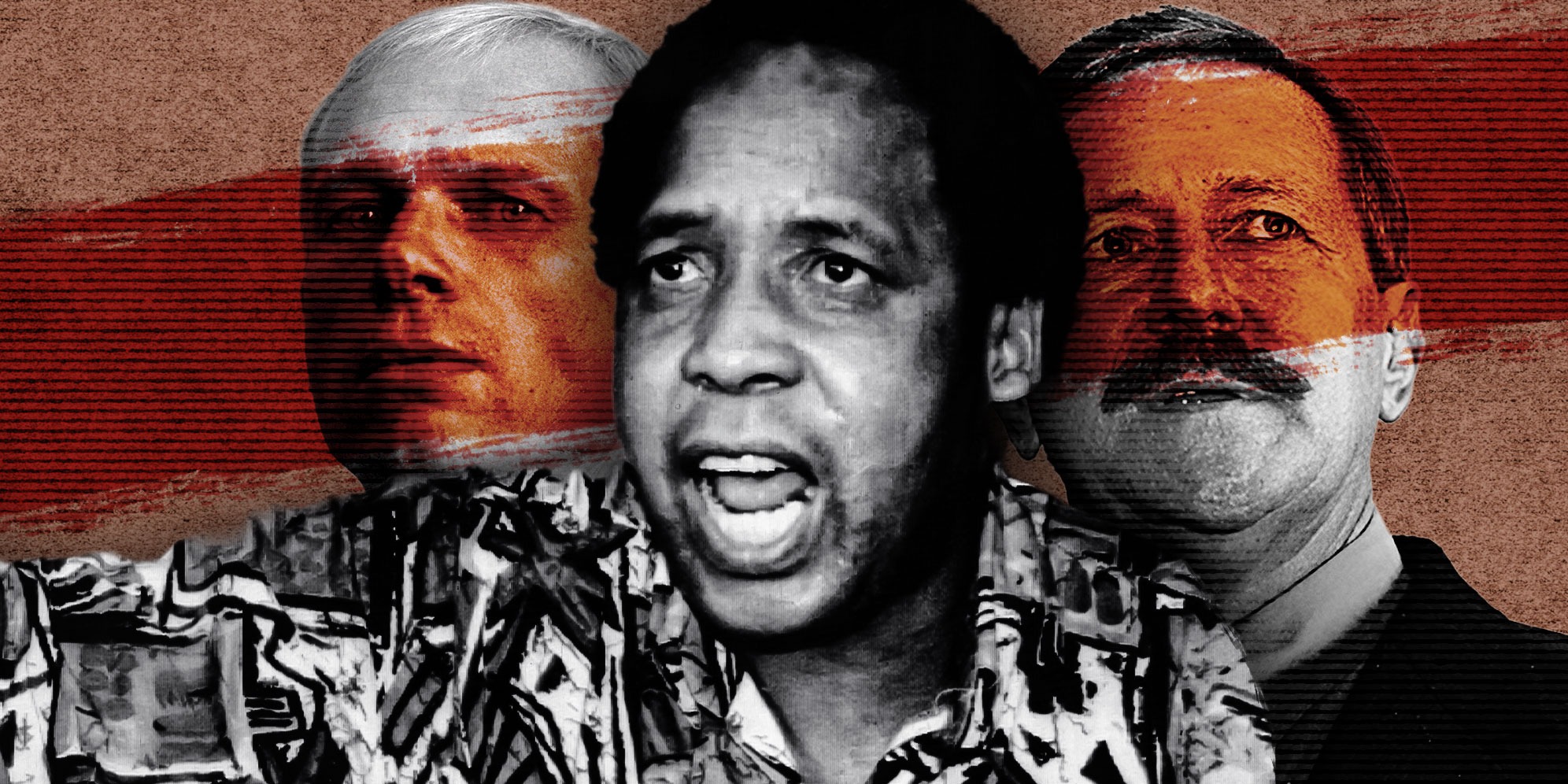
 Illustrative Image: Janusz Waluś, Chris Hani's killer. (Photo: Gallo Images / Oryx Media Archive) | Leader of the South African Communist Party and Umkhonto weSizwe Chris Hani. (Photo: Media24 / Gallo Images) | Clive Derby-Lewis. (Photo: Gallo Images / Sunday Times / Elizabeth Sejake) | (By Daniella Lee Ming-Yesca)
 South Africa should learn from its history and lionise incorruptible individuals, says author and retired high court judge Chris Nicholson.
At the same time, “the bad guys” should be “demonised”.
“It would be so nice if the bad guys can go to jail occasionally,” Nicholson says during a phone interview with Daily Maverick on Wednesday, 17 December 2025.
His words emphasise an accountability deficit when it comes to dealing with State Capture crimes in South Africa.
Nicholson’s latest book, Who Really Killed Chris Hani?, focuses on this issue - accountability, or a lack thereof, in terms of the anti-apartheid activist’s assassination on 10 April 1993 in Boksburg.
Hani’s murder was an attempt to derail South Africa’s transition from racist apartheid rule to democracy.
Waluś and Derby-Lewis
Two men – Polish immigrant Janusz Waluś and local Conservative Party founding member Clive Derby-Lewis – went on to be convicted in connection with the killing.
Derby-Lewis died in 2016, while Waluś, after spending about 30 years in jail in South Africa, was released on parole in 2022.
Early in 2025, he told eNCA’s Annika Larson that elements of military and navy intelligence were involved in a plot to destabilise the broader political landscape.
Read more: Cold, Cold Heart: Chris Hani assassin Janusz Waluś has no regrets
Of the Hani murder, Waluś told Larson that there was no reason to “look for a bigger story here” to be used “by members of the ANC against each other”.
But Nicholson (80) looked for a bigger story. And wrote about it.
In short, he believes (much like other sources have previously told this journalist) that Hani, an “incorruptible” individual, was the victim of a plot involving several individuals other than Waluś and Derby-Lewis.
‘They can suppress the truth’
“We live in a world where the multinationals [big companies] still dominate … They can bribe or corrupt the elite … and suppress the truth from coming out,” Nicholson says.
Who Really Killed Chris Hani? took him about 15 years to complete, during which time he kept unearthing more information. (This included while he was in hospital during the Covid-19 pandemic.)
The book was published in 2024, but it did not garner much attention.
Now, with a fresh burst of publicity, and possibly also because of what has since happened in South Africa - the development of an unprecedented law enforcement scandal - the book is gaining traction.
/file/attachments/orphans/Author-and-retired-high-court-judge-Chris-Nicholson-Picture-Suppied_568687.jpg "Author and retired high court Judge Chris Nicholson. (Picture: Supplied)")
In it, Nicholson does not hold back from naming individuals and companies; he identifies many of them.
He never had a chance to meet Hani, but says he always felt empathy towards him.
“I had a deep sense of … these are voices from the grave.”
Nicholson says he has always sided with the “poor and oppressed”, and believes the ultra-rich should be taxed more.
Giving some insight into his deeper thinking, he questions whether democracy is working in South Africa, if more than 60% of its residents go to sleep hungry each night.
The product of Nicholson’s quest to find answers about Hani’s assassination is an exceptionally detail-dense 443 pages (minus notes and extra attributions) that spans multiple decades and countries.
Enemies without and within
According to the book itself, it “attempts to dig out the truth and discover who the ‘enemies of change’ were who contributed to [Hani’s] murder … This leads us across the world and across generations.”
It explores who Hani would have been up against, including “enemies in the white conservative establishment”, those worried about his economic goals to equalise society, and his “rivals and enemies within the ANC”.
Nicholson also looks at broader political patterns into which Hani’s murder fits and other pivotal assassinations, including the:
- 1961 killing of Congolese politician Patrice Lumumba and the death that same year of United Nations Secretary-General Dag Hammarskjöld in a plane crash.
- 1986 hit on Swedish Prime Minister Olof Palme.
- 1989 murder of Namibian anti-apartheid activist Anton Lubowski.
Consistently referenced throughout the book is the South African Institute for Maritime Research (SAIMR), which a 1998 South African Press Association report says was “thought to be an SA Defence Force front company”.
Nicholson goes much deeper, looking at aspects including whether the SAIMR was tied to British intelligence - MI6 - and Waluś.
Because of the murky global spy, political and business arenas it approaches, Who Really Killed Chris Hani? can edge towards the realms of a conspiracy theory, or theories.
It is, however, meticulously referenced in the actual text, not just with endnotes.
During his interview with Daily Maverick, Nicholson says he despises the “troublesome” term “conspiracy theory”.
Second assassin suspected
The reason his book is so dense with details, he explains, is that he wanted to try, as far as possible, to keep strands of information “in front of the reader”. (Nicholson’s past work as a judge, which he retired from 15 years ago, is evident through this.)
In other words, he presents granular details and information gleaned from a vast array of sources so that the reader can see how theories are deduced.
This can also help them come to their own conclusions.
/file/attachments/orphans/The-cover-of-the-book-Who-Really-Killed-Chris-Hani_269779.jpg "The cover of the book Who Really Killed Chris Hani? (Picture: Supplied)")
Among the many issues Nicholson addresses and questions in his book is how many assassins were at Hani’s murder site and whether this scene was tampered with.
He tells Daily Maverick that, based on the details he has gleaned, he suspects there were indeed two, and that “I think they cleaned the scene”.
Suspicions, theories and questions aside, it is known that some apartheid-era crime scenes were tampered with so that evidence would not lead back to those in the state who were behind the lawbreaking.
Apartheid crime accountability
This is where Who Really Killed Chris Hani? resonates with what has recently been happening in South Africa.
Previously covered-up apartheid crimes are receiving fresh scrutiny.
Take, for example, the Cradock Four inquest into the 1985 deaths of Matthew Goniwe, Fort Calata, Sicelo Mhlauli and Sparrow Mkonto.
In January 2024, it was announced that an inquest into this was being reopened.
This inquest is set to resume in March 2026.
Read more: The unfinished work of truth and reconciliation: Lessons from the Cradock Four inquest
(Nicholson also wrote a book on this, Permanent Removal – Who Killed the Cradock Four?)
Aside from delving into noxious spy networks stretching across countries, Who Killed Chris Hani? underscores the global and saturating nature of organised crime.
Nicholson emphatically agrees, during his interview with Daily Maverick, that drug traffickers, greedy politicians and seemingly legitimate businesses - especially multinational ones with extensive reach - are absolutely part of organised criminality.
Past meets present
Some of these aspects roughly mirror what has been surfacing in two parallel hearings into South Africa’s law enforcement scandal that started erupting in July.
That was when Lieutenant General Nhlanhla Mkhwanazi, who heads police in KwaZulu-Natal (where Nicholson is from), held a press conference and alleged that a drug trafficking cartel infiltrated the criminal justice system, politics and the private security sector.
Allegations of duplicitous Crime Intelligence officers, a problem in policing for years, have also surfaced through the scandal.
Nicholson has noted this and, during the Daily Maverick interview, asks: “If we have our intelligence agencies corrupted, who is policing the police?”
He says what has emerged from the law enforcement scandal “in a way … shows just how deeply corrupted our society is”.
Nicholson says in his Hani book he has written about people who “were killed because they stood in the way” of those wanting to suck up state wealth and resources, especially minerals, for themselves.
This roughly correlates with the murders of certain whistleblowers that have happened in South Africa in recent years.
Nicholson says a question he has been asked many times is: What would have happened to South Africa if Hani had not been assassinated?
The answer is in his book: “Had Hani lived and been able to hold together the ANC and rid it of its rotten core, South Africa might have enjoyed a distinctively different outcome.
“Hani had proved moral, but it is a sad fact of history that his quest to share the country’s riches brought together an unholy alliance determined to exterminate anyone who so much as thought of giving back some of the treasure they had yanked from the ground and with which they paid off those who had the power to interfere with their looting.”
In other words, Nicholson believes Hani could have changed South Africa's trajectory.
That trajectory, we now know, led to State Capture, a scourge that still manifests in different ways. DM