



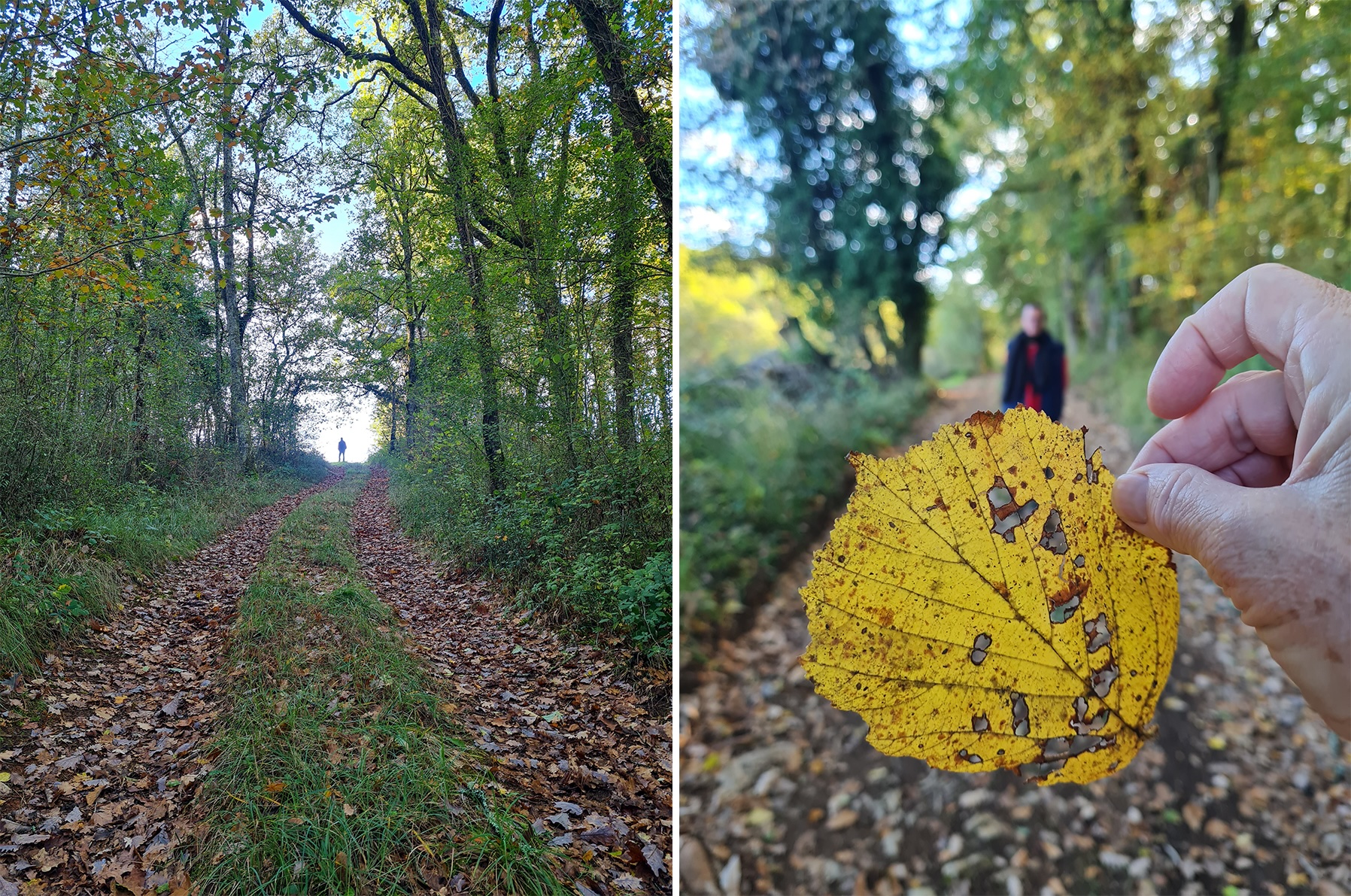
 An autumnal walk in the season of colourful exuberance. (Photos: Marita van der Vyver)
Autumn is the season of endings and loss, disappearances and death. We lose a little more light every day, insects and flowers disappear, we mourn the dead on All Saints Day — still a public holiday in France where I live.
But it is also a season of colourful exuberance, when nature throws a last party before darkness and bareness descends upon us. I’ve always loved the season of mists and mellow fruitfulness in Keats’ poetic ode to autumn, but it is an Afrikaans poet, Boerneef, whose words touch me on a deeper level as I grow older.
Slam on the brakes hold your breath and look and look / long and reverently the way we must at such an autumn
This is the way Annelize Visser, translator of my latest book, My Year of Fear and Freedom, breathed English life into the poems of Boerneef that I quoted. His words capture the sublime sense of awe that autumn colours can inspire.
Let it burn into you for a later time / the warm yellow and red for later on
/file/attachments/2985/marita-leaves_534320_b000fda4847814fdc7950978c8d1e3c4.jpg "Autumn leaves. (Photo: Marita van der Vyver)")
Yes, autumn is still my favourite season, despite the sense of an ending, to quote the title of another favourite novel, despite the despair that the growing darkness sometimes sparks. Perhaps even because of these darker emotions. Melancholy is my go-to mood, and autumn allows me to be melancholic to my heart’s content.
Of course we can wallow in melancholy in spring and summer too, but blossoms and bright sunshine are to melancholy what garlic is to a vampire. A deterrant, a natural protection against the vampire’s bite, even if the victim secretly yearns for that bite.
So, wallowing in mellow melancholy, I attempt my first Substack post, after procrastinating for many months. Finding excuses, too busy writing books, too many deadlines to meet, why waste precious time writing about the writing life? But the truth of the matter is that I miss writing for the sake of writing, as I used to do in diaries long ago.
And later, after I’d become too lazy to keep a diary, in letters to friends and family, as well as in regular columns for various magazines. In the days when we still wrote letters on paper, I would keep copies of my letters to loved ones, convincing myself that this is also a way of keeping a diary.
But in the last decade or two, all my writing has happened on screens rather than on paper, the ‘letters’ getting shorter as the screens got smaller, until the only record of my daily musings was short snippets on social media or WhatsApp. Somewhere along this slippery road I even stopped printing copies of personal correspondence, because everything was stored in some digital cloud anyway, wasn’t it?
And now? Autumn is not only about endings, but also about beginnings. In the northern hemisphere the academic year starts, little children go to school for the first time, young people begin new lives as students. It is the season when hundreds of new books are published in France and when new literary prizes are awarded. Even the Nobel Prize is an autumn affair, with the announcement of the winners in October/November and the award ceremonies taking place in early December in Oslo and Stockholm, before the Scandinavian winter really sets in.
So why not, I ask myself, start a regular Substack column now, in this melancholic yet ever hopeful season of endings and beginnings?
Writing about the writing life
I plan to write once a week, more often if I get enough traction, about writing and reading, walking and thinking and travelling, music and movies and sights and sounds that inspire me. In short, writing about the writing life, which encompasses so much more than just writing. If you’ve been reading my books for years, you’ll hopefully enjoy these slices of life. If you taste my writing on Substack without ever having heard my name, it might tempt you to read one of my books, all published in Afrikaans and English, some also available in French, German, Dutch and other languages.
Breyten Breytenbach, an Afrikaans poet I fervently admire, started one of his early poems by introducing himself as the thin man with the green jersey. For those of you who don’t know me yet, allow me to introduce myself as the not-so-thin woman who never wears green. Almost never. Something to do with an old school uniform, but that is a story for another day. Meanwhile, let us remember that Breytenbach also wrote a poem (oorganklik) about spring that always follows winter. Loosely translated, it states that the flowers you see shining outside in the gardens are only little knives of ice against the window…
… but spring will come / look spring will come / yes spring will come / (believe me though)
On a more personal note, today is also the beginning of a demolition job I’ve been preparing for months. As I write these words, a huge bulldozer outside my window has started to destroy what’s left of the roof of an uninhabitable ruin next door. The plan is to preserve the outer walls, because they are built from beautiful centuries-old stones, and to transform the roofless interior into a patio, an open space for al fresco dining and entertaining. The French version of a South African stoep, I suppose you could call it, where you could kuier to your heart’s content.
But first the old roof must fall, to make the new patio possible. Endings and beginnings, once again. We are tackling this Falling Roof project in autumn, knowing only too well that unpredictable weather might drag it out over many weeks. Still, when the first warm days of spring arrive (yes, spring will come), we want our patio/stoep to be ready for an outdoor meal after the cold dark months (look, spring will come).
That’s the spirit in which I start this new column as the days grow shorter. You’re welcome to become a subscriber if you’re curious to see where it leads, which byways and hidden paths we’ll take. Or you can simply wave from the sideline, leave me a note, and wait for spring (believe me though).
Sight of the week: Sunlight filtered through the bright yellow leaves of a single tree flaming in a field, lonely as a cloud, proud as a poem.
Sound of the week: The whisper of fallen leaves when they are caressed by my shoes, insisting they are still here, they still have beauty to offer.
Taste of the week:
/file/attachments/2985/marita-raclette_825237_851e37327c66a4dbf10ef114cb4fda47.jpg "Raclette. (Photos: Marita van der Vyver)")
Our first raclette of the season. This is the French version of a winter braai, with an electric grill in the middle of the table and everyone melting their own slabs of cheese on little metal spades, then scraping the melted cheese on baked potatoes. Raclette is derived from racler, the French word for scrape, an unpretentious traditional meal as popular as ever, and still the most convivial way to welcome winter. DM
Republished from Marita van der Vyver’s Substack