




 Kyran-Buckets
 At the Missionvale Care Centre in Nelson Mandela Bay, hunger is not a background issue or a temporary emergency. It’s the starting point of nearly every story and person that walks through their gate. As the cost of living rises and jobs remain scarce, staff say food insecurity is preventing children from learning, patients from taking medication and young people from imagining a future beyond day-to-day survival.
“Hunger doesn’t go away just because certain things come to an end at a certain time of the year. The one thing we all do, regardless of where you’re coming from, is eat,” says Linda van Oudheusden, marketing manager at the Missionvale Care Centre, an organisation based in one of Nelson Mandela Bay’s most impoverished communities.
“No human being can do anything without food,” says Van Oudheusden. “Our patients in the clinic cannot take their medication without food. Our schoolchildren cannot concentrate. The young people who come here can’t focus either.”
This is the reality behind South Africa’s hunger crisis — a crisis so visible it has become almost invisible. Outstretched hands at traffic lights. Children asking for coins outside shops. A normalised desperation that masks just how severe the situation has become.
“It’s probably the single most important and urgent need out there — basic food,” says Van Oudheusden. “I think, as South Africans, we’ve become a little desensitised.”
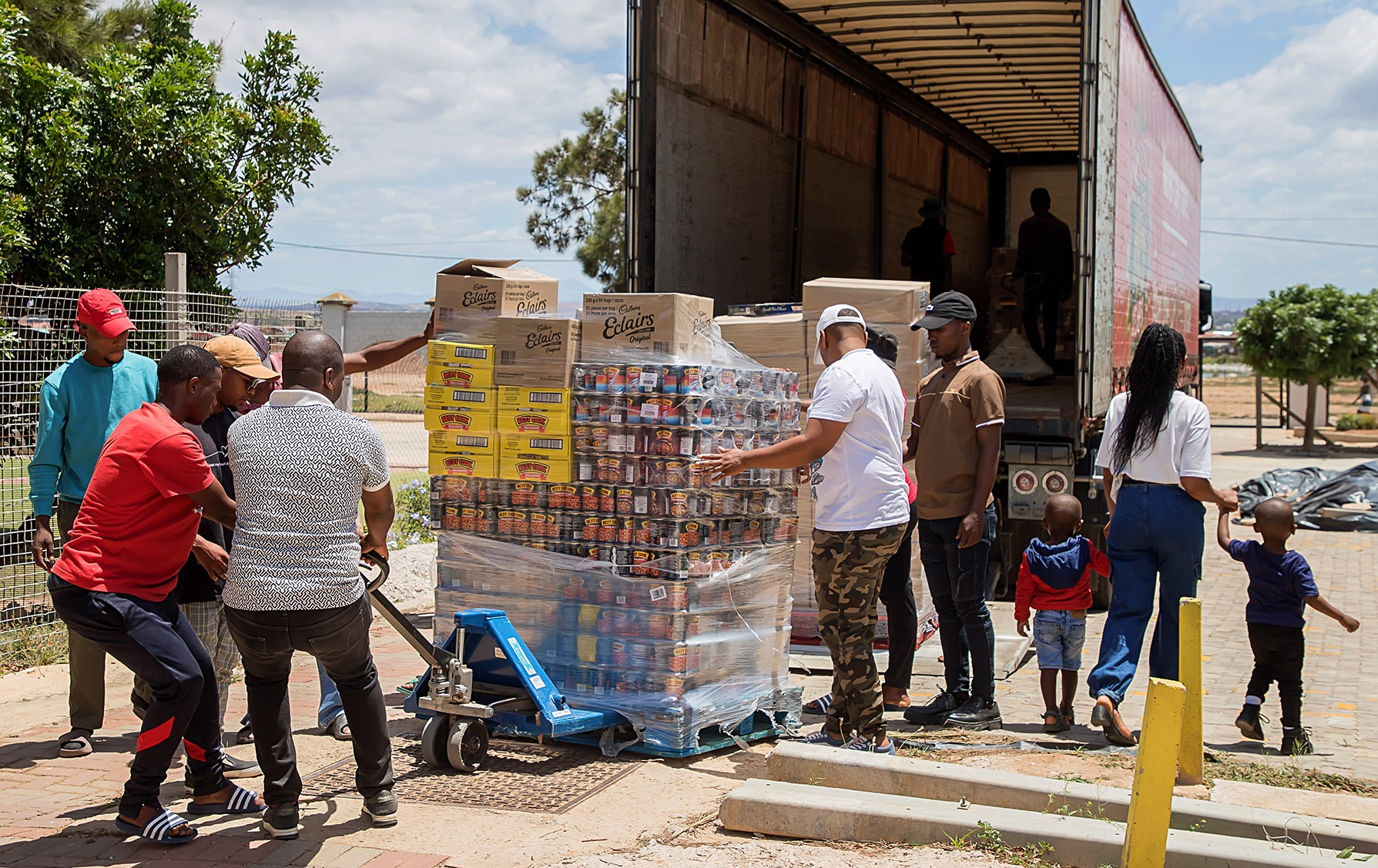
Van Oudheusden spoke to Daily Maverick on Thursday while volunteers at the centre were packing 200 buckets of food parcels in preparation for Daily Maverick and SA Harvest’s annual Buckets of Nutrition campaign.
Read more: Daily Maverick and SA Harvest’s food campaign — Restoring dignity and hope this festive season
Last year, the campaign distributed buckets to vulnerable families whose children were in hospital or being treated for chronic conditions.
/file/attachments/orphans/SAHarvestDay12025cDonnavdWattPhotography176_527883.jpg "Volunteers worked hard to ensure each bucket was carefully packed and ready for Friday’s handover. (Photo: Donna van der Watt)")
This year, the campaign will focus on families with children in holiday programmes — making sure they have enough to eat and that their families will have sufficient food not to worry about empty stomachs over Christmas. After being alerted to an urgent need from women-led families affected by gender-based violence, some of the buckets will also be distributed to families in crisis.
The Missionvale Care Centre has learned through decades of work that hunger is not only about empty stomachs. It is about exclusion — about people being pushed to the margins because survival takes precedence over everything else.
“Food speaks to dignity,” says Lucky Ngamlana, the head of skills training at the centre. “People being fed speaks to dignity being restored, to self-worth and to a sense of belonging.”
Where every journey begins
The care centre runs a wide range of programmes, from a primary healthcare clinic to early childhood development, schooling support, skills training and job placement. Through these programmes, more than 350 previously unemployed young people have been placed into jobs.
“The people who come to us — I would dare say 100% of them — start their journey here looking for something to eat,” says Ngamlana.
Only once hunger is addressed can real transformation begin.
“It all starts with nutrition,” says Van Oudheusden. “Everything else we do is valuable and important. But without food, none of it works.”
/file/attachments/orphans/SAHarvestDay12025cDonnavdWattPhotography129_999705.jpg "Lucky Ngamlana and Linda van Oudheusden of the Missionvale Care Centre helped pack the food buckets, which families from Missionvale will receive. (Photo: Donna van der Watt)")
Ngamlana sees this reality play out daily in the skills training classrooms. This is where, he says, enthusiasm and hardship often sit side by side.
“It’s difficult as a facilitator to walk into a classroom full of people with potential, hopeful individuals with different capabilities,” he says. “They know they’ve got what it takes, but concentration-wise they can’t invest because their stomachs are empty. Before you can feed the mind, the body must be fed.”
Read more: More than two dozen children have starved to death in Nelson Mandela Bay in the past year
In a country where unemployment remains staggeringly high (31.9%), particularly among young people, hunger and hopelessness feed off one another, creating a cycle that is hard to escape. The lack of opportunity strips young people not only of income, but of dignity, stability and a sense of purpose.
“You’ve got young people without jobs who turn to crime simply because they want to provide,” says Ngamlana. “People can’t work when they haven’t eaten. They can’t even go out and look for work.”
Hunger as exclusion
Ngamlana speaks about hunger not only as deprivation, but as removal from community life. A hungry person, he says, feels disconnected from the society they live in.
“A hungry stomach does not feel like it belongs in whatever is happening in a community,” he says. “Someone who is hungry doesn’t feel they have it in themselves to contribute — or even to share an opinion. Food restores dignity.”
This is why feeding schemes, though often undervalued, are foundational, says Van Oudheusden. Yet funding them remains a challenge.
“Many people prefer to give tangible things like books, equipment or stationery,” she says. “Feeding schemes are often seen as a bottomless pit. If someone donates a laptop, it will still be there next year. But if you give food today, it will be eaten, and it will be gone.”
But the need is undeniable.
“No patient can take medication without food. No child can learn without food. Nobody can do anything without food,” says Van Oudheusden.
Growing food, growing futures
In response to rising food prices, increasing need and dwindling donations, the Missionvale Care Centre has introduced food gardens and home gardens at daycare centres and primary schools.
“Even these stakeholders still need food,” says Ngamlana. “And there are very few sponsors willing to support that.”
The centre relies heavily on partnerships with organisations like SA Harvest and Daily Maverick, whose Buckets of Nutrition campaign frames hunger not as charity, but as a matter of justice.
“We are very grateful to organisations like SA Harvest, and to platforms like Daily Maverick,” says Ngamlana. “That advocacy matters.”
Dignity over handouts
The care centre’s approach is deliberately holistic. While emergency food relief is essential, the centre works hard to avoid dependency. Instead, it has built a system based on reciprocity.
Participants earn “MCC bucks” by volunteering, attending programmes or bringing in recycling. They then use those tokens to buy what they need — almost always food first.
“They can choose the food they want,” explains Van Oudheusden. “They can also buy household items, clothing and toiletries. But the queue is always at the food store. It’s not about luxuries. It’s very basic staples.”
Behind those queues are stories that rarely make headlines, stories unfolding quietly in clinics, classrooms and overcrowded homes, far from public view. The hunger that staff encounter is not occasional or abstract, but severe and prolonged, with consequences that can shape children’s lives long after their stomachs are filled.
“I can tell you horrific stories of hunger,” says Van Oudheusden. “Of severely malnourished children who are badly stunted. You lose a lot of dignity when you can’t provide for your family. That weighs heavily on parents and grandparents.”
A bucket of food, or a bag of basic staples, becomes a catalyst — allowing a child to concentrate, a patient to take medication, and a young person to show up, learn and try again.
“When hunger is what you’re worried about,” says Van Oudheusden, “it’s very difficult to put your mind to anything else.”
What does a Bucket of Nutrition look like?
The buckets are more expensive than last year, at R1,000 apiece. Still, they contain significantly more nutritious food products, a few treats and some cleaning materials that will be sufficient to carry families into the new year. Any donation towards a bucket will do; it isn’t necessary to contribute the full amount.
A Bucket of Nutrition contains the following:
- 10kg maize meal;
- 5kg rice;
- 2kg samp;
- 500g macaroni;
- 500g soup mix (dry);
- 2 × 410g tinned beans;
- Baked beans;
- 1 × 400g pilchards;
- 500g soya mince;
- 400g peanut butter;
- 500g instant milk powder;
- 2 × 400g tinned mixed veg;
- 1kg potatoes/butternut;
- 1 pack Morvite/FutureLife econ pack;
- 750ml cooking oil;
- 1kg sugar;
- 1 × 12-pack stock cubes;
- 500g salt;
- 400g mixed sweets value bag;
- 400g extra mixed sweets value bag;
- 1 pack family biscuits;
- 2 packets of jelly powder;
- 750ml dishwashing liquid;
- 1 laundry bar; and
- 1 bottle Jik / detergent (small)
How to donate
These are the banking details for SA Harvest:
Please use your name, surname and DM as a reference. If you would like to remain anonymous, you need only use DM as a reference.
- SA Harvest
- Business Platinum Account
- First National Bank
- Account Number: 62693490478
- Branch Code: 255955 (Randpark Ridge)
- Swift: FIRNZAJJ
To donate online, please follow this link: Buckets of Hope - SA Harvest.
The campaign will run until early January. DM