




 phahlane-adhoc-caryn
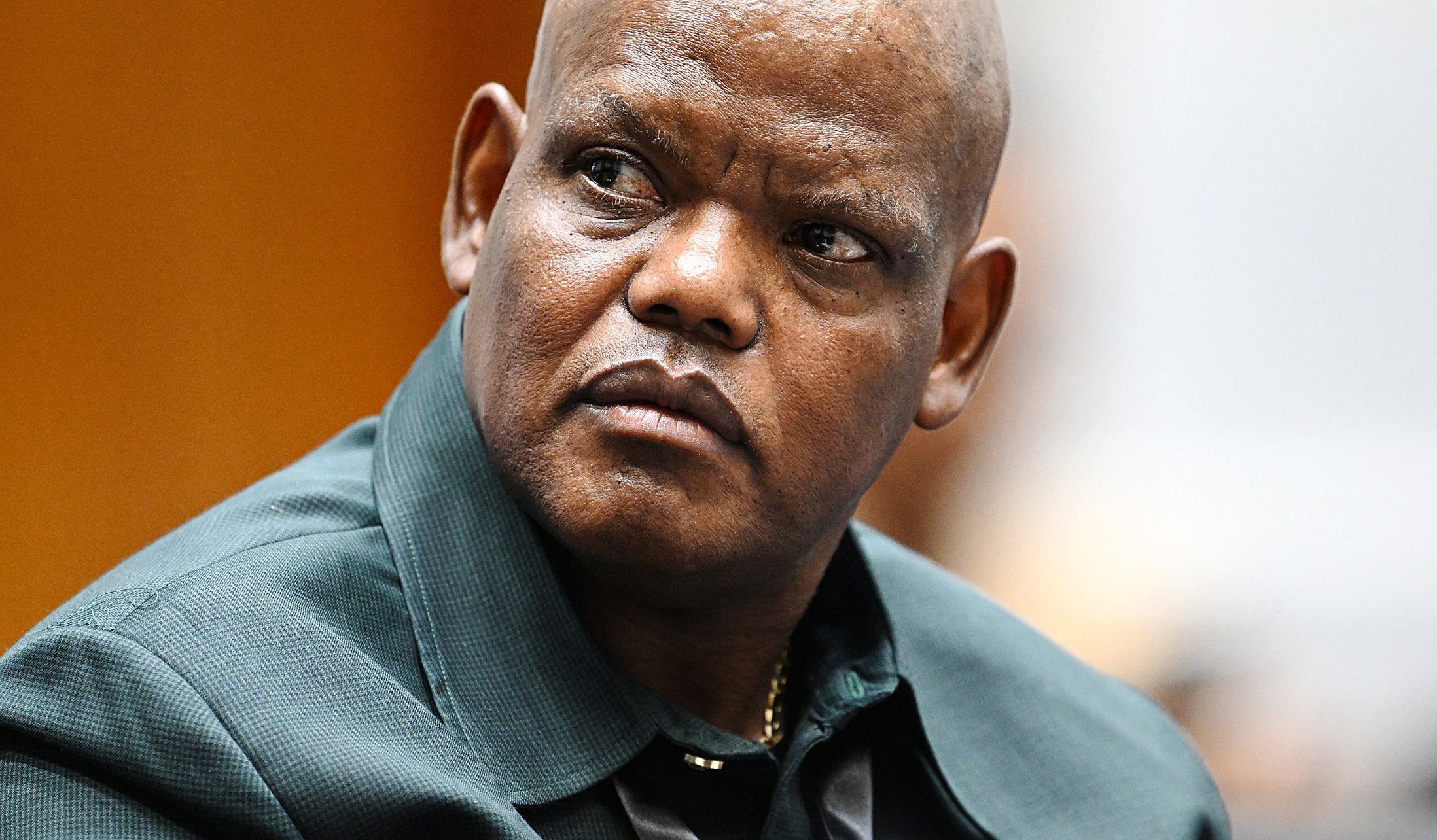
 Former acting national police boss Khomotso Phahlane, who was fired and accused of corruption, says political interference in the South African Police Service (SAPS) escalated nearly two decades ago.
Phahlane, who insists he has been the target of a campaign to discredit him, detailed his stance on political meddling on Wednesday, 14 January 2026, while testifying before Parliament’s ad hoc committee investigating accusations that a drug cartel has infiltrated South Africa’s criminal justice system, politics, and private security.
‘We must not shy away,” he said.
“Political interference in the South African Police Service became more prevalent following the 2007 Polokwane conference.”
Phahlane was referring to the ANC’s 52nd National Conference, where Jacob Zuma was elected the party’s president.
/file/attachments/orphans/pic1_124768.jpeg "Former acting national police commissioner Lieutenant General Khomotso Phahlane testifies before Parliament’s ad hoc committee. (Photo: Phando Jikelo / RSA Parliament)")
Zuma subsequently became head of state between 2009 and 2018, a period that coincided with State Capture when the country’s law-enforcement structures, as well as the South African Revenue Service, were intentionally weakened.
Parliament’s ad hoc committee is now investigating another set of accusations that point towards capture.
KwaZulu-Natal police boss Nhlanhla Mkhwanazi alleged in July last year that a cartel had infiltrated the country’s policing and politics.
Political allegiances and purging
The ad hoc committee began its hearing in October last year and, following a break over the holiday period, resumed on Wednesday.
Part of an affidavit that Phahlane submitted to the committee added to his testimony about political interference.
It said that after the 2007 ANC conference in Polokwane, some police officers, “especially those with struggle credentials” who fought apartheid and who were integrated from non-statutory forces (former political organisations), “revealed their allegiance/loyalty to political formations and/or leaders”.
Phahlane’s affidavit continued: “This impacted negatively on discipline and the management of conduct at all levels within the SAPS.”
It said senior police managers were “purged from key positions” and redeployed.
A significant part of Wednesday’s proceedings focused on Phahlane’s controversial SAPS past.
Phahlane portrayed himself as a former officer who was horribly wronged years ago and is still trying to clear his name of accusations that he deems unwarranted.
He repeatedly said he was the target of a narrative intentionally crafted to tarnish his name.
Wednesday’s proceedings began at 11am, and by 3.40pm, the DA’s Glynnis Breytenbach asked for a focus on the committee’s terms of reference, because what Phahlane was testifying about was “irrelevant and we can do nothing about it”.
EFF leader Julius Malema was also not sure about “what we’ve been doing from the morning until now”.
Ad hoc committee chair Soviet Lekganyane instructed that its reference terms be adhered to. “We’re not a dispute resolution forum,” he told Phahlane.
Dismissed
Zuma appointed Phahlane to act as national police commissioner in October 2015.
Two years later, in June 2017, Phahlane was ordered to step down from the post because of negative publicity relating to corruption accusations.
Fikile Mbalula was police minister at the time.
On this, Phahlane said on Wednesday that Mbalula had no authority to make such an order, adding: “You will know that I was a guinea pig of the step-aside policy because it was just applied to me for whatever reasons.”
Phahlane was dismissed from the SAPS in 2020.
This was connected to a 2014 contract worth R92-million awarded to Ethemba Forensic Group for the provision of specialised cameras to the police.
Ad Hoc Committee on Mkhwanazi allegations is back today. LT Gen Khomotso Phahlane is our first witness for the year. We resume now after the lunch break. @ParliamentofRSA @SAPoliceService @DOJCD_ZA @NPA_Prosecutes @DefenceCluster @GovernanceClus1 @HealthSocClust pic.twitter.com/xYJzgSYOqR
— Justice-and-security-Cluster (@JustSecuCluster) January 14, 2026
However, no order was placed for the system, and this resulted in a R24-million settlement between Ethemba and the SAPS.
Phahlane was accused of causing the R24-million loss. On Wednesday, he again denied any wrongdoing.
Phahlane testified: “What I can tell, and I can tell it until I die, I will never spend public funds on something that is not going to be used, especially R92-million go down the drain just because there’s a glorified service provider somewhere, who has been given a contract and I must append my signature and say: ‘Place an order.’
“I will never do that.”
In July 2021, the Safety and Security Sectoral Bargaining Council found that Phahlane’s dismissal was fair and justified.
But on Wednesday, he insisted in Parliament that he had been “unlawfully dismissed.” An appeal he lodged in the Labour Court over this may be finalised within a fortnight.
‘Blue lights’ case
Meanwhile, Phahlane was arrested in 2019 (a year before his dismissal).
This saga ended up in court and is known as the “blue lights” case, which involved millions of rands linked to an allegedly fraudulent tender to supply emergency equipment to the SAPS in 2016. (It appears this case has not yet concluded.)
In 2022, Phahlane approached the Public Protector, asking for an investigation into the circumstances around his dismissal, and broader policing issues.
Daily Maverick previously reported that part of his submission to the Public Protector said: “The 1st of June 2022 brought about a completion of a vicious five-year circle/period of an onslaught, character assassination, assault on one’s integrity, abuse of power and authority including insults experienced in a malicious and destructive battle for the soul and control of the South African Police Service waged against Lieutenant General Johannes Khomotso Phahlane.”
On Wednesday, he told the ad hoc committee that four years had lapsed since he lodged his Public Protector request, but he was still awaiting an outcome.
McBride and O’Sullivan
In this broader scandal, Phahlane has previously insisted he has been nefariously targeted.
Among those he accused of crafting a campaign to tarnish his name are former Independent Police Investigative Directorate (Ipid) boss Robert McBride and forensic investigator Paul O’Sullivan.
This is similar to the earlier testimony to the ad hoc committee of the sidelined police minister Senzo Mchunu’s chief of staff, Cedrick Nkabinde.
Nkabinde had claimed that while Phahlane was still acting national police commissioner, a team had been assembled to ensure that he would not be appointed in a permanent capacity.
According to Nkabinde, the aim of the team, which included O’Sullivan, was to ensure McBride became national police commissioner.
/file/attachments/orphans/osullivan1_425044.jpg "Forensic investigator Paul O'Sullivan. (Photo: Sally Shorkend)")
On Wednesday, Phahlane referred to Nkabinde and again alleged that McBride and O’Sullivan had run a “sustained campaign” against him through the media, via select journalists.
Wednesday’s proceedings continued late into the evening.
There was a possibility that Phahlane would be called to return to the ad hoc committee on a later date so that its members, MPs, would have an opportunity to question him.
Looking ahead
Crime Intelligence boss Dumisani Khumalo is set to testify before the committee on Thursday and Friday.
Next week, McBride is expected to be called as a witness, as well as suspended Ekurhuleni Metropolitan Police Department head Julius Mkhwanazi.
The ad hoc committee plans to wrap up its witness testimony by 6 February 2025 and compile a report on its hearings by 20 February, the deadline by which it needs to finalise its work.
Another hearing, the Madlanga Commission of Inquiry, has been running parallel to the ad hoc committee and is investigating the cartel infiltration accusations.
Following a break, it is set to resume on 26 January.
/file/dailymaverick/wp-content/uploads/2025/11/ED_576045-1.jpg "Crime Intelligence head Dumisani Khumalo. (Photo: Gallo Images / Frennie Shivambu)")
A statement issued on Monday, 12 January, said: “As part of its remaining work, dozens of witnesses are due to appear before the commission over the next few months.”
The first phase of the Madlanga Commission focused on evidence from witnesses who added to the cartel infiltration accusations, first publicised last year.
During the second phase, set to start later this month, that evidence will be tested. Implicated individuals will be allowed to respond to allegations against them.
“Phase Two also provides for the ventilation of other issues falling within the commission’s terms of reference but not addressed in Phase One,” the statement from Monday said.
The third phase of the commission will involve recalling Nhlanhla Mkhwanazi, among its first witnesses, to testify again. DM