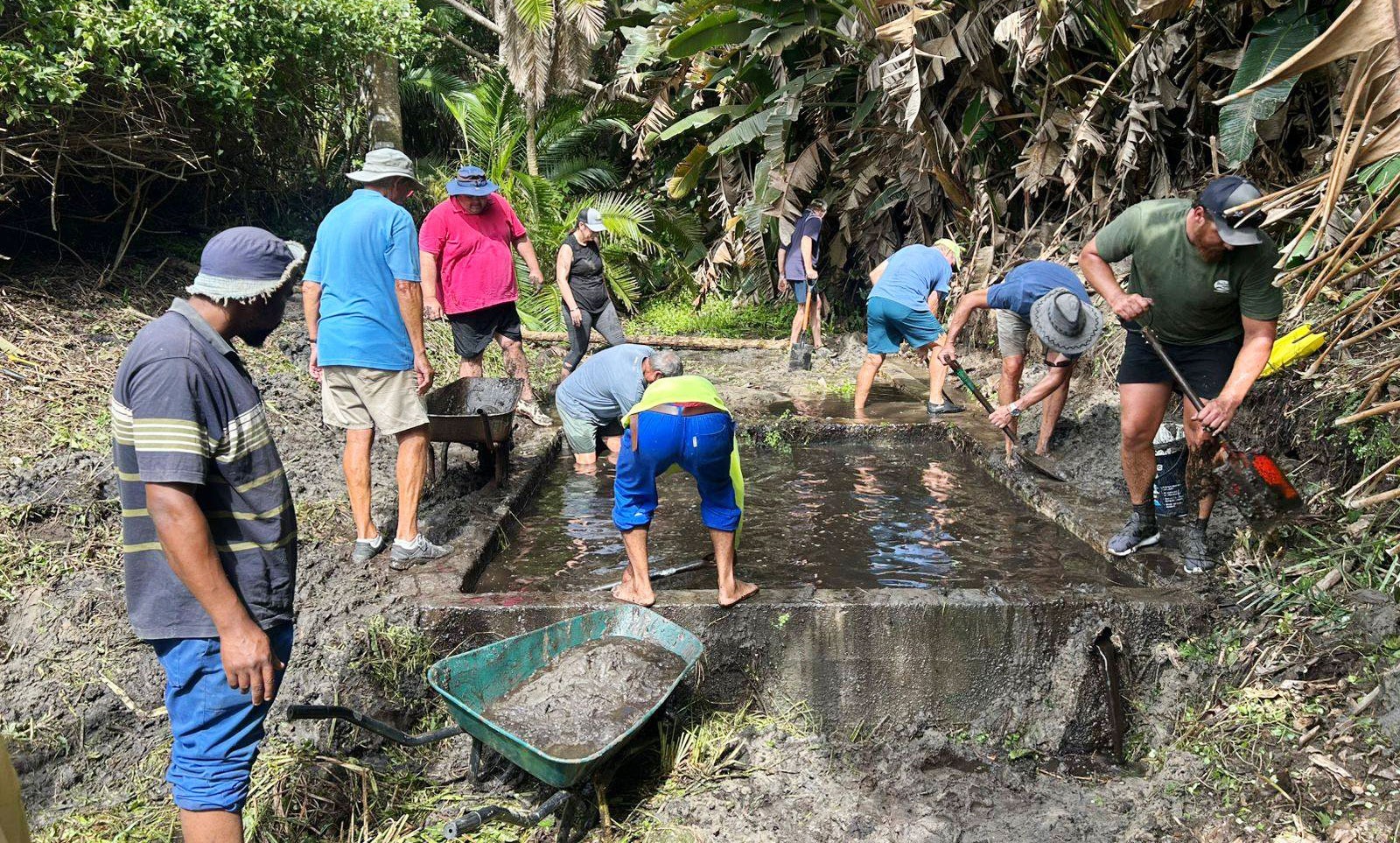
 Residents removed tonnes of mud using wheelbarrows from the freshwater spring settling dams in Kei Mouth so the town can use this valuable water source. (Photo: Elilze Haber / Kei Mouth Times)
On 26 January, the Amathole District Municipality ordered immediate and drastic water rationing for the towns of Kei Mouth and Cwili in the Eastern Cape. After brutally hot January temperatures, high festive-season consumption and below-expectation rainfall, the Cwili dam had run dry.
The municipality announced that both Kei Mouth and Cwili would have water every second day from now on, with no water at night and on Fridays. A tough blow for a town relying on tourism.
/file/dailymaverick/wp-content/uploads/2021/12/Tembile-shellkeiCase.jpg "Kei Mouth Village on the Wild Coast. (Photo: Supplied)")
“But we decided that we can point fingers, and we really want to do so, but it was not going to get us anywhere. We moved the fight with the municipality to the sidelines and focused on the crisis at hand,” long-time Kei Mouth resident Brendon Freitag said.
In 2020, the town lucked-out when Trevor Balzer, the legendary former deputy director-general responsible for strategic and emergency projects – the man who led the national drought responses for the country – chose Kei Mouth as his retirement home.
Read more: Water scarcity in South Africa and the precarious road ahead
Balzer, a qualified engineer and veteran in drought response, and Freitag started mobilising the town to provide their own plan for the crisis.
Kei Mouth is one of many towns currently facing a dire water shortage due to an ongoing drought in the Eastern Cape and the Southern Cape. Knysna is facing an emergency situation, as is Nelson Mandela Bay, where the municipality has warned of rapidly dropping dam levels as extremely hot weather and dry conditions persist.
Freitag, who also owns the Spar in town, was working this weekend to distribute thousands of 5-litre bottles of drinking water to every family in town and in Cwili – a donation from Spar Eastern Cape.
When the crisis measures were announced last week he said people from Kei Mouth discussed the matter and decided to see if it would be possible to clean the old town ponds.” The ponds were created around a freshwater spring to serve as reservoirs for that water, but fell out of use and became overgrown with plants and silted with mud.
“Lots of us are old and fat,” Freitag laughed, but the town came together, and we cleaned out those ponds. We basically just reinstituted it. It is far from done, but there is water that can now feed into the old reservoir from where it can be pumped,” he said. Next on their list is to see how they can fix the pump line.
/file/attachments/orphans/Cleaning-Kei2_653534.jpg "Settling dams built decades ago for the freshwater springs had become completely silted with mud on 1 February 2026 (Photo: Elilze Haber / Kei Mouth Times)")
“The dam is dry,” he said. “We had a borehole but it got damaged through vandalism.”
He said they were working with the Amathole District Municipality (ADM) and they are helping them “finish the job”.
“We have come up with three to four interventions to help,” he added. But he said they are not happy that 40% of their water still goes to waste because of leaks. This came to us as a hell of a shock. We were not made aware of anything. Just the notice that arrived saying the water is gone.”
He said that in November 2025 they were discussing a possible water shortage due to the dry, hot summer in the Eastern Cape. “Now we are staring down that barrel.”
He added that the sudden water throttling introduced by ADM was very harsh. “We did ask if we could regulate ourselves and perhaps rather have water for two hours in the morning and two at night,” he added.
“I am also concerned that with the town’s pipe network being older than 30 years and already beyond its end-of-life time we are going to lose more water with all this switching on and off.”
/file/attachments/orphans/Cleaning-Kei3_340793.jpg "More work being done on the settling dams for the freshwater springs 1 February 2026 (Photo: Elilze Haber / Kei Mouth Times)")
Previously the town raised about R50,000 to buy what was needed to fix the leaks in their reticulation network.
Freitag moved to Kei Mouth in 2010. “We have been through quite a few of these disasters,” he said. “We first get the work done, and then we fight.”
He said the existence of the freshwater ponds was “common knowledge” around town, and they were used during previous “setbacks and disasters”.
“There are a good few of us left who knew about those ponds,” he said. He added that there are some farm dams in the area that they want to negotiate about as well. “Previously the municipality would pump from the Kei River but the pipes and the pumps were stolen.”
The municipality confirmed that several key water resources are currently at critically low levels affecting the Great Kei, Mbashe, Amahlathi and Ray Mhlaka local municipalities. They further confirmed that to prevent the “total collapse” of the water system it was necessary to implement measures for extreme savings including water throttling for Kei Mouth from 8pm to 6am, with Kei Mouth and Cwili alternating between days with no water and no water coming into town on Fridays.
Balzer said on Sunday he has been worried for a long time about the state of water resources in the seaside town.
“We haven’t had any substantial rain this season. There is not much water going into our system,” he added.
/file/dailymaverick/wp-content/uploads/2021/05/IMG_20210521_072847.jpg "Early Morning at the mouth of the Great Kei River. (Photo: Derek Hill)")
The town’s main water system, the Cwili dam, was built in the 1960s. “This system can barely cope [with] out-of-season demand,” Balzer said. “So, in season the draw-down on the water supply nearly doubles.
“About two weeks ago we raised the alarm as a community that the system was running dry. Nothing was done. It said you have 12 to 24 hours of water left. On Monday night we received the notification that the dam was at 0%. Then we got a notification on water rationing,” he added. The only usable water at that stage was the little trickle coming to the dam from the Cwili River.
But the town had freshwater springs with infrastructure that had been left to fall into disrepair.
“These were totally covered in silt. We had to clean them out. We moved tons of sand by wheelbarrow,” Balzer said. He said that for the one side of the springs the municipality sent a contractor to help.
Balzer explained that the system was set up so that freshwater runs into two chambers where the mud can settle from the water and then into a reservoir. “We have reinstated the pumps as well.
“The municipality came to the party, appointed a contractor to help us. These are quite strong springs. The system is not quite working yet. There is still a little bit of a pipeline that needs to be repaired,” he said.
Once it is up and running he was confident that this system will produce 100 cubic metres for the town’s use.
“We also identified a borehole that was sunk during the previous drought but has since fallen into disrepair,” he said. “I think from here we can get another 200m3.
“But that is only 45% of what we need.”
Balzer said the municipality should have acted earlier.
“I don’t want to pooh-pooh the work being done but it would have been good if three months ago, when the first signs were there, there was action.”
But he added that the whole town had been mobilised to work together. “We will be meeting again on Tuesday.
“But it remains a concern for us that the municipality did not act when the system was constrained. We had a meeting in July last year. They have a plan in place for a longer-term solution, but it is February now and we have not seen this being executed.
He was concerned that the municipality might lose unspent grant-funding.
“I have managed droughts nationally, but this is my first drought in Kei Mouth,” he said. “You can’t be watching the clouds. But I have looked at the models, and we are hoping for some good rain between middle February and March.” DM