




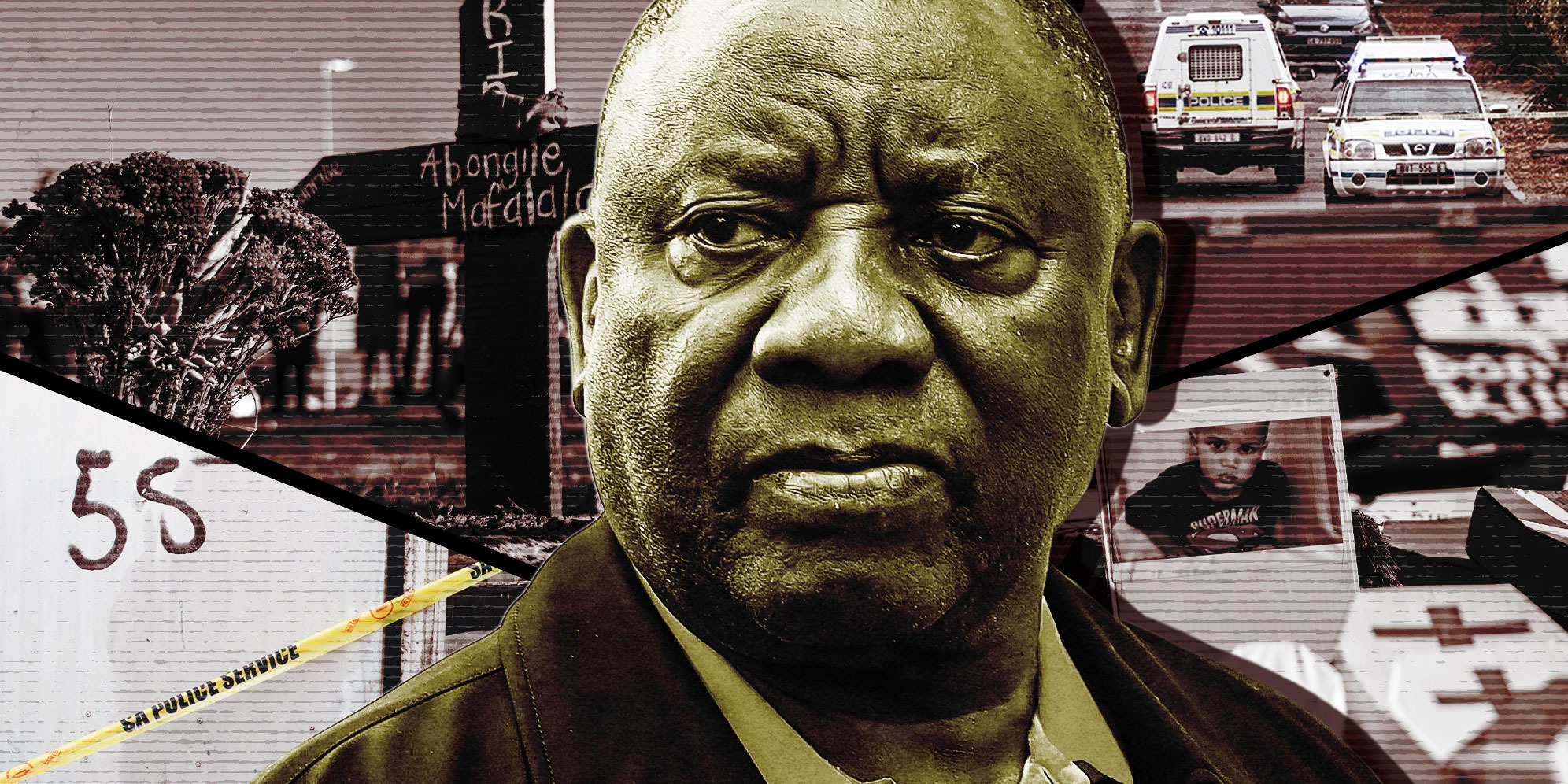
 Illustrative Image: Crime scene in Kanana informal settlement, Cape Town, where seven men were gunned down on 28 June 2025. (Photo: Brenton Geach / Gallo Images) | A cross at the scene of a mass murder in Parkwood, Cape Town, on 5 June 2022. (Photo: Brenton Geach / Gallo Images) | Crime scene experts at a multiple murder scene in Constantia, Cape Town, on 25 May 2023. (Photo: Brenton Geach / Gallo Images) | Coffins representing children killed in gang wars. (Photo: Brenton Geach /Gallo Images) | President Cyril Ramaphosa. (Photo: Sharon Seretlo / Gallo Images) | (By Daniella Lee Ming Yesca)
 /file/dailymaverick/wp-content/uploads/2025/10/label-analysis-2.jpg)
Violent crime continues to plague South Africa while high-ranking police officers accuse one another of conspiring with criminals.
Over the past few months, top law enforcers have spent many hours in Parliament denying the wrongdoing they have been accused of and pointing fingers at others.
They appeared before Parliament’s ad hoc committee investigating allegations that a drug cartel has infiltrated South Africa’s criminal justice system, politics and private security.
There have been similar scenes at a parallel hearing, the Madlanga Commission of Inquiry, which has been on a break and is set to resume this week.
The proceedings are necessary — South Africans need to hear from those accused of deceiving us and those who have apparently been framed.
Contradictions and ‘sadness’
It is evident that some witnesses are lying, jeopardising South Africa’s security and endangering residents’ lives. Their contradictory statements highlight deepening divisions within the country’s law enforcement organisations.
Meanwhile, violent crime, exacerbated by transnational drug trafficking, continues to plague the country. This criminality must be addressed by a unified and trustworthy law enforcement response.
On Monday, 19 January, the Presidency issued a statement about two sets of tragedies.
PRESIDENT RAMAPHOSA MOURNS MULTIPLE DEATHS IN CAPE FLATS VIOLENCE AND SCHOLAR TRANSPORT CRASH
— The Presidency 🇿🇦 (@PresidencyZA) January 19, 2026
President @CyrilRamaphosa has expressed his sadness at the loss of life in violence on the Cape Flats at the weekend and in a collision involving a scholar transport vehicle this…
One of those tragedies involved the murders of at least 26 people on the Cape Flats that weekend. One of those killed was 13-year-old Ashtin Brooks. News24 reported he was shot while playing soccer.
All Ashtin Brooks, 13, wanted was to become a professional soccer player one day. He had been playing the game he loved so much when bullets rang out in St Peter’s Street, Seawinds, on Friday, ending his young life. | @Lisaleesolomon1https://t.co/oTIL0PaSlB
— News24 🇿🇦 (@News24) January 19, 2026
President Cyril Ramaphosa expressed his “sadness” at the loss of life.
He said communities could “expect stronger law enforcement and increased police visibility to stabilise affected communities and reduce the potential for further violence”.
(This weekend, Ramaphosa said a call for the army to be deployed to gang hotspots needed to be considered with caution because soldiers did not investigate crimes and were trained to “shoot to kill”.)
Ceaseless killings
The situation is horrific — and it has been going on for a long time.
The Western Cape is South Africa’s gangsterism capital.
Fatal shootings are concentrated in the Cape Flats — suburbs to which black and brown-skinned residents were removed under apartheid.
Daily Maverick has reported that around 31 murders were apparently (these statistics were leaked, not official police ones) recorded in a day.
In 2024, it was reported that “over about 72 hours … 94 people were killed in the province”.
Ramaphosa vs Cachalia’s reaction
The Presidency’s statement of 19 January said that Ramaphosa “recognises the fear to which criminals subject residents and therefore calls on communities to strengthen their partnership with law enforcement agencies in community policing forums”.
Ramaphosa also urged residents to provide information about criminal activities to the police, even if it meant outing neighbours or relatives.
“With the assistance of community members, the South African Police Service has been able to arrest 100 gang leaders and 106 runners in the past three months,” the statement said.
“President Ramaphosa assures residents that government is balancing short-term actions to prevent and respond to violence and stabilise communities, with long-term socio-economic interventions to improve social conditions and living standards.”
Read more: Police not ready to combat ‘growing gangs’ — Cachalia
Meanwhile, acting Police Minister Firoz Cachalia, speaking in the Eastern Cape last week, came across as much less optimistic than Ramaphosa, saying: “I do not believe that we are currently in a position to defeat these gangs.”
/file/attachments/orphans/ED_572640_804640.jpg "Acting Police Minister Firoz Cachalia is pessimistic about South Africa’s current ability to defeat gangs. (Photo: Brenton Geach / Gallo Images)")
Gang violence, or the reaction to it, can be politicised when, for example, political parties criticise the SA Police Service, which is widely viewed as an ANC remit, for not doing enough to quell the violence.
Politics and crime accusations
Around these arenas are suspicions and accusations — especially in the Western Cape — that certain politicians are aligned with gang bosses.
Former DA Cape Town Mayco member Malusi Booi faced accusations that he accepted gratifications from alleged 28s gang boss Ralph Stanfield. (The case was provisionally withdrawn.)
/file/dailymaverick/wp-content/uploads/2025/07/04-ED_468063.jpg "Alleged 28s gang boss Ralph Stanfield. (Photo: Jaco Marais / Gallo Images)")
The Mail & Guardian has reported that then president Jacob Zuma met several top gangsters in 2011 as part of a plan for the ANC to wrest control of the Western Cape from the DA. (The ANC labelled this “baseless”.)
As for Ramaphosa, he does not often publicly comment on the Western Cape violence situation, so the Presidency’s Monday statement stands out.
Read more: ‘New evidence’ — stalled R1bn Malusi Booi and Ralph Stanfield tender fraud case still on track
It should be noted that the statement was issued at a time when South Africa is heading towards elections. But let’s put politics aside and assume the statement‘s timing simply corresponds with that of the killings and was intended to reassure residents that action is being taken to stem the plague of violent crime.
Seismic scandal
Underpinning these tragedies is the crisis that has everything to do with politics — the law enforcement scandal.
It has become a magnifying glass, focusing on fractures between different policing and prosecuting structures.
Over the three days following the Presidency’s statement about killings in Cape Town, more law enforcers appeared before Parliament’s ad hoc committee.
Suspended Ekurhuleni metro police deputy chief Julius Mkhwanazi admitted to the committee he had accepted money from organised crime accused Vusimuzi “Cat” Matlala.
/file/dailymaverick/wp-content/uploads/2025/11/Julius-Mkhwanazi.jpg "Suspended EPMD Brigadier Julius Mkhwanazi. (Photo: Facebook)")
The former head of the Independent Police Investigative Directorate (Ipid), Robert McBride, also testified before the ad hoc committee last week.
Read more: ‘Mkhwanazi tried to disrupt Ipid probe into ex-acting cop boss Phahlane’ — McBride
He cast doubt on KwaZulu-Natal’s police commissioner, Nhlanhla Mkhwanazi, who ignited the law enforcement scandal in July last year by alleging during a press conference that a drug cartel had infiltrated SA’s criminal justice system, political spheres and private security.
These accusations resulted in the creation of Parliament’s ad hoc committee and the Madlanga Commission of Inquiry.
Divided law enforcers
McBride alleged to the ad hoc committee that Mkhwanazi had attempted to undermine an investigation into the former acting national police commissioner Khomotso Phahlane.
“From my time at Ipid, I am aware of ... General Mkhwanazi having played an undue and prosecutable role in trying to disrupt and scuttle the Ipid’s investigation into Phahlane,” said McBride.
Phahlane faces corruption accusations and previously countered that he was the target of a smear campaign, which he alleged McBride had orchestrated.
/file/attachments/orphans/pic2_106928.jpeg "Robert McBride testifies before Parliament’s ad hoc committee on 20 January. (Photo: Phando Jikelo / RSA Parliament)")
McBride told Parliament that Phahlane and Mkhwanazi were friends.
He also said that Mandla Mahlangu, an Ipid investigator who was murdered in 2020, was killed “after making incriminating statements” about a person who had since testified before the committee.
Mahlangu had been investigating Phahlane, who previously testified at the committee.
McBride spoke favourably of the deputy national commissioner of crime detection, Shadrack Sibiya, who was suspended last year following Mkhwanazi’s accusations. This points to clear divides among state law enforcers — McBride does not see eye-to-eye with Mkhwanazi, who does not see eye-to-eye with Sibiya.
Confirmed lie
Another issue McBride testified about was the “fire pool” constructed many years ago at Zuma’s Nkandla residence in KwaZulu-Natal.
McBride said it had no security purpose and was a waste of money.
/file/dailymaverick/wp-content/uploads/2025/10/ED_507910-1.jpg "Former President Jacob Zuma. (Photo: Gallo Images / Luba Lesolle)")
Before his assertions, even the ANC’s secretary-general, Fikile Mbalula, revealed the party had lied about the pool to protect Zuma.
Read more: Zuma’s ‘security fire pool’ cost as much as a mansion — McBride dredges up past scandal
These many years of scandals make it difficult to trust South Africa’s politicians and law enforcers.
In addition, the two inquiries have highlighted ongoing attempts to capture South Africa’s law enforcement agencies and political structures.
Corruption in the state can fuel violence on the ground (violence that politicians can issue statements about).
Gangsters and government
For example, if a police officer smuggles a firearm to a criminal who shoots someone, or if an officer accepts bribes from a dodgy tenderpreneur, different kinds of criminality combine.
Aspects of government merge with gangsterism.
This underscores the real crisis in South Africa.
The Presidency’s statement last Monday said Ramaphosa “recognises the fear to which criminals subject residents”.
Read more: 28s gang ‘capture’ top Western Cape cops, prosecutors’ lives at risk – judge sounds corruption alarm
At the same time, Parliament’s ad hoc committee proceedings have made it clear that there are criminals, or individuals with criminal intent, in the state.
This translates to another kind of “fear to which criminals subject residents”.
/file/attachments/orphans/ED_588157_568117.jpg "Vusimuzi ‘Cat’ Matlala testifies at the parliamentary ad hoc committee into alleged corruption and political interference in the criminal justice system on 27 November 2025. (Photo: Gallo Images / Lefty Shivambu)")
Devious state characters aside, there are undoubtedly honest law enforcers trying to keep us safe.
And press statements, plus testimony at hearings investigating corruption — while at times contradictory — have forced critical problems to the forefront.
These problems cannot be tackled in isolation because they do not exist independently.
Ridding state structures of rot will save lives and, hopefully, will prevent the recurrence of events like 26 killings in Cape Town over a single weekend. DM