



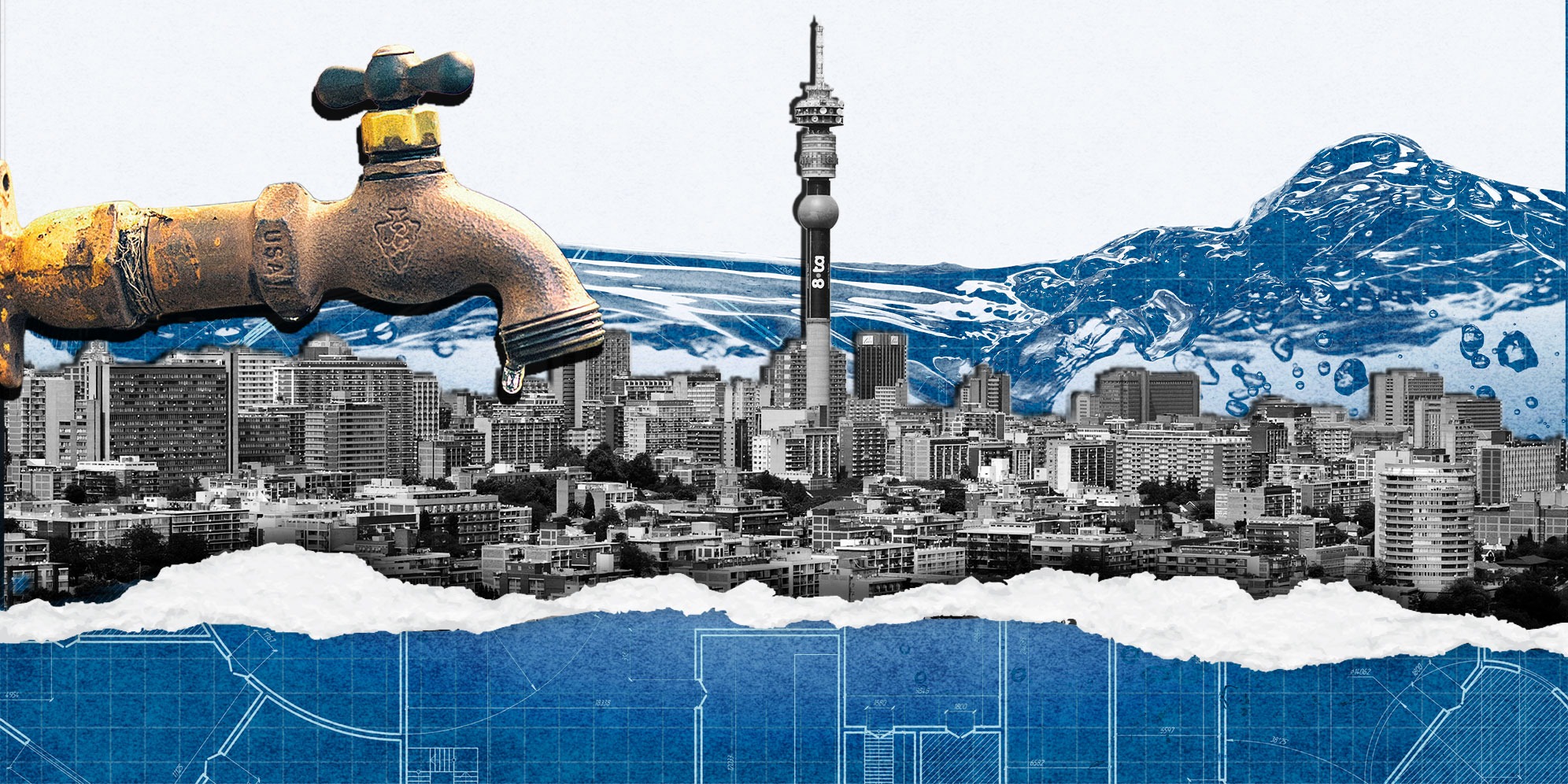
 Illustrative Image: Tap. (Photo: Unsplash) | Johannesburg skyline. (Photo: Herman Verwey) | Water. (Image: Freepik) | Building plans. (Image: Freepik) | (By Daniella Lee Ming Yesca)
One of the joyful luxuries after a long time away over the festive season was being back in my own shower at home.
It’s not particularly special – in fact the pipes don’t work hundreds and it has a rather frustrating habit of switching off just as the water gets hot.
But living in a place where the two main dams that supply us – Vaal and Sterkfontein – are both chock-a-block full, after two weeks in a place where it hasn’t rained since who knows when, meant I could actually shower with the shower on.
Veterans of Cape Town’s water crisis will know what I mean. I didn’t have to share my shower floor with a bucket.
So I was slightly perturbed to be reminded, again, about how serious the longer-term water problems in Joburg really are.
News24 published a report on a meeting at which water and sanitation director-general Sean Phillips suggested there may even need to be some kind of water rationing in Gauteng by the end of the year.
This came as a slight surprise because for a long time my rule of thumb has been that the Vaal Dam could get us through one completely dry year, and the Sterkfontein Dam another.
Since they’re both full now, that should mean we’re good until around December 2027.
But it seems the real problem is not how much water we have, but how much we are losing.
As Phillips points out, in Gauteng the average water use is 279 litres per person per day. In the Western Cape it’s 164.
Now, despite what members of your family WhatsApp group might say, I refuse to believe that people in the Western Cape are thriftier or that people in Gauteng are cleaner.
And it would make no sense that South Africans living in one city would use nearly twice as much water every day as South Africans living in another.
The only way to make sense of this is to understand that in Cape Town the amount of water that is lost – or to use the technical term “non-revenue water” – is 29.4%. In Joburg it’s 46.2%.
In other words, Joburg is losing nearly half of the water it gets from the Vaal.
I should say that nowhere in the world, not in Sweden, Washington or Greenland, will you find a water system that doesn’t lose water.
But Joburg’s figure is astronomically high and the cause of so many of our problems.
As Phillips says, the main reason for this is, of course, the way the metros in Gauteng have been run.
Cheerfully, as Africa Check has found, Joburg spends less on maintenance than any other city in the country.
And over time, the real-world cost of that has started to really mount.
In the meantime, the crisis that we may be about to live through will be eased, probably not because Joburg gets its act together (this is the real world, please), but because Phase Two of the Lesotho Highlands Water Project will finally come on stream.
Read more: Lesotho Highlands Water Project's hydropower bonus
Amazingly this project has been delayed for years. And considering the stakes involved, the fact that the future of Gauteng rests on it, the reasons for the delays are particularly awful.
It is mainly, you may remember, because of our awful politics.
In fact, the roots of the delay go back until at least 2016 when, as amaBhungane reported in Daily Maverick, it emerged that the water affairs minister at the time had allegedly intervened in particular tenders.
It was pretty obvious why. She wanted a particular company to benefit from the BEE part of the tender. And we all know what that really means. It certainly looks like someone close to the ANC was going to benefit.
That person is now the first deputy secretary-general of the ANC, Nomvula Mokonyane.
In fact, when Gugile Nkwinti took over that department in 2018 (after Mokonyane promised, and failed, to “lift up the rand”) he described it “as a mess”.
But that’s not all.
In 2024 it emerged that our government clashed with the government of Lesotho over the CEO of the Lesotho Highlands Water Project.
Our government wanted Tente Tente reappointed for a second term, despite the fact that he had not met many of his targets. Lesotho did not, saying he had failed (Tente is a citizen of Lesotho, not South Africa).
In the end, Pretoria prevailed over Maseru.
Once again we had politics interfering with actual competence.
It is absolutely amazing that all of the politicians involved in this, whether it’s Mokonyane or the various mayors of Joburg, have all allowed it to get to this point.
And watch, they are going to claim it wasn’t them, and blame it on us for wanting to have a normal shower.
Phillips is a person I take very seriously. Someone trying to do an important job in a difficult space under some tough deadlines. He, and others like him in his department and councils everywhere, need all the help they can get (and a jolly good handshake if you meet them over a braai).
If he says we need water rationing, then we do.
But, and this is a big but, this is a local government election year. And I would put a lot of money down that the politicians won’t let him do it just before people are due to vote.
Which means that you and I can have a normal shower perfectly legally for some time.
Even if it would be better to save as much water as we can. DM