




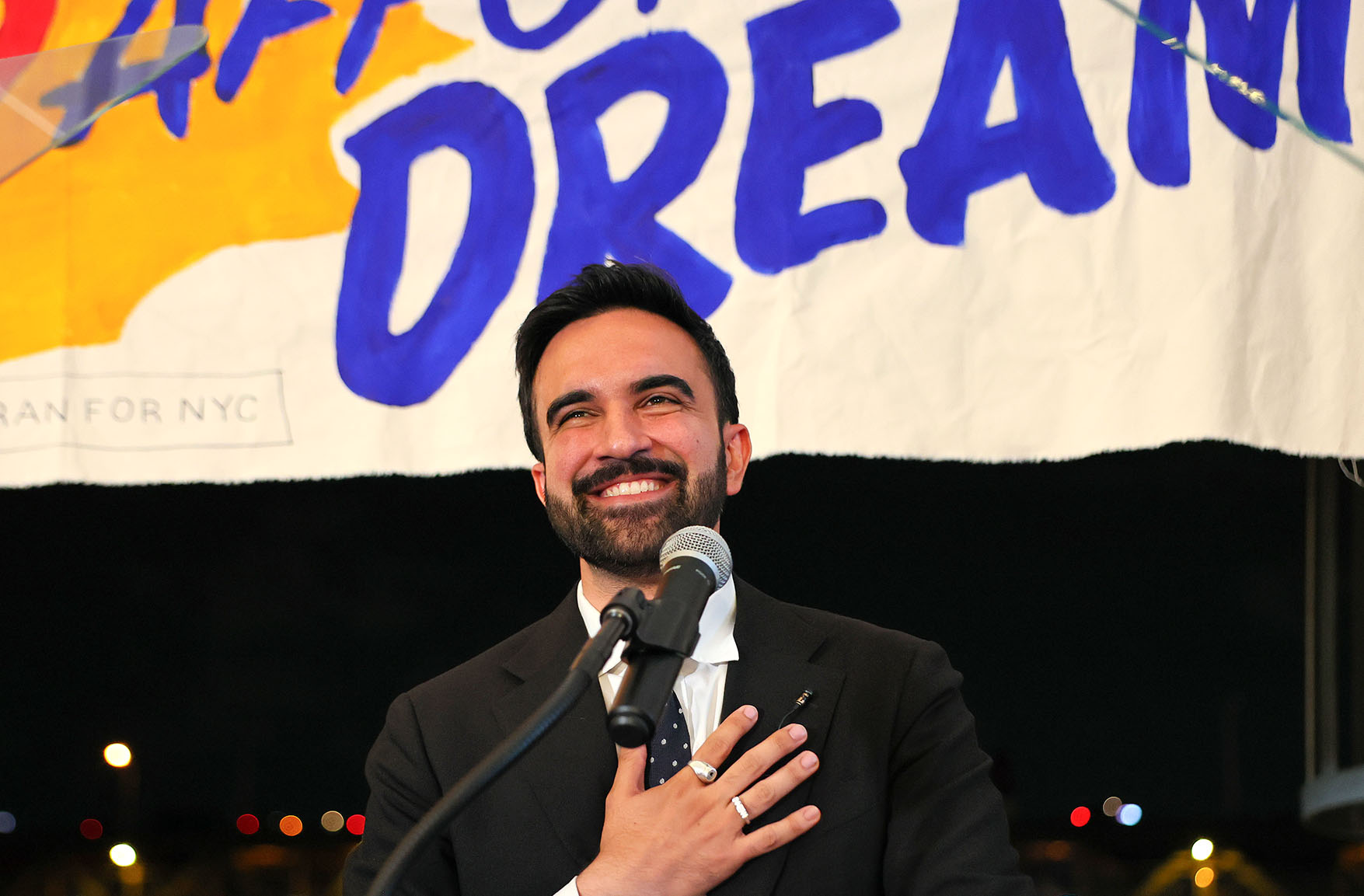
 Zohran Mamdani speaks to supporters during an election night gathering on 24 June in the Long Island City neighborhood of New York City. (Photo: Michael M. Santiago / Getty Images)
 He is being hailed as the potential saviour of left-wing politics in the US — and he spent some of his formative years in Cape Town’s southern suburbs.
Zohran Mamdani (33), who on Tuesday won the race for the Democratic nomination as the mayor of New York City in an extraordinary upset over establishment politicians, was raised in Uganda and South Africa before his parents moved to the US.
Mamdani’s father is well-known Ugandan academic Mahmood Mamdani, who arrived at the University of Cape Town shortly after the transition to democracy and tried to spearhead a process of academic decolonisation that was so intensely resisted by the UCT old guard that the episode is known to this day in academic circles as the “Mamdani Affair”.
His mother is the director Mira Nair, renowned for films including Monsoon Wedding and Mississippi Masala.
At the age of five, Zohran was enrolled at the co-ed St George’s Grammar School in Little Mowbray, Cape Town.
“We can place Zohran Kwame Mamdani at St George’s Grammar School during the years 1996, 1997 and 1998, corresponding to Sub A, Sub B and potentially Standard 1 as the grades were known then,” St George’s Grammar head Julian Cameron told Daily Maverick on Wednesday.
“We wish Mr Mamdani well in the contest to be mayor. In terms of thoughts from the school around his potential new role, our school motto is ‘Virtute et Valore’, which we translate to ‘The courage to do what is right’. I hope that through his brief time at St George’s he was able to internalise this way of being in the world and that he will be steadfast in working for what is right and just for the citizens of New York City.”
/file/dailymaverick/wp-content/uploads/2025/06/Zohran-1.jpg "Zohran Mamdami (circled) in 1998, aged six or seven, at the St George's Grammar 150th birthday celebration. (Photo: Julian Cameron / St George's Grammar)")
Mamdani v Cuomo
The New York City mayoral election takes place in November. What Mamdani has won is the nod to be the Democratic candidate in an overwhelmingly Democrat-supporting city. Betting website Polymarket is now giving him 73.6% odds of taking the mayoral chain — meaning that bar an all-out dirty tricks campaign against Mamdani, which is possible given the stakes, he is all but guaranteed to be New York City’s next mayor.
If elected, Mamdani would become the first Muslim and first millennial mayor in New York City’s history. Some have also pointed out that, appropriately enough for a millennial, he would also be the first mayor to have met his wife on the dating app Hinge.
/file/dailymaverick/wp-content/uploads/2025/06/GettyImages-2221994222.jpg "Zohran Mamdani kisses the hand of his wife Rama Duwaji as they celebrate during an election night gathering in Long Island City on 24 June. (Photo: Michael M. Santiago / Getty Images)")
/file/dailymaverick/wp-content/uploads/2025/06/GettyImages-2221994163.jpg "(L-R) New York mayoral candidate, State Rep. Zohran Mamdani (D-NY) stands with his mother Mira Nair, and father Mahmood Mamdani as they celebrate during an election night gathering at The Greats of Craft LIC on June 24, 2025 in the Long Island City neighborhood of the Queens borough in New York City. (Photo: Michael M. Santiago / Getty Images)")
The nature of Mamdani’s upset cannot be overstated. He was running against 10 other candidates, of whom the clear frontrunner was Democratic household name Andrew Cuomo, who, despite having to resign as governor of New York in 2021 following a flood of sexual harassment accusations, was initially expected to stroll to victory.
Cuomo is a centrist of the kind the Democratic Party has increasingly favoured, and his campaign was rolling in money: almost $24-million, much of it from corporations. Mamdani’s funding vehicle, The New York Times reported in June, had 1/50th of the funds.
Why were businesspeople so keen to pour money into Cuomo’s campaign? Because of the “dangerous”, “radical” nature of Mamdani’s promises to the electorate. A proud socialist in a country where that is a dirty word, Mamdani pledged to freeze rent, provide free buses, and raise taxes on corporations and the rich.
Mamdani had to fight Islamophobic smears
Initial polls earlier this year predicted Mamdani taking just 1% of the vote, but he ran an astonishing campaign: joyful, hopeful, inclusive and authentic. The good-looking and charismatic former councilman was able to harness popular support in a manner that saw a startling 50,000 volunteers ultimately sign up to canvass door-to-door for him.
He tirelessly criss-crossed the city for weeks on end, recording campaign ads in Urdu and leafleting Orthodox Jewish neighbourhoods in Hebrew. On the final Friday before the election, Mamdani walked the entire length of Manhattan to talk to ordinary New Yorkers.
/file/dailymaverick/wp-content/uploads/2025/06/GettyImages-2221884017.jpg "New York mayoral candidate, State Rep. Zohran Mamdani (D-NY) greets voters with Democratic mayoral candidate Michael Blake on 161st Street on June 24, 2025 in the South Bronx in New York City. Mamdani held several campaign events throughout the day including greeting voters with mayoral candidates Blake and NYC Comptroller and Mayoral Candidate Brad Lander. (Photo: Michael M. Santiago / Getty Images)")
/file/dailymaverick/wp-content/uploads/2025/06/GettyImages-2221992032.jpg "New York mayoral candidate, State Rep. Zohran Mamdani (D-NY) (L) is joined by fellow mayoral candidate Brad Lander during an election night gathering at The Greats of Craft LIC on June 24, 2025 in the Long Island City neighborhood of the Queens borough in New York City. Mamdani was announced as the winner of the Democratic nomination for mayor in a crowded field in the City’s mayoral primary to choose a successor to Mayor Eric Adams, who is running for re-election on an independent ticket. (Photo: Michael M. Santiago / Getty Images)")
He also broke new ground in forging partnerships with his rivals, producing a campaign ad in collaboration with New York City Comptroller Brad Lander — also running for the mayoral nomination — which encouraged each other’s supporters to vote for both Lander and Mamdani, possible in terms of the ranked choice voting system.
Analysts are quick to note that New York City’s politics are not representative of the wider country — but Mamdani’s success has nonetheless exploded a number of shibboleths of US politics.
One was that it was practically impossible to get elected without expressing support for Israel, and perhaps particularly in New York City, which is the world city home to the highest number of Jewish people outside Tel Aviv.
Mamdani is openly in favour of Palestinian freedom and campaigned accordingly. This, together with his Muslim faith, inevitably became the central controversy of his candidacy, particularly when he was invited to condemn the phrase “globalise the intifada” during a recent podcast interview, and declined to do so.
As election day approached, attempts to smear Mamdani as “anti-Semitic” picked up pace — but the charge was outlandish. Mamdani was campaigning alongside Lander, who is New York City’s most highly ranked Jewish official; his record as a councilman revealed that he had fought to preserve a synagogue; and he affirmed Israel’s right to exist and repeatedly spoke out against anti-Semitism. One of the groups that campaigned door-to-door for him was called “Jews for Zohran”.
Still, throughout his campaign he was consistently grilled about Israel in a way that was disproportionate to the other candidates and criticised for his responses.
Cuomo’s campaign was accused of growing Islamophobia in its handling of Mamdani, reaching a peak when it produced campaigning materials to smear Mamdani in which Mamdani’s beard had been artificially lengthened and darkened to liken his resemblance to a mullah.
These scare tactics didn’t work. And astonishingly, Mamdani ended up winning several thousand votes in New York City’s Orthodox Jewish neighbourhoods.
Ordinary voters sick of establishment politics
The second shibboleth Mamdani exploded was that you have to have the support of the US establishment to win elections. Mamdani was never endorsed by any of the Democratic Party’s top brass. He was also subjected to unrelenting attacks by the city’s most read tabloid, the New York Post, and The New York Times ran an editorial in mid-June advising New Yorkers not to vote for Mamdani on the grounds of his lack of experience and alleged want of “political savvy” — a highly questionable charge given his astoundingly successful campaign.
To Gen Zs, in particular, this was greeted as laughable evidence of how out of touch legacy media is with the desires and aspirations of ordinary people. The editorial may, in fact, have ended up helping Mamdani among voters sick of the political establishment — as may the last-minute endorsement of Cuomo by former president Bill Clinton.
The fact that one of former president Barack Obama’s top aides went on record to express his conviction that Mamdani’s economic policies would bankrupt New York City was also taken gleefully by his supporters as evidence that the elites were quaking in their boots.
Once the results of the vote were declared on Tuesday, there was no containing social media.
Maga-ites warned of sharia law coming to Manhattan; one account advised every Jew in New York City to leave immediately. “Why would we, when we’ve literally been canvassing for him,” responded an X user.
Mamdani fans, meanwhile, mischievously played on the paranoia of his opponents.
“Tonight, we celebrate,” posted one. “Tomorrow: the JIHAD.” DM
Comments
Scroll down to load comments...