



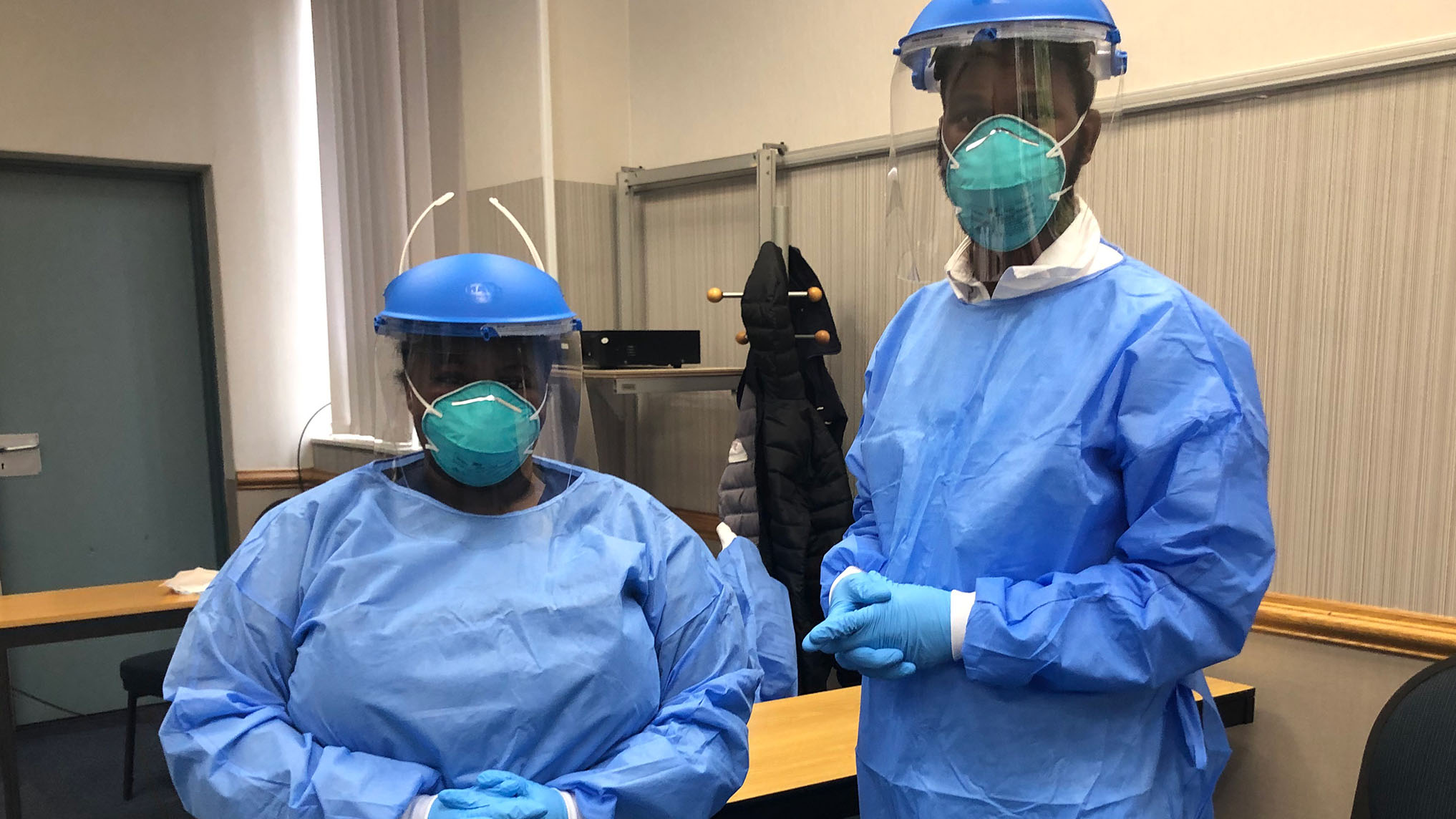
 Nurses at the converted pop-up testing centre at Edcon Training Centre in Johannesburg South. (Photo: Chanel Retief)
Every morning, Zithobile Cele heads from her flat in Hillbrow to her pick-up spot, gets into a newly kitted out mobile lab, belonging to the state’s National Health Laboratory Service (NHLS) and attends the Covid-19 frontlines while most of us are in lockdown at home.
“It’s a 10-minute walk. I go straight to the office and we collect our stuff off our list. We must have 100 swabs, four gowns, I need to check my equipment. Then when we reach there [the test site], we set up. I wear my gown. We put up a gazebo and people say ‘there’s the mobile clinic’. People admire us,” says Cele.
/file/dailymaverick/wp-content/uploads/ferial-cele-nurse-inset.jpg "‘I always say my God is there with me. Sometimes, we had no masks when we were doing TB testing,’ says Sister Zithobile Cele. (Photo: Chanel Retief)")
For somebody who works within spitting distance of the infectious virus, Cele is remarkably jovial and spirited. And also, excited. There is something of a mission in Cele I first noticed when the media was invited to see the mobile labs. It was a tense occasion when Health Minister Zweli Mkhize read the riot act to the NHLS, which was then too slow at rolling out mass testing.
Cele’s demeanour broke the ice as she showed Mkhize how the nurses in the mobile vans kitted up in gowns and masks to perform the swab test. It struck me that in all the big-game politics and positioning that is inevitable in a public health emergency, the frontline is being staffed by the best of us – ordinary people doing work in extraordinary times.
The day the virus could have jumped
The 28-year-old nurse was putting in the hours. Cele had spent the day in Stjwetla in Alexandra, Johannesburg where a cluster infection threatened to take Covid-19 from one South Africa (relatively wealthy, suburban living with access to private medical care), to the other South Africa (dirt poor, cheek-by-jowl township living and with access only to an already overwhelmed public health system). It would have been a disaster if the outbreak had turned from a small flame to a blazing fire, as Covid-19’s scientist-in-chief Salim Abdool Karim this week warned could happen at any time in South Africa where the fault lines of inequality are never far away.
Cele was among the frontline troops who quenched that fire, testing quickly at a level not seen before by a public lab. Gauteng MEC for Health Bandile Masuku told Daily Maverick that the Alex outbreak is now contained.
The first young man, who contracted the infection from his employer who had returned from abroad, and his contacts are in quarantine. I asked Cele if she had been scared. “Not at all. In Stjwetla, most people were nervous. They were asking me ‘what if I’m positive, people won’t want to come around me.’ How will I be isolated.’” Then she explains how she answers. “If there is no place, government will organise a place. It’s better to know than not to know.”
While HIV and the coronavirus are very different organisms, the stigma they carry upon infection is similar. Masuku said he was finding it difficult to get people who had recovered to become ambassadors to show people that Covid-19 is most often not a death sentence if caught early and managed well.
‘What about St. Augustines?’
It is probably the sight of the bodies in Spain, Italy and New York that are now a staple on television that has put the fear in us, but in South Africa, 27 people had died by 14 April 2020, lower than most countries in the world. “My mom is scared [her mother’s a retired nurse], especially after this thing at St. Augustines,” she says. In the cluster infection at the Netcare hospital in Durban, a whopping 47 health workers tested positive. Around the world, doctors and nurses have died.
“I was tested as a baseline and then tested again,” says Cele. “I always say my God is there with me. Sometimes, we had no masks when we were doing TB testing.” Cele qualified in KwaZulu-Natal in 2017 and registered in 2018, but says “I was a nurse since I was five [years old]. When I am at work, I feel I am fulfilling my purpose,” remembering how she played nurse since she was a little girl.
She worked in Durban before heading to the big smoke to work as an agency nurse. This freelance service is now much in demand as South Africa ramps up its mass testing drive to determine whether or not the viral curve is in fact flattening or whether the dual nature of the country is hiding a mass infection. South Africa now has the capacity and the kits to do over 20,000 tests a day and by 14 April, 87,000 tests had been done, a big jump on the previous week.
Getting tested
Most days, Cele is still testing in Alex, this time doing mass random testing. But when we met again, it was at the Gauteng government nerve centre where a mobile lab is set up for visitors who must be tested. It’s not yet a rapid test (a pin-prick antibody test), but still the World Health Organisation recommended a polymerase chain reaction test (PCR), with a 48-hour turnover for results. That’s being sped up.
“You explain to the person it will be irritating, but not painful,” Cele tells me. It’s very irritating and a bit painful, done with what looks like a giant ear-bud. “When we go through the mouth, it feels like you will vomit,” the nurse tells the testers.
“The scientists believe it makes home in the back of the throat or the mouth. It makes itself comfortable there and that’s why it feels like a sore throat.” It’s the best explanation I’ve heard in the flood of science-talk – Cele has a great chair-side manner.
Her training for the Covid-19 testing was rapid, she says, as the virus is moving so fast. “It’s not easy (she says about physical distancing), in shacks in Alex. I reinforce personal hygiene. I tell people ‘there are things you can do’ and I tell them ‘do it for your own good and for your children’.” But her chief equipment is not her swab, her mask or the welder-like helmet I later see her wearing as her PPE is upgraded through the days.
“Before I speak to you, I have a smile. A smile gives hope,” she says. In addition to a smile, she speaks five languages which makes her dexterous in multilingual South Africa. She is the Florence Nightingale of Hillbrow or a Charlotte Maxeke for the 21st century. DM/MC
The Frontline is a series of profiles from the frontline of Covid-19, the virus posing the greatest challenge to South Africa’s people, its health and its economy.