



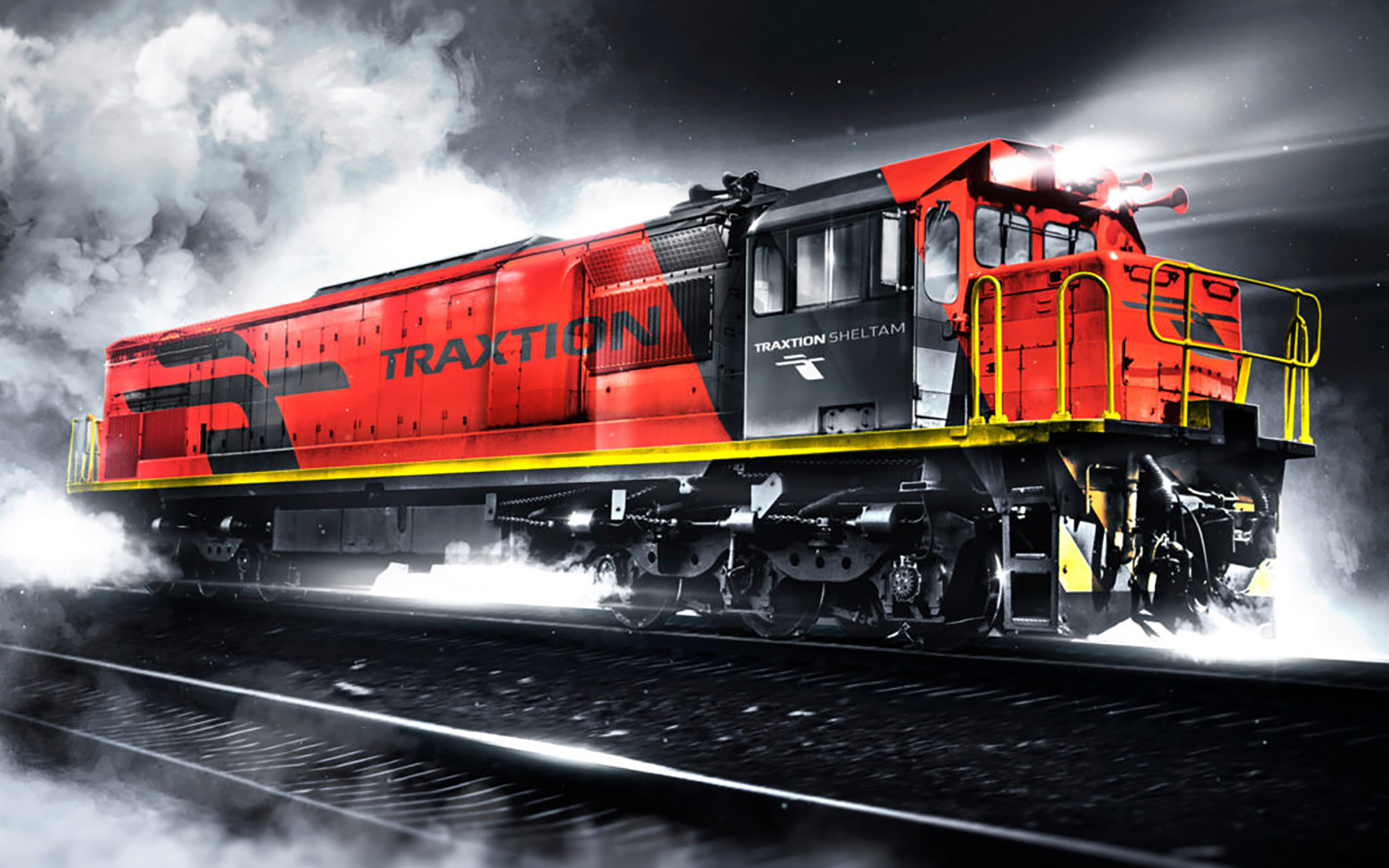
 Traxtion has pledged billions of rand to secure SA’s freight rail future. (Photo: Traxtion website)
It’s beginning to look a lot like Christmas for South Africa’s beleaguered freight rail sector. First came the big announcement of private participation, then the R15-billion government bond issuance to raise the capital to fix the infrastructure problem, and now more billions to get Transnet glistening once again.
But, by the admission of Traxtion CEO James Holley, it isn’t all tinsel and fairy lights. This is only the beginning of a new chapter that seemed shut for good in 2023.
Read more: Government cannot do it alone — a GNU proverb
Back then, under previous Transnet leadership, a pilot process known as “phase one slot sales” attempted to woo private players onto the tracks. It failed spectacularly. Holley told Daily Maverick exactly why that deal fell apart, describing the terms as “problematic” and the scope as “very limited”. The offer of a measly two-year access right was hardly enough to entice serious capital to the table.
Once bitten, twice shy
Traxtion had initially participated, in his words, merely to “establish the precedent of private trains operating in South Africa”, but the pilot was eventually cancelled by mutual agreement.
“It proved to be quite a complicated process,” Holley said, adding that it was ultimately “overtaken by the march of reform”.
And what a march it has been. Fast forward to late 2025, and the regulatory landscape had shifted enough to convince Holley to pull the trigger on a massive R3.4-billion investment plan (R1.8-billion for locomotives and R1.6-billion for wagons).
“This is going to be the biggest private investment in South African freight rail history,” Holley says. “We wouldn’t be making this investment if it wasn’t for the progress that has been made, that’s for sure.”
The “progress” he refers to is the structural separation of Transnet into an Infrastructure Manager (Trim) and a Freight Rail operator, a move designed to break the state-owned entity’s monopoly and create a level playing field.
Holley points to the Interim Rail Economic Regulatory Capacity as a game-changer, crediting the body with already having “significantly moderated the tariffs” and “lengthened the access rights to 10 years and more”.
Not a service provider
It is important to understand what Traxtion is actually buying here. It isn’t stepping in as a glorified subcontractor for Transnet.
“We are basically bringing private train sets to operate in the country... these will be trains that would provide private sector freight services for the first time,” He stresses. “We are not a service provider to Transnet.”
Read more: South Africa’s rail revival: new operators, old problems
Read more: Operation Vulindlela — a trillion-rand investment needed to achieve actual growth
This distinction is vital. It signals the start of genuine competition on the tracks, a shift that Transport Minister Barbara Creecy has placed at the centre of her strategy to fix the logistics crisis.
Creecy has been vocal about her target: 250 million tons of freight carried on the Transnet network by 2029. She has repeatedly stated that while strategic infrastructure will remain in public hands, “private sector investment is critical” to clawing back capacity.
How the Grinch read the network statement
However, despite the shiny R3.4-billion figure, Traxtion hasn’t actually applied for slots yet. The cheque is written, but the ink isn’t dry on the access agreement. Why? Because the rulebook governing the tracks, the Network Statement, still has some nasty clauses that need ironing out.
Holley identified four critical areas in the current draft agreement that are keeping the cork in the champagne bottle:
- Service levels: There’s a lack of commitment from the Transnet Rail Infrastructure Manager on service delivery.
- Penalties: The current penalty regime is “completely one-sided” and “extremely onerous” on private operators, with no reciprocal penalties for Transnet if the infrastructure fails.
- Legal protections: The general legal balance of the contract is skewed.
- Lender rights: Crucially, the agreement doesn’t currently recognise lender rights, which makes raising finance off the back of the contract nearly impossible.
Holley expects the regulator and Transnet to address these in the next iteration of the Network Statement. It’s a high-stakes regulatory compact. Just as a ship cannot sail unless the navigational charts are accurate, Traxtion cannot deploy its fleet until the rules of the rail are proven bankable.
The stakes for SA Inc.
If these wrinkles can be ironed out, and with Creecy pushing for the first Request for Proposals by later this month, the economic upside is massive. Holley says that while their initial fleet will only service about 5% of the country’s rail freight shortfall (estimated at a demand of 250 million tons versus Transnet’s current 160 million), it proves the concept.
“An economy stands on the back of its network industries.”
If the rails work, the economy moves. For now, Traxtion is betting billions that Creecy and the new Transnet leadership can finally get the signals to turn green. DM