



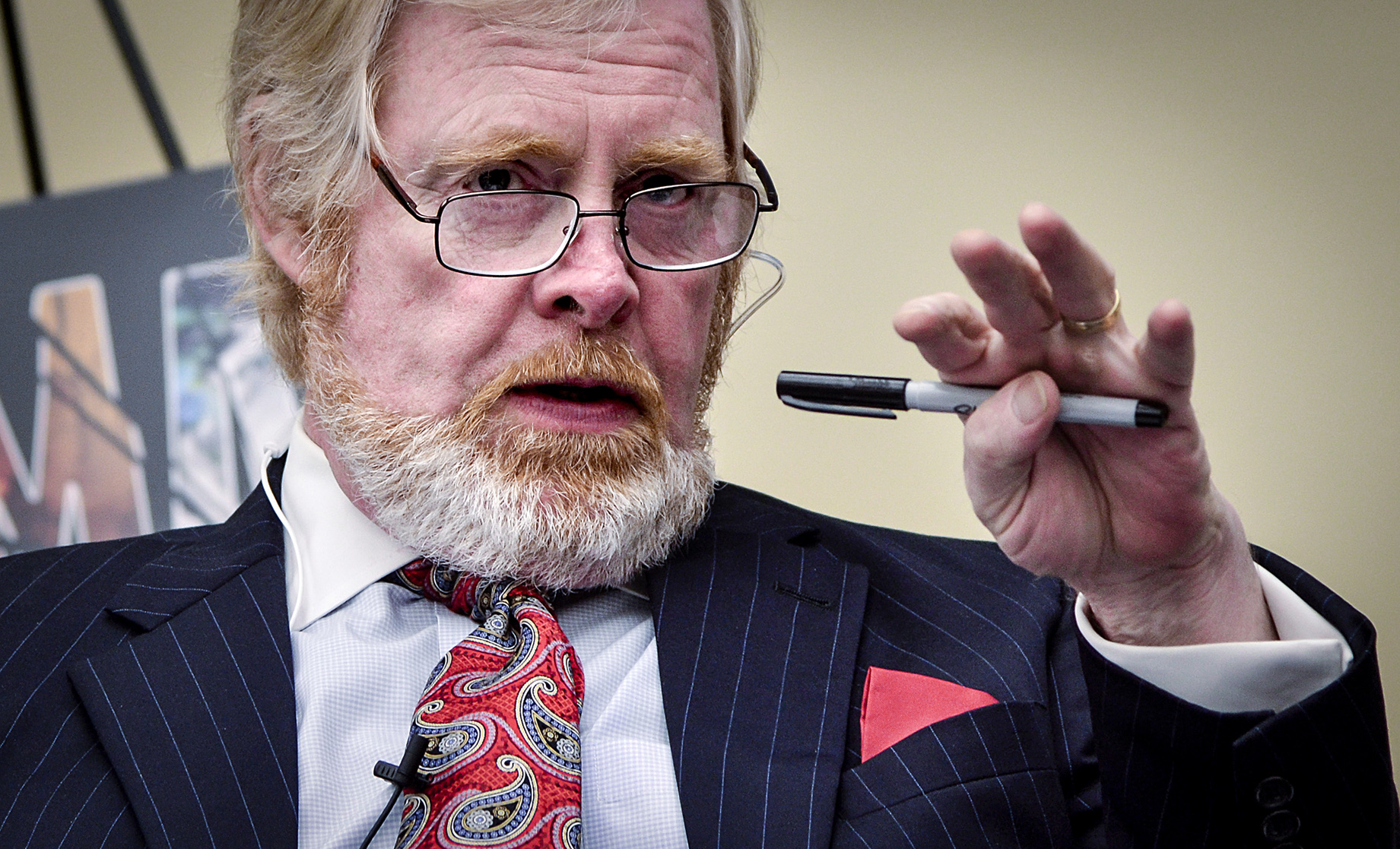
 Leo Brent Bozell III, US President Donald Trump’s ambassador-designate to South Africa. (Photo: Kris Connor / Getty Images)
/file/dailymaverick/wp-content/uploads/2025/10/label-analysis-2.jpg)
In recent statements, South Africa’s Minister of International Relations and Cooperation Ronald Lamola has expressed sharp critiques of American positions ambassador-designate L Brent Bozell III had stressed were his on his call sheet in his Senate Foreign Relations Committee confirmation hearings, as well as criticism of the recent arrest by US forces of Venezuelan leader Nicolas Maduro.
While Lamola did not specifically voice opposition to Bozell’s assignment to Pretoria, City Press reported that he was “carefully considering the credentials of the new US ambassador-designate”. He told the publication, “Credentials will be presented, the process will be followed, and at that time, the President will make a decision.”
After Bozell was confirmed by the US Senate and took his oath of office last week, some South Africans are arguing that the new American ambassador’s credentials, which would allow him to take up his posting in Pretoria, should not be accepted by the South African government.
Are opponents of Bozell’s assignment to Pretoria acting out of principle — or is this more a convenient target for expressing anger at American criticisms of South African government policies, such as its pursuit of a genocide case at the International Court of Justice?
In sync with Trump
Yes, it is true that Bozell clearly was no supporter of South African liberation organisations that advocated bringing the old regime to an end. He put such views in writing in the 1980s. But his stance was not unique.
Others in positions of authority also labelled those groups as “terrorists”. Some supported the Inkatha Freedom Party as the best avenue for change, others backed some kind of cantonal system to protect group rights, and some argued for qualified support for the National Party’s continued rule, arguing its actions could be ameliorated through a policy of “constructive engagement”.
Things change, people change, just as they should. Bozell has not been nominated to be ambassador to the old regime, but rather to the one that exists in the here and now.
What Bozell’s critics should appreciate is that one of an American president’s constitutional powers, subject to nominees’ confirmations by the Senate, is to appoint his country’s representatives to other nations.
Read more: South Africa’s Maduro dilemma — when principles meet pragmatism
At least from the beginning of the 20th century, presidents usually have appointed a majority of their ambassadors from among the pool of senior career diplomats, although many of the most prestigious positions — such as to London, Moscow, Berlin, Paris, Rome, Beijing and Tokyo — go to political appointees who were political supporters of the incumbent president and — often — were substantial contributors to their election or re-election campaigns.
It is true that many of these individuals were successes in their previous work, but sometimes turned out to be less than distinguished as senior diplomatic representatives. Nevertheless, there have also been political appointees who have had serious policy and academic chops and who have been able to make real contributions to nurturing the bilateral relationships they worked on.
/file/attachments/2660/612128799_1289614076534854_6091426123527834443_n_115345_880866.jpg "Leo Brent Bozell III, US President Donald Trump’s ambassador-designate to South Africa, was sworn in by Senator Ted Cruz on Friday, 9 January 2025. (Photo: Supplied / US Embassy South Africa)")
But the key for all appointees is that they must be in sync with the policy goals and objectives of the president who appointed them. Otherwise, why would they have been selected in the first place?
While it might be popular here among some, it must be understood that someone like the Rev Jesse Jackson will never become Donald Trump’s nominee to be ambassador to South Africa. And that is the reality of things.
In fact, the incoming US ambassador, given his conservative political views and well-known proclivities to criticise American media for presumed left-wing biases, fits with many of the rhetorical and policy stances the president takes.
Read more: Leo Brent Bozell III — who is the US’s new ambassador to SA?
Real consequences
South Africa’s refusal to accept this ambassadorial appointment would certainly intensify the current US administration’s antagonisms towards South Africa. It would result in more than just harsh memos.
It will lead to further punitive tariff regimens and exclusion from any renewal of the Agoa duty-free export window — if that measure passes Congress and is signed by the president. It will also give impetus to congressional action towards a total review of the bilateral relationship, measures already being considered in both houses of the US Congress.
Read more: US House backs Agoa extension, but SA’s continued participation remains uncertain
There would probably be public pressure on US businesses operating in South Africa to lessen their presence, and there will be threats of cutbacks to US government programmes operating in South Africa, such as educational exchanges and any remaining cooperation in health and medicine. Not good outcomes.
From my chair, it seems that rather than a collective harping about Bozell’s past, it will be more useful to accept him as the US’s new ambassador, but make use of his presence in South Africa to find areas where the US and South Africa may again find common ground. And, even, help find areas where his voice might add to the admittedly small quanta of factual understanding among American officials in Washington about South Africa and its policies.
Opportunity for dialogue
Among an ambassador’s core tasks (as with all diplomats) is the need to listen carefully and observe closely the views and ideas of their interlocutors in government and beyond. Equally, their responsibility is to fully and accurately convey the views and positions of their home office to host government officials so that there should be no misunderstandings.
Ambassadors are not supposed to be freelancers who advance their own ideas, absent congruence with their home office. We should assume that Bozell, as the new American ambassador, will be articulating his government’s positions, even as he and his staff pay attention to the ideas of the people he interacts with in the course of his work.
(It is here where South Africa’s former ambassador to the US, Ebrahim Rasool, came a cropper when he voiced his own opinion, in a webinar heard internationally, that the US president was deliberately pursuing a white supremacist agenda.)
Because Bozell has been a player in the right-wing media world for decades, he is a pro in dealing with the media. Consequently, he should be encouraged to accept opportunities to be interviewed by South Africa’s media and to have his views accurately portrayed in the resulting reporting or broadcasts.
Of course, his statements must be interrogated carefully, and he should be pushed to furnish evidence on any claims he makes. But he should be allowed, no, he should be encouraged, to be a frequent voice in the media as he defends his president and his nation’s policies and positions and be subject to serious responses.
From such interactions, the content from those discussions will filter back to Washington through the embassy’s own reporting of the ambassador’s media engagements. And so it will be crucial that journalists who engage him are thoroughly prepared with information to challenge his preconceptions or misunderstandings.
Modifying perceptions
Reporters must do these tasks, but the rest of South Africa must play their part as well. The new ambassador must be invited to observe all manner of discussions, debates, projects, activities, successes (and even the failures) of government and private enterprise in improving the lives of South Africans.
It is too easy for an ambassador to become a prisoner of a golden cage, gliding from one protocol-heavy ceremony, reception and cocktail party to the next. That is the responsibility of an embassy staff, but it is also a task for the surrounding community to move an ambassador beyond such circumstances. This is particularly true for a political appointee who easily could be consumed by the cocktail party circuit.
Speaking personally, I would look forward to an early opportunity to engage with him, on the record, for this publication, giving him the opportunity to state his case freely, but also to make sure he is challenged where facts do not mesh with Washington’s rhetoric.
And in all this, a conscientious ambassador can do one of the most important tasks of all — adjusting and refining a home office’s perceptions of events and opinions in the country where they have been assigned to serve. In tandem with that, the embassy’s top officer must ensure the staff carries out careful, assiduously accurate reporting on the country’s politics, society and economy — its successes as well as its challenges.
The challenges for an ambassador in the age of Trump, serving such a mercurial president, are very real. But here in South Africa, where there is much relationship rebuilding to be accomplished, the rewards could also be real. DM