



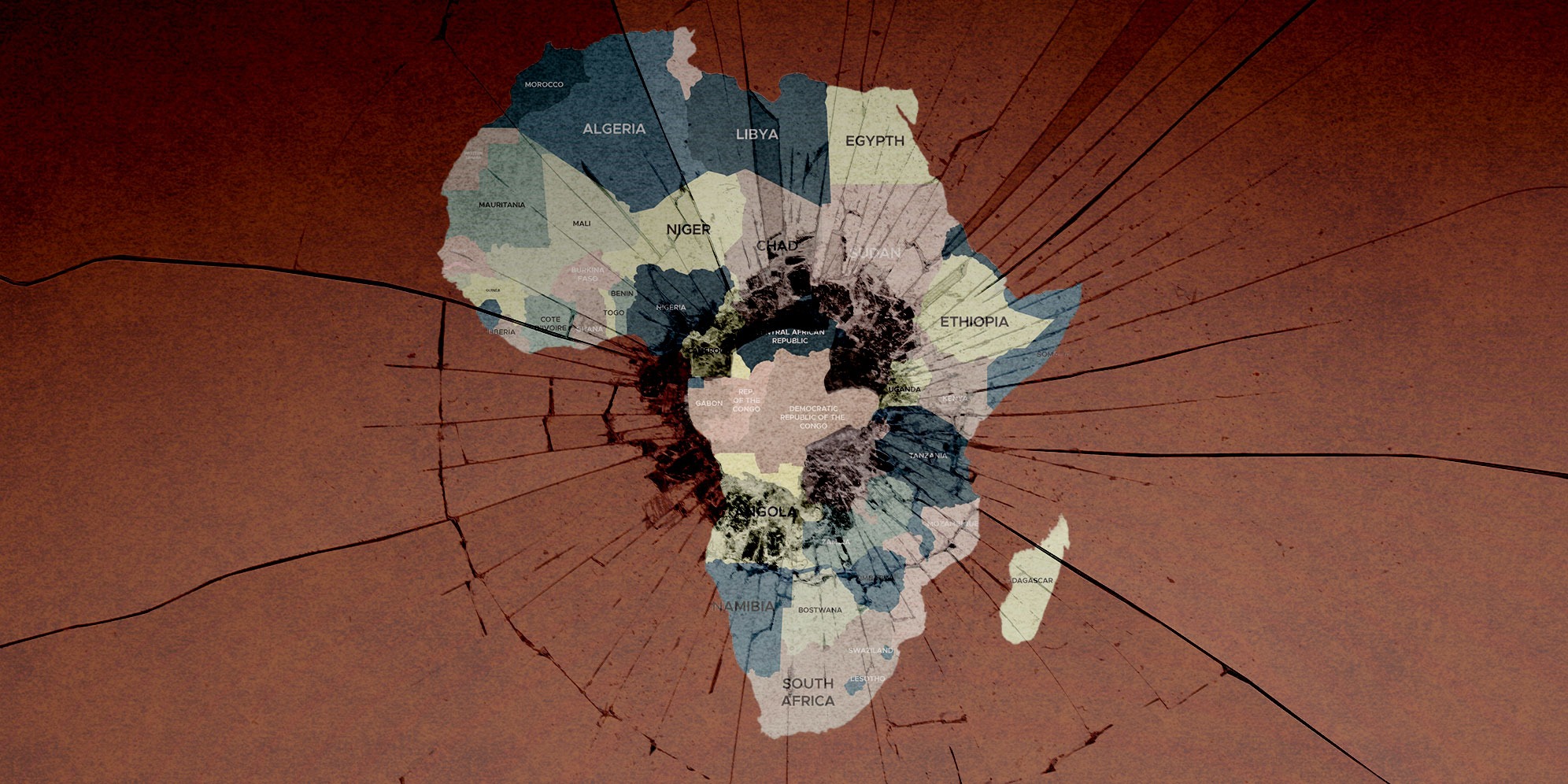
 Illustrative Image: African continent. (Image: Freepik) | Cracked glass. (Image: Freepik) | (By Daniella Lee Ming Yesca)
/file/dailymaverick/wp-content/uploads/2025/10/label-Op-Ed.jpg)
Africa is today the world’s primary epicentre of terrorism. That is not a slogan, nor is it a rhetorical exaggeration. It is a statistical, political and moral reality, one that should trouble us far more deeply than it does.
What is often missed in public debate, however, is that violent extremism on the continent is not fundamentally an ideological problem. It is a governance problem. Terrorism in Africa is not born primarily from theology; it grows out of absence of the state, of services, of justice and of legitimacy.
Recent expert deliberations on terrorism and violent extremism in Africa paint a bleak but clarifying picture. Fatalities linked to extremist attacks have surged dramatically over the past few years, with tens of thousands of lives lost. Even in periods where deaths dip marginally, the number of attacks continues to rise relentlessly. This is not episodic violence. It is entrenched, expanding and becoming structurally embedded in parts of the continent.
The Sahel, particularly Mali, Niger and Burkina Faso, has emerged as the most affected region in the world. Somalia remains locked in a long-running insurgency, despite decades of international intervention. The Lake Chad Basin continues to bleed. Northern Mozambique has become a new front. And across these geographies, civilians are increasingly the primary victims.
On average, more than 40 Africans die every day as a result of extremist violence. That figure alone should end any complacency.
Theatre of opportunity
How did Africa become the new centre of gravity for global extremism? Part of the answer lies outside the continent. As extremist groups were weakened in the Middle East through sustained military pressure, they adapted. They relocated. They followed the path of least resistance. Africa, with its vast ungoverned spaces, fragile institutions and chronic governance failures, became the new theatre of opportunity for these extremists.
But to stop there would be to absolve African states of responsibility. Extremist groups do not thrive simply because they arrive. They thrive because they are allowed to take root.
Where the state is absent, extremists govern. Where courts do not function, they dispense “justice”. Where police abuse communities, they offer “protection”. Where services do not exist, they impose order. Brutal, coercive order, but order nonetheless.
This is an uncomfortable truth. Many communities living under extremist control do not support these groups ideologically. They tolerate them out of necessity. Survival, not belief, explains much of extremist endurance.
Grievance is the gateway. Radicalisation begins not with doctrine, but with lived frustration, unresolved land disputes, unemployment, corruption, insecurity and abuse by state or foreign forces. When governments respond to these conditions with indiscriminate military force, they often deepen the problem they are trying to solve. Civilian casualties, especially when they are poorly investigated or denied, push communities closer to militant actors.
The over-militarisation of counterterrorism in Africa has therefore become part of the problem, because despite massive expenditure on security operations, extremist groups continue to multiply. Moreover, external military partners, whether they be Western or Russian, frequently prioritise tactical success over civilian protection, resulting in devastating consequences for public trust.
And so, terrorism in Africa cannot be defeated by guns alone. Security operations may be necessary, but they are never sufficient. Without governance reform, they merely suppress symptoms while allowing causes to fester.
The Ghana option
There is, however, an important counter-example, one that deserves far more attention.
Ghana is surrounded by countries battling violent extremism. Yet it has, thus far, remained largely resilient. This is not because it is immune, nor because it is lucky. It is because it has invested, consciously and consistently, in legitimacy.
Democratic governance, interfaith dialogue, ethnic and cultural inclusion, a vibrant civil society, proactive early warning systems and an open information environment have together created social buffers against extremist penetration. Grievances surface through civic channels, not armed movements. Trust in institutions, while imperfect, remains intact enough to deny extremists the space they need to operate.
Ghana demonstrates that extremism is not inevitable. It is conditional.
The lesson for Africa is therefore not primarily about better weapons or more troops. It is about rebuilding the social contract. It is about restoring the credibility of the state in the eyes of its citizens. It is about presence, schools, clinics, courts, police who protect rather than prey.
Countering violent extremism must be reframed as a governance renewal project. This means investing in accountable institutions, empowering civil society as an early warning system, institutionalising interfaith and intercultural dialogue, protecting media freedom and addressing structural exclusion. It means regional cooperation that goes beyond border security to shared political solutions.
Most importantly, it requires humility: the recognition that legitimacy cannot be imposed at gunpoint.
Africa’s terrorism crisis is not a failure of courage. It is a failure of governance. And until that reality is fully confronted, the violence will continue to migrate, mutate and deepen, claiming lives not because extremism is strong, but because states are weak.
That is the uncomfortable truth we must now face. DM
Odile Bulten coordinates the Africa Think-Tank Dialogue (ATD) and Daryl Swanepoel is the Chief Executive Officer of the Inclusive Society Institute, which serves as the ATD’s secretariat. This article draws from the ATD dialogue on security and extremism in Africa.