



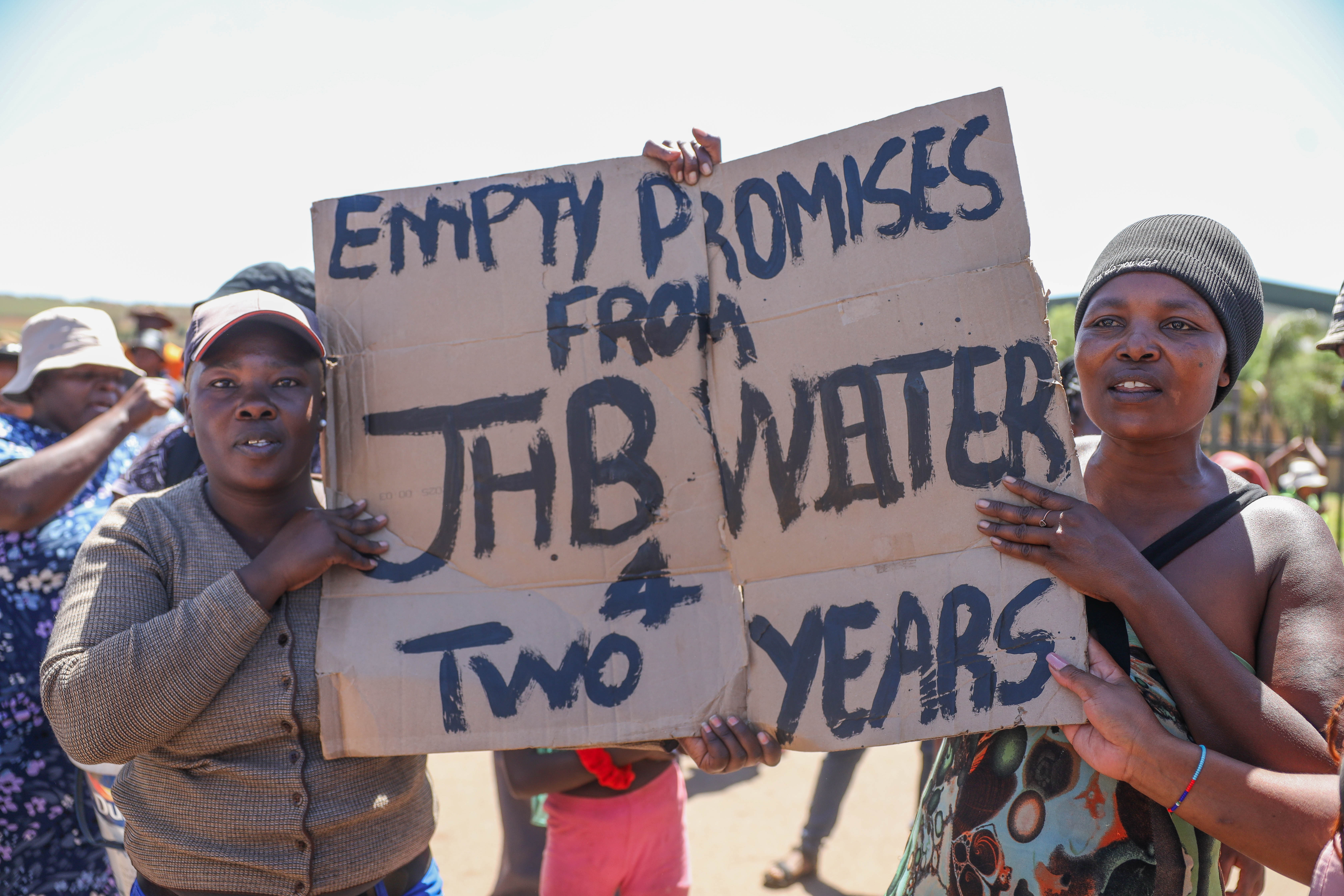
 Phumlamqashi residents during a protest against water cuts in Lenasia South on 2 December 2024. The protests followed a Johannesburg Water operation to disconnect illegal water connections. (Photo: Gallo Images / Sharon Seretlo).
Despite fierce community resistance, on 13 November 2024, Johannesburg Water officials disconnected illegal water links to communal taps in Phumlamqashi informal settlement near Lenasia in Johannesburg South. The pipes were sealed.
For over six years, residents had relied on those connections. Since the cut-off, they have turned to wheelbarrows, hired cars and the kindness of strangers in Vlakfontein Extension 3 and Lenasia South to get water.
Johannesburg Water sent trucks after a violent water strike in the area, but the water trucks are not delivering water because the contractor has not been paid. Daily Maverick asked Johannesburg Water on Thursday, 11 November, why the contractor was not paid and when they will be paid so that they can resume delivery of water to Phumlamqashi, but Johannesburg Water had not answered this particular question six days later, by the time of publication on Tuesday, 16 November.
“Even today, there is no water in Phumlamqashi,” said community leader Degreat Makhubele. “The tanks are empty. The trucks are parked. The contractor has said no payment, no water delivery.”
More than 35,000 residents are affected. Meetings with Region D officials, ward councillors, the mayor’s office, the premier’s office and Johannesburg Water have not yielded any positives.
“We are still fighting,” Makhubele said. “But it’s been unfruitful.”
The community’s only water source is a local hardware store, where the queues are too long and only a small number get water. Residents said they do not pay for the water.
/file/dailymaverick/wp-content/uploads/2024/11/DSC_0081.jpg "Johannesburg Water workers sever illegal water connections in Phumlamqashi informal settlement. (Photo: Julia Evans)")
“We can’t afford to keep hiring transport to fetch water,” said Noma Mokwena, a single mother. “It’s not sustainable. Our children had to go to school without bathing. Now schools are closed, but the taps are still dry.”
Phumlamqashi, like many informal settlements, is already burdened by poverty, unemployment and neglect. The water crisis has turned survival into a daily struggle.
And still, the water trucks remain parked. Full of potential but empty of promise and purpose.
Residents now whisper what officials seem to fear, another big protest…
Phumlamqashi residents have not reconnected illegally to the communal water supply after the pipes were repaired and the area sealed.
eMdeni and security concerns
An operation to disconnect illegal water connections in eMdeni, Soweto, scheduled for 15 November 2024, was shelved officially because of security concerns. Johannesburg Water cited the underwhelming turnout of the Johannesburg Metro Police Department (JMPD) officers as the reason for cancellation of that operation.
Daily Maverick has since established that this operation was likely abandoned.
“I’m not aware of a place that was disconnected at eMdeni. The only operation relating to Johannesburg water, is the ablution facility they are currently installing in Naledi near eMdeni,” ward councillor Nduduzo Mzolo said.
Daily Maverick visited one of the houses that was disconnected on Mokwena Street in eMdeni. Residents in the area told Daily Maverick that they were forced to connect illegally because Johannesburg Water teams were incompetent.
One of the occupants of a house that had been disconnected said he had no choice but to connect illegally because he still can’t afford to pay.
“When you report it, Johannesburg Water responds very late or never does. What else can I do because I need water,” the occupant, who begged to remain anonymous, said.
Historical deprivation
According to residents, one of the drivers of illegal water connections is historical deprivation. Since the establishment of Phumlamqashi in 2017, there has never been formal water reticulation and residents have had to fend for themselves.
“For this reason, penalties for illegal connections cannot be applied, as such measures are only enforced in formalised areas where rates and taxes accounts are linked to a registered erf or stand,” Johannesburg Water spokesperson Puleng Mopeli said.
“Penalising illegal connections in such areas is legally untenable,” Mopeli said. She added that enforcement measures apply only in formalised zones where properties are registered and linked to municipal accounts.
Shoddy work and miscommunication
But historical deprivation is only part of the story. Residents also point to shoddy workmanship and a chronic lack of communication as catalysts for the growing crisis of illegal connections.
“The cost of water isn’t the issue; water is affordable,” said Vhengani Munyayi, a Soweto resident. “I pay monthly. The real problem is communication. Most people wouldn’t hesitate to pay R100, which is roughly what I pay monthly, unless they truly cannot afford it. And even then, indigent households receive free electricity. If Johannesburg Water communicated better, more people would know they’re entitled to 6,000 litres of free water each month.”
Munyayi added: “No one dodges such a small fee on purpose. But when the water teams don’t engage or explain, people are left in the dark and that’s when illegal connections happen.”
In eMdeni, Siyabonga Zwane described a pattern of incomplete work and inertia. “They (Johannesburg Water) install meters but don’t activate them. And when they do activate them, you cannot credit your account. It takes ages to get a response from Johannesburg Water, if any at all.”
Zwane warned that the city is bleeding revenue. “Billions are lost because of half-done jobs. When residents report issues and nothing happens, they’re pushed to connect illegally. It’s not defiance but desperation,” Zwane said
Resistance
Mopeli said that Johannesburg Water continues to encounter resistance in many communities where disconnections are conducted. “To ensure the safety of our teams and the effectiveness of these operations, we undertake all disconnection activities in collaboration with the JMPD, the South African Police Service (SAPS), and contracted private security providers.”
Mopeli said while operations usually proceed despite opposition, they are halted only when law enforcement authorities determine that conditions have become unsafe.
In Phumlamqashi, officials, law enforcement officers and private security faced strong resistance.
Generalising the issue
“They must stop generalising and treating everything as a blanket issue,” Munyayi said. “They must stop using a general approach. People who are paying for water must be clearly exempted and not suffer with those that do not pay. Generalising is a problem.”
Munyayi added: “Even with the indigent free water provision, the Department of Social Development must communicate with Johannesburg Water.”
Mopeli said that on-site inspectors carry out daily monitoring of supply and demand to address any operational issues, and regular engagements continue with the ward councillor and committee. “To date, the community of Phumlamqashi have not attempted to reinstate any illegal connections,” she said.
Any customers found to have connected, or subsequently reconnected, to the water supply without authorisation will be subject to immediate disconnection, she said.
“Where circumstances warrant, additional penalties and charges will be applied in accordance with the relevant municipal by-laws and regulatory frameworks.
Dr Ferrial Adam, executive manager of non-profit WaterCan, said Johannesburg Water can disconnect, “but they must provide an alternative supply because water is a basic right“.
Dr Adam said the City of Johannesburg must accept a portion of the blame because it holds the purse strings. She said the whole council must own up to the water crisis in the city.
As of 30 November, Johannesburg owed about R690-million to contractors.
“As a result of that, water trucks are not supplying water to communities, especially informal settlements, and so people do not have access to water,” Dr Adam said.
“We are all pointing fingers at Johannesburg Water, but it’s all of them. Johannesburg Water, the mayor, the City of Johannesburg and council need to account for what is going on,” Dr Adam said. “I wasn’t aware of the situation in Phulamqashi, but the fact that [residents] travel so far to get water is unacceptable and someone must be held accountable for this.”
“What has come out from these residents you have been speaking to is dysfunction in our city,” Dr Adam said.
Insufficient budget
Johannesburg Water claims it does not have enough budget to cover maintenance, capital expenditure and fixing leaks.
For at least two years now, WaterCan has been sounding the alarm, urging the city to ringfence funds for water and sanitation as it continues to bleed millions in revenue.
Dr Adam said civil society oversight is required. She said the priority is to deal with water leaks.
“We know that non-revenue water is now sitting at about 44 or 45%. Of that, about 26% is direct water leaks and the rest of it is non-billable water and theft,” she said.
Dr Adam added: “You are targeting the vulnerable because you can, but not those who are defaulting in affluent areas.” DM