



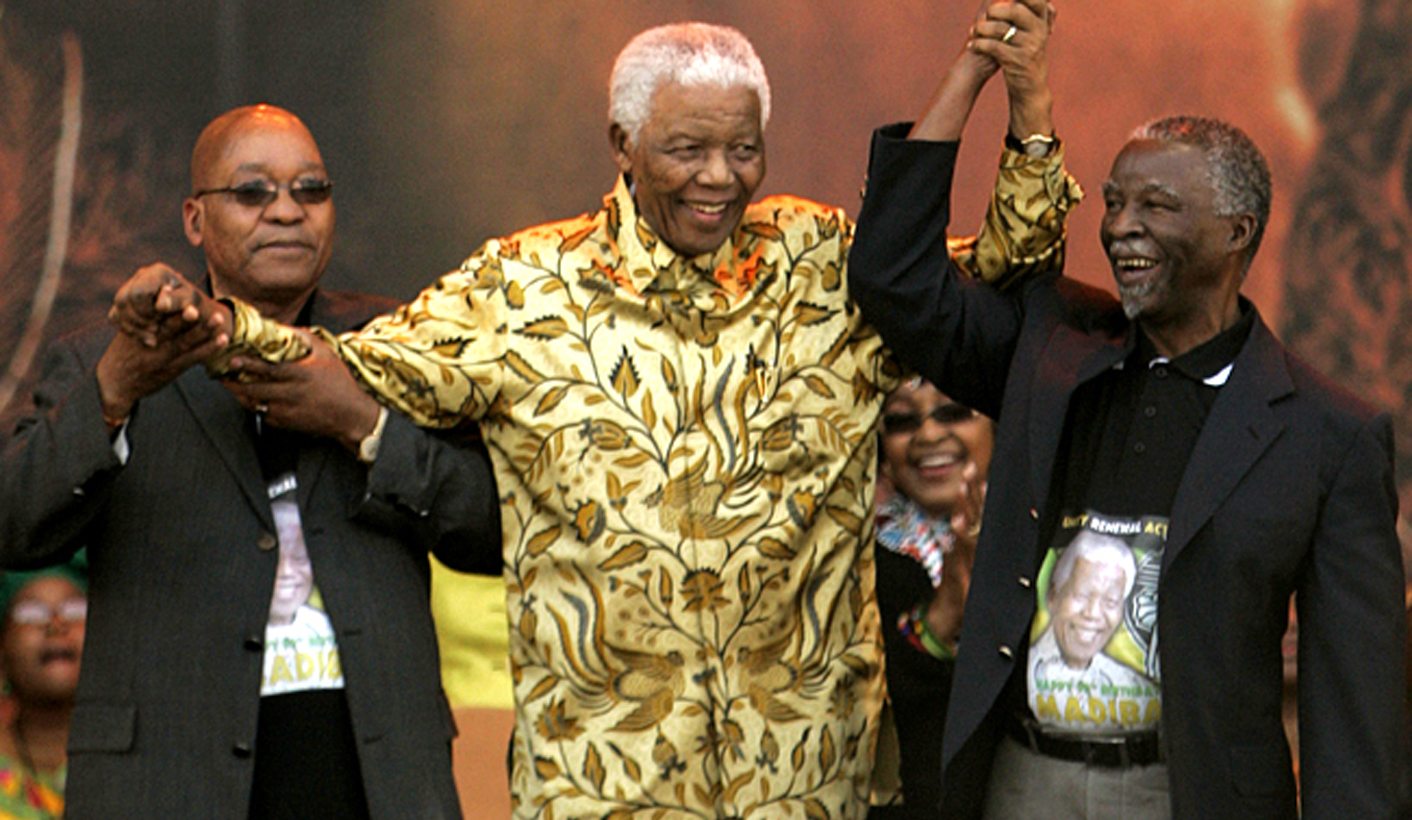
 Former president Nelson Mandela (centre) arrives with then ANC president Jacob Zuma (left) and then South African president Thabo Mbeki at Loftus Versfeld Stadium in Pretoria for a rally organised by the ANC to celebrate Mandela’s 90th birthday on 2 August 2008. (Photo: Reuters / Siphiwe Sibeko)
 South Africa in the early and late 1990s was a place consumed not only by simmering violence, but also by an urgent mission to set a course for a new country. Before the ship could leave harbour, however, past atrocities and human rights violations had to be acknowledged.
It was the country’s first democratic president, Nelson Mandela, who, in an attempt to calm the heated political transitional temperature, expressed the government’s commitment to “national reconciliation” and “nation-building’, a position many younger South Africans have criticised and find politically kitsch.
Today, many South Africans view this era as a time of broken promises and betrayed ideals. But those at the centre of this pivotal moment in our history had many balls to juggle.
Here are Mbeki and Zuma’s responses, drawn from the Rule 3.3 court documents in the Calata and others vs the South African government and others.
Mbeki’s view
Mbeki’s argument on TRC cases is centred on Mandela’s guiding vision of nation-building and reconciliation in the aftermath of years of violence, struggle and bloodshed.
When tabling the final TRC report in 2003, Mbeki had argued that the state had to balance the need for legal accountability against the imperatives of managing the transition to democracy.
He stated there would be no general amnesty, as such an approach would have flown in the face of the TRC process and the principle of accountability.
However, he emphasised that many participants in the past conflict had not taken part in the TRC due to “calculated risks or misleading leadership”, and that this reality could not be avoided.
Mbeki had proposed that while “normal legal processes” would apply, the state would work with intelligence agencies to enable those who still wished to speak the truth to enter into “standard arrangements” within the execution of justice.
In his reply, the former president explicitly denied any executive interference in the work of the National Prosecuting Authority (NPA) or that it had prevented prosecutors from pursuing TRC-related cases.
/file/dailymaverick/wp-content/uploads/2021/10/ED_0006620.jpg "Chair of the Truth and Reconciliation Commission Archbishop Desmond Tutu (centre right) and vice chair Alex Boraine (centre left) at the first TRC hearing in East London in 1996. (Photo: Gallo Images / Oryx Media Archive)")
Principal architect
Mbeki added that the ANC had been the “principal architect” of the Constitution and that his government had always acted with the knowledge that constitutional prescripts were binding.
He further claimed that no minister of justice had ever been authorised to instruct a National Director of Public Prosecutions (NDPP) on specific cases.
He also said no NDPP, including Vusi Pikoli, had ever approached him to complain that they had been instructed by a minister or official to violate their independence.
Claims of “executive interference” were a “pure fabrication”, said Mbeki, used as a “fig leaf” to hide “institutional failure”.
Mbeki stated that the failure to investigate and prosecute the TRC cases rested entirely with the NPA and not the executive.
/file/dailymaverick/wp-content/uploads/2025/04/0000119117.jpg "Former South African police chief Jackie Selebi. (Photo: Felix Dlangamandla / Foto24 / Gallo Images)")
He had publicly questioned Pikoli’s commitment to the principle, asking why he had allegedly “acquiesced” to members of the executive on TRC matters when he had defied him (Mbeki) over former National Police Commissioner Jackie Selebi’s corruption case.
Mbeki contended that the NPA should apologise to the victims for its own inaction rather than “propagating falsehoods” regarding political pressure.
Pardons
The former president justified his 2007 Special Dispensation on Political Pardons as a necessary means to resolve the “unfinished business” of the TRC.
He also argued that this process was consistent with his constitutional obligation to consider pardon requests from those convicted of offences that would have qualified for TRC amnesty.
He viewed this as “a tool for national cohesion and a further break from the conflicts of the past”.
While Mbeki publicly advocated for legal processes, Major General Dirk Marais, former deputy chief of the army, has claimed that during secret talks with the generals, Mbeki’s objective was “quid pro quo”.
Marais claimed Mbeki had stated “they don’t want us to be charged – and they don’t want them to be charged”.
Jacob Zuma’s view
Zuma’s argument on TRC cases claims the same “national interests” defence as Mbeki, as well as the need at the time for a political solution over a legal one.
During the high-level, secret deliberations with former apartheid-era generals that began in 1998, Zuma explicitly stated that criminal prosecutions were “not in the interest of the government”.
He argued that pursuing trials for past atrocities would be counter-productive to the progress of nation-building and reconciliation, as “such trials would constantly revisit the bitterness of the past”.
Consequently, he said he had advocated for a “mutual indemnity mechanism” – an arrangement between the government and former security forces to avoid trials after the conclusion of the TRC process.
KwaZulu-Natal context
Zuma’s role in the volatile political situation in KwaZulu-Natal during the late 1990s formed part of his strategy in these talks.
Having successfully mediated between ANC and IFP factions, he noted that he had viewed the question of accountability for political crimes as “a critical” issue that required a political solution, to prevent fresh outbreaks of violence.
He had believed that a purely legal or prosecutorial approach by the National Prosecuting Authority (NPA) would undermine the peace and appeasement efforts in that region.
TRC suspicions
Zuma also expressed significant scepticism of the TRC, characterising it as “staged”.
He questioned the efficacy of the commission, questioning why numerous cases were left “rotting” rather than being resolved through the transition.
/file/dailymaverick/wp-content/uploads/2021/07/ED_0006942.jpg "TRC chair Archbishop Desmond Tutu shakes the hand of President FW de Klerk at the commission hearings at the Good Hope Centre, Cape Town, in 1997. (Photo: Gallo Images / Oryx Media Archive)")
Zuma was part of a group of 37 high-ranking ANC leaders whose collective amnesty application was rejected by the TRC in 1999 because it failed to disclose specific individual acts.
In 2010, then president Zuma actively joined legal efforts to overturn an interdict that had stopped the Special Dispensation on Political Pardons.
He argued that the head of state should have the power to grant pardons for politically motivated crimes to complete the “unfinished business” of the TRC. DM