




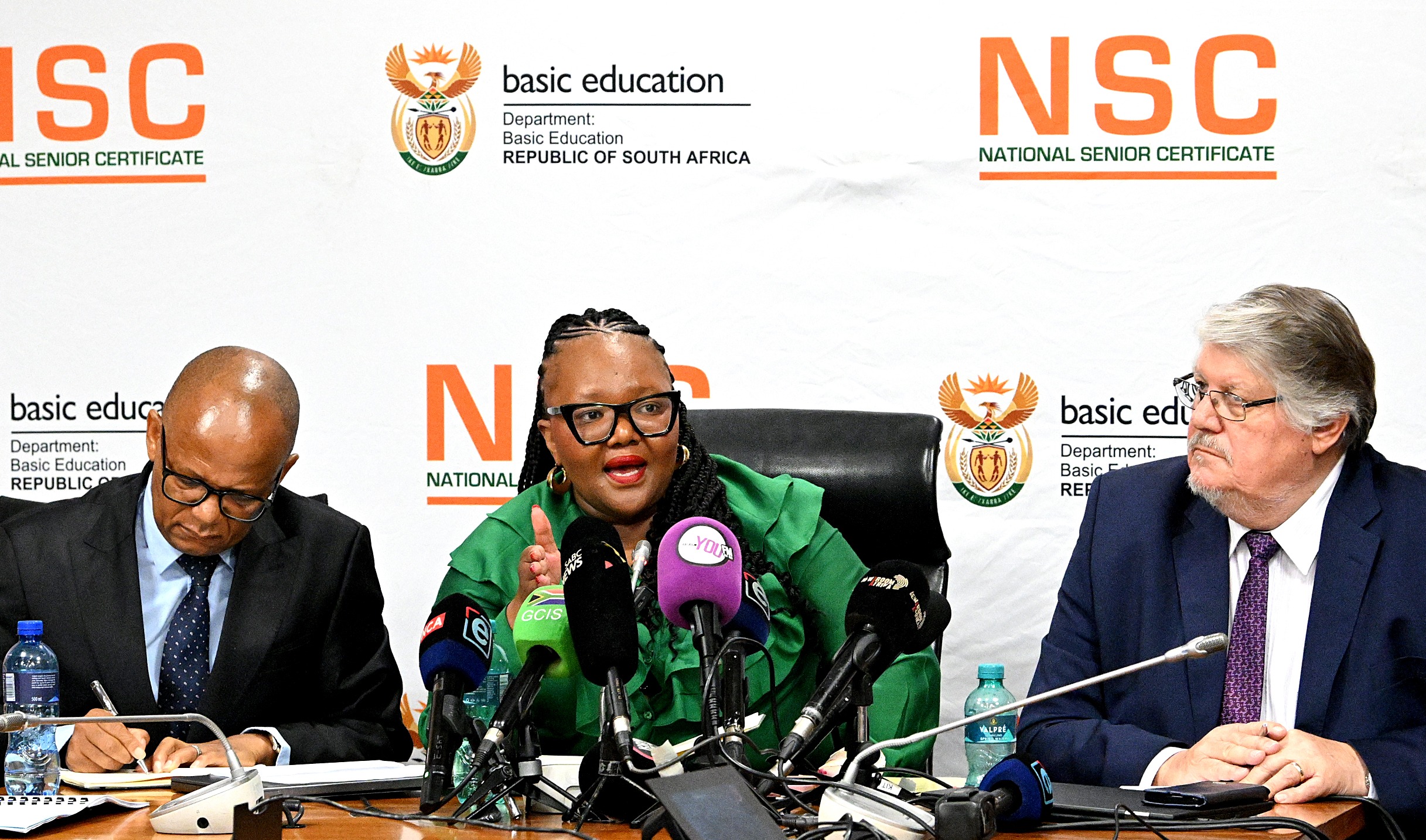
 Minister Siviwe Gwarube is flanked by Prof Chika Sehoole and Brian Schreuder briefs the media to formally release the findings of the Interim Report of the National Investigative Task Team into the 2025 examination breach at Department of Basic Education (DBE) Auditorium on January 09, 2026 in Pretoria, South Africa. The briefing forms part of the Department’s commitment to transparency, accountability, and the protection of the integrity and credibility of the National Senior Certificate (NSC) examinations. (Photo: Gallo Images / Lefty Shivambu)
The Minister of Basic Education, Siviwe Gwarube, has assured the public that the 2025 National Senior Certificate (NSC) exams remain credible despite a detected security breach involving leaked exam papers.
Gwarube was speaking at a media briefing in Pretoria on Friday, 9 January 2025, following the National Investigative Task Team’s (NITT) presentation of interim findings on the breach to the Department of Basic Education (DBE) and Umalusi.
“Let me reiterate, we will not compromise the future of thousands of honest learners because of the actions of a few. We will not leave any stone unturned in ensuring accountability and safeguarding the credibility of the NSC certificate,” said Gwarube.
The breach, revealed by Gwarube in December, involved pupils at seven Pretoria schools accessing papers for English Home Language (papers 1, 2, and 3), Mathematics (papers 1 and 2) and Physical Science (papers 1 and 2) before the exams.
Gwarube said the department would not publicly name the schools involved.
“School-level analysis was used purely as an investigative tool. Culpability attaches to individuals, not institutions, unless evidence establishes otherwise. Schools in the Tshwane area should not be presumed implicated by association,” she said.
The results of the 40 implicated candidates will be temporarily withheld while formal irregularity processes are concluded.
/file/attachments/orphans/ED_592166_735267.jpg "Minister Siviwe Gwarube briefs the media to formally release the findings of the Interim Report of the National Investigative Task Team into the 2025 examination breach at Department of Basic Education (DBE) Auditorium on January 09, 2026 in Pretoria, South Africa. The briefing forms part of the Department’s commitment to transparency, accountability, and the protection of the integrity and credibility of the National Senior Certificate (NSC) examinations. (Photo: Gallo Images / Lefty Shivambu)")
Probe pinpoints NSC breach source
The NITT was chaired by Professor Chika Sehoole with Brian Schreuder as his deputy, alongside education experts, labour union representatives and South African Council for Educators members. Umalusi was included as an observer.
The team’s mandate focused on tracing the breach’s source and spread, identifying affected learners, recommending remedies and preventing future occurrences.
Using digital forensics, data patterns, additional marking checks and interviews, the NITT traced the breach to the department’s secure exam-paper system environment, where question papers are set, handled and stored. A department official whose child wrote the NSC 2025 is implicated, with the learner sharing material. A second official’s involvement is under verification, while forensic work with law enforcement continues.
Sehoole provided a comprehensive overview of the investigation, noting alignment with DBE protocols, including forensic investigation, statistical analysis, investigative marking, learner interviews and discussions with invigilators and chief markers.
“We wanted to scan the whole field in order to trace the extent to which this leak might have spread,” he said.
This evolved into parallel work streams: forensic investigation, statistical analysis, investigative marking and interviews with learners, invigilators and chief markers. Each was guided by three pivotal questions: “What is the source of the leak? What is the spread? Who are the candidates involved?”
Sehoole said the department appointed a private forensic company to examine electronic devices such as cellphones, laptops and smartwatches that may have facilitated the breach. “The forensic team provided technical expertise in tracing the source,” he added.
Cross-analysis was supplemented by oral evidence from learner interviews, written statements and questioning of suspected officials and candidates.
The investigative marking work stream unfolded in three phases, using DBE-trained markers to detect verbatim guideline responses, identical answers, batch high scores or replicated errors. Where statistics flagged suspicions, scripts from affected centres were scrutinised for signs of leaked materials.
Read more: Matric exam leak — how ‘investigative marking’ bust pupils at 7 Pretoria schools
Phase one targeted Physical Sciences, English Home Language and Life Sciences in seven Tshwane and three North West schools. Phases two and three extended to 17 centres in total, identified via statistical analysis, interviews and statements, encompassing subjects including Economics, Geography, Mathematics and English Home Language papers 1–3.
The candidate interviews work stream identified those with access. This multi-layered approach confirmed the impact was contained to 40 Tshwane candidates across seven leaked papers. By following due process, Umalusi’s certification was supported and the NSC’s credibility was safeguarded for 900,000 honest learners, Sehoole concluded.
NITT’s key recommendations
Schreuder delivered the NITT’s detailed recommendations. He categorised the proposals into three areas: general invigilation enhancements, reforms for the DBE’s secure examinations unit and stringent consequence management to handle the leak’s fallout.
The first set of recommendations targets broader exam administration standards, unrelated to the NITT’s core mandate but vital for ongoing improvement. Interviews and statements revealed inconsistencies in invigilation and writing processes at certain centres.
“It was identified that there were a number of areas in invigilation and in writing that were not necessarily up to standard. We have to guard standards that are set in those writing examinations,” Schreuder said, praising most invigilators while flagging isolated issues.
Specific recommendations include:
- Continuous monitoring of high-risk centres across all provinces, where vulnerabilities persist;
- Uniform strengthening of candidate processing before entering exam rooms, including searches to ensure no prohibited items, as evidence showed lapses at some venues; and
- Investigations into the cases of invigilator complacency and laxity that were reported in some statements.
The second set of recommendations directly confronts the leak’s source in the DBE secure-examinations unit.
Key actions are:
- A full investigation and review of security systems for managing, processing and storing exam papers; and
- Review and strengthening of protocols governing officials’ access and movement within secure areas to prevent insider threats.
Schreuder warned of the leak’s potential devastation nationwide, despite its localisation.
“When we get a leak of this nature, particularly the leak of an exam paper, and in this instance, also certain marking guidelines, the consequences of such a leak can be huge for the nation, [including] thousands of candidates. Therefore, the management of those consequences [...] flowing from that must be looked at very carefully,” he said.
Recommendations emphasise:
- Formal hearings for all 40 implicated candidates via provincial irregularities committees;
- A DBE review of sanctions for leaking, cheating, buying, selling or distributing materials, incorporating criminal charges for adults over 18 to escalate severity;
- Disciplinary proceedings against implicated officials under the Public Service Act, based on testimonies, plus continued forensics into private devices and bank accounts;
- Criminal proceedings where guilt is established, distinguishing labour from legal accountability;
- Provincial handling of centres and officials enabling malfeasance, such as unattended venues or unchecked copying; and
- Holistic security review for paper storage and handling.
Umalusi approves NSC results
On Friday morning, 9 January 2025, the quality assurance body Umalusi rubber-stamped the 2025 NSC exams. CEO Mafu Rakometsi said the conclusion of the NITT investigation presented to Umalusi on 6 January showed that the leak was limited to the “three subjects or seven papers” and that the leak was contained to around 40 candidates in eight examination centres in the Pretoria area.
Read more: Matric 2025 results: All you need to know about release dates, access and next steps
/file/dailymaverick/wp-content/uploads/2025/10/ED_541998.jpg "Dr. Mafu Rakometsi, the CEO of Umalusi. (Photo: Gallo Images / OJ Koloti)")
Rakometsi said the council may cancel a certificate issued to a learner if, upon investigation, it is found that the learner has not met the requirements for the qualification.
“Any person who fails to comply with such notice is guilty of an offence and liable on conviction to a fine or to imprisonment for a period not exceeding six months. The message is that if you cheated in this examination and you are found out later on, you will have to return the certificate, failing which to will be imprisoned,” Rakometsi said.
“It’s very unfortunate [and] we are very sad about it, but what should give us comfort is the fact that there's been swift action taken in terms of the culprits; there’s been swift action taken in terms of identifying where the problem is to the extent that we're even able to approve the results as things stand.”
The chairperson of Umalusi Council, Professor Yunus Ballim, said meanwhile that there were no systemic irregularities reported that might have compromised the overall credibility and integrity of the November 2025 NSC exams administered by the DBE. Therefore, the council approved the release of the exam results.
/file/attachments/orphans/ED_542020_408184.jpg "Prof Yunus Ballim (Deputy Vice Chancellor at University of the Witwatersrand) at the official announcement of the 2024 end of year national examination results of the public (DBE and DHET) and private assessment bodies (IEB and SACAI) at Umalusi, Thuto-Mfundo Building on January 13, 2025 in Pretoria, South Africa. It is reported that the exams quality assurer has approved the release of the 2024 matric exam results, noting that no systemic irregularities affected the exam's credibility. (Photo: Gallo Images / OJ Koloti)")
The council also approved the release of the results for exams that were administered by the South African Comprehensive Assessment Institute, Independent Examinations Board, the DBE and the Department of Higher Education and Training. DM
Comments
Scroll down to load comments...