



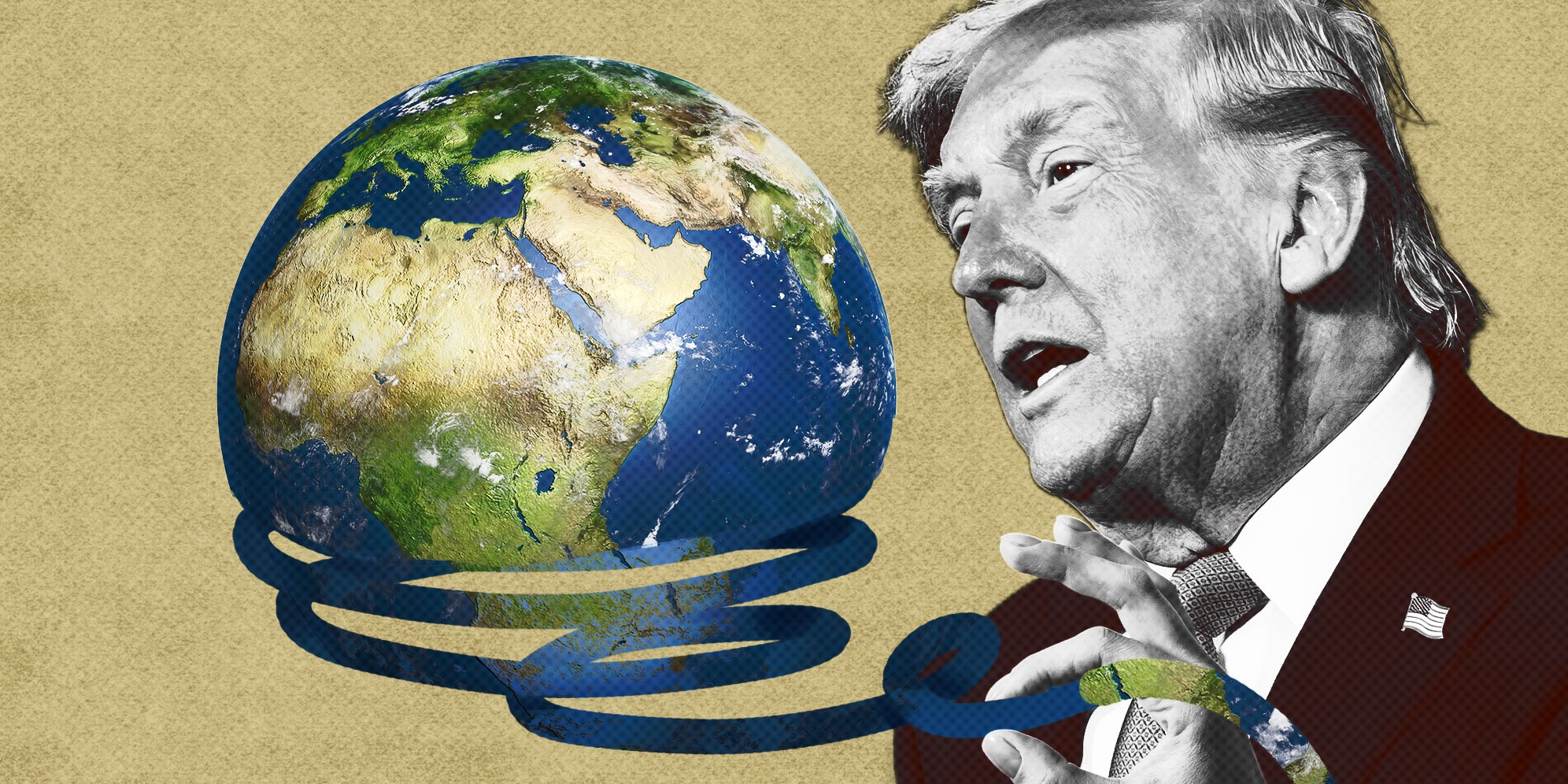
 Illustrative Image: US President Donald Trump (Nicole Combeau / EPA) | World (Image: Istock) | (By Daniella Lee Ming Yesca)
/file/dailymaverick/wp-content/uploads/2025/10/label-analysis-2.jpg)
US President Donald Trump is rapidly shredding the remnants of a world governed by international law, replacing it with an order where a few superpowers exercise unrestrained dominion over their spheres of influence. This is particularly alarming for Ukraine, Taiwan, and now, it seems, Greenland, although some other countries unfortunate enough to be located in the backyards of the US, Russia and China are getting nervous too.
“The biggest downside of the Venezuela operation could be the precedent it sets, affirming the right of great powers to intervene in their backyards against leaders they deem to be illegitimate or a threat,” Richard Haass, president emeritus of the Council on Foreign Relations, wrote for Project Syndicate.
“One can only imagine Russian President Vladimir Putin, who is calling for the ‘de-Nazification’ of Ukraine and the removal of President Volodymyr Zelensky, nodding in agreement. Trump’s military operation in Venezuela makes a negotiated end to the Russia-Ukraine war even more remote than it already was.
“A similar reaction is likely in China, which views Taiwan as a breakaway province and its government as illegitimate. This is not to say that President Xi Jinping will suddenly act on his ambitions for Taiwan, but events in Venezuela could increase his confidence that he would succeed if he were to invade, besiege, or otherwise coerce the island,” Haass concluded.
Trump and the crime of aggression
The attack by US forces on Venezuela and their capture of President Nicolás Maduro and his wife, Cilia Flores — as well as Trump escalating threats to seize Greenland and to attack Colombia, Cuba and Mexico — have further exposed the flimsiness of a post-World War 2 global order supposedly based on international law.
/file/attachments/orphans/13622975_929436.jpg "Captured Venezuelan President Nicolás Maduro and his wife, Cilia Flores, arrive at the Wall Street Heliport during their transport to the federal courthouse for their arraignment in New York on 5 January. (Photo: Stringer / EPA)")
“The main instrument of international law that is violated here is the UN Charter, more specifically Article 2(4) of the charter, which sets out the prohibition on the use of force or threat of force,” said Atilla Kisla, international justice cluster lead at the Southern Africa Litigation Centre.
Read more: Trump escalates threats to take Greenland after mixed global response to Venezuela
This norm, he said, is considered to be jus cogens (“compelling law”), like the crime of genocide, from which no exception or waiver can be allowed, and so is a binding law for any state regardless of whether the state has taken up the principle in its own domestic law.
“The prohibition of the use of force constitutes the bedrock of the modern international order,” said Kisla. “There are only two narrow exceptions where force may be used under the UN Charter ” — either the UN Security Council (UNSC) authorises it, or a state uses force in self-defence under Article 51 of the charter.
“However, none of those two exceptions to the prohibition of force apply here. There is certainly no authorisation by the UNSC. And there is no armed attack that could trigger the right of self-defence under the UN Charter. What we are left with is unilateral use of military force under the guise of necessity. The US as a state has violated a cardinal norm of the UN Charter and is responsible for this internationally wrongful act.”
/file/attachments/orphans/GettyImages-2254783215_609005.jpg "The US ambassador to the United Nations, Mike Waltz, speaks at a UN Security Council meeting on 5 January concerning the situation in Venezuela. (Photo: Spencer Platt / Getty Images)")
Kisla said that international law not only regulates state conduct, it can also hold leaders and individuals personally accountable. Ordering the unlawful use of force can amount to the crime of aggression, criminalised under Article 8bis of the Rome Statute of the International Criminal Court (ICC).
“The crime of aggression is a leadership crime, and if there were ever to be such a prosecution, President Trump would be the main accused in such a matter. However, such prosecution before the International Criminal Court would only be possible if states like Venezuela ratify the so-called Kampala amendments to the ICC Statute and once the ICC is enabled to also investigate and/or prosecute against non-ICC member States,” said Kisla.
Noting that Venezuela’s representative to the UN had this week also accused the US of violating the Geneva Conventions — by killing civilians in the attacks — Kisla said for the Geneva Conventions and international humanitarian law to apply, there must be an armed conflict — which some commentators had argued there had been between the US and Venezuela, since at least 3 January 2026.
If the US attacks killed civilians, that could amount to war crimes and trigger state responsibility, and individual criminal responsibility, which states would be obliged to prosecute. Reports indicate civilians were killed in the attacks, but it’s unclear how many.
/file/attachments/orphans/13621578_449313.jpg "The interior of a building in Catia La Mar, Venezuela, that was damaged by an explosive device during the US attacks on 3 January. (Photo: Miguel Gutiarez / EPA)")
In the past, the US has tended to pay at least lip service to international law. In 2003, for instance, President George W Bush claimed the US attack on Iraq was “preemptive self-defence” because he said, wrongly as it turned out, that Iraqi President Saddam Hussein was developing weapons of mass destruction which could be used against the US.
However, the Trump administration is hardly even pretending to respect international law. Yes, the US representative to the UN, rather than admitting to military action, called the Venezuela attack a “surgical law enforcement operation” (a euphemism which recalled Russian President Vladimir Putin’s insistence on calling his invasion of Ukraine a “special military operation).
Greenland and imperialism
When CNN host Jake Tapper asked Stephen Miller, one of Trump’s top aides, about Trump’s repeated threats to seize Greenland, he said Greenland rightfully belonged to the US as it was necessary for its national security.
“Nobody’s going to fight the United States militarily over the future of Greenland,” said Miller.
“We live in a world, in the real world, Jake, that is governed by strength, that is governed by force, that is governed by power,” he continued. “These are the iron laws of the world since the beginning of time.”
/file/dailymaverick/wp-content/uploads/2025/01/12777178.jpg "A protestor at a protest against American presence in Greenland, in Copenhagen, Denmark on 26 January 2025. (Photo: EPA-EFE/IDA MARIE ODGAARD)")
/file/attachments/orphans/GettyImages-2232912786_257270.jpg "Stephen Miller. (Photo: Aaron Schwartz / CNP/Bloomberg via Getty Images)")
Progressive independent Senator Bernie Sanders called Miller’s candid remarks “a very good definition of imperialism”, as was Trump openly coveting Venezuela’s oil. The Trump administration was taking the world back 100 years to when big, powerful countries exploited poorer countries for their natural resources, said Sanders.
In other words, back to the world before the UN Charter was written in 1945. And back before Nato — the North Atlantic Treaty Organisation — was formed in 1949. The ‘might is right’ philosophy, which Miller so unashamedly articulated, threatens both of these institutions.
As Danish Prime Minister Mette Frederiksen said this week, if the US attacked Greenland, it would be attacking Denmark, a fellow Nato member and that would mean the end of Nato.
/file/dailymaverick/wp-content/uploads/2023/09/11698751.jpg "Denmark's Prime Minister Mette Frederiksen and Ukraine's President Volodymyr Zelensky chat as they arrive to address a press conference outside the presidential palace in Kyiv, Ukraine, on 6 September 2023. (Photo: Ida Marie Odgaard / EPA-EFE / )")
Trump’s playbook
This week Trump also threatened attacks on Cuba, Columbia and Mexico, which, even just as threats, constituted violations of Article 2 of the UN Charter.
Though the world has been shocked by the events of the last week, it cannot say it was not warned. As early as February 2024 in his Senate confirmation hearings, Secretary of State Marco Rubio said: “The post-war global order is not just obsolete, it is now a weapon being used against us.”
/file/attachments/orphans/GettyImages-2254497867_530983.jpg "U.S. Secretary of State Marco Rubio listens as U.S. President Donald Trump addresses the media during a news conference at his Mar-a-Lago club on January 03, 2026, in Palm Beach, Florida. President Trump confirmed that the U.S. military carried out a large-scale strike in Caracas overnight, resulting in the capture of Venezuelan leader Nicolas Maduro and his wife, Cilia Flores. (Photo: Joe Raedle / Getty Images)")
This “liberal world order” was based on the “dangerous delusion” that all people were part of one human family with no national interests, he said.
More recently, when Vice-President JD Vance was warned on social media that the US, by killing helpless Venezuelan civilian survivors of attacks on alleged drug boats, was committing war crimes, he replied: “I don’t give a shit what you call it”.
Haass noted that the ousting of Maduro showed that we should have taken more seriously Trump’s National Security Strategy, published in November. It openly reasserted the 1823 Monroe Doctrine — which Trump updated to the “Trump Corollary to the Monroe Doctrine” — that proclaimed that the Western Hemisphere was the exclusive sphere of influence of the United States.
Kisla said Trump’s latest acts “do not surprise” since they are only the most recent violations of international law, which included the bombing of Iran’s nuclear facilities last year and the export of arms to Israel, thereby “aiding and abetting the crime of genocide.
“Trump’s approach in this context reflects contempt for international law, multilateral institutions, and the view that power should not be constrained by rules. The internationally wrongful acts we are now witnessing, from unilateral use of force to the threat of force against sovereign states, follow a philosophy that the UN Charter is not binding law and merely an inconvenience.
“It further reflects the latest US security strategy, which abandons a rules-based restraint and embraces a doctrine of so-called peace through strength, which can be broken down to ‘might makes right’.
“The administration’s conduct in that regard reflects a systematic rejection of the post-1945 legal order. The legal consequences are profound. When a state with the world’s most powerful military capabilities violates the UN Charter, particularly the prohibition on the use of force under the disguise of a fabricated necessity, it erodes the very norms it once claimed to defend,” said Kisla.
Read more: Venezuela: Peace, survival of humanity depend on UN Charter remaining a living instrument
“This is not about the abstract relevance of international law. It is about whether international law, such as the UN Charter, has any meaning or binding force beyond rhetoric at this point. It invites escalation, weakens collective security and peace, and legitimises conduct by other states eager to follow the same playbook. The result is the continued dismantling of international law.
“This slide into lawlessness is not inevitable. It can be stopped, but stopping it requires courage on the part of states. It requires the international community to call out tyranny when it sees it, to condemn violations of international law, such as the situation in Venezuela, not with whispers, but clarity.
“A dismantling of international law can only be prevented if states are willing to defend it. That means exposing blatant violations of international law and it means investigating and potentially prosecuting individuals for international crimes — no matter how powerful they may be.
“The hiding behind ongoing fact-finding or claimed lack of evidence must stop. This is how fundamental principles of international law erode and how the world drifts away from law towards raw power. An international community of silence or acquiescence lays the groundwork for a world governed not by law, but by force.” DM