



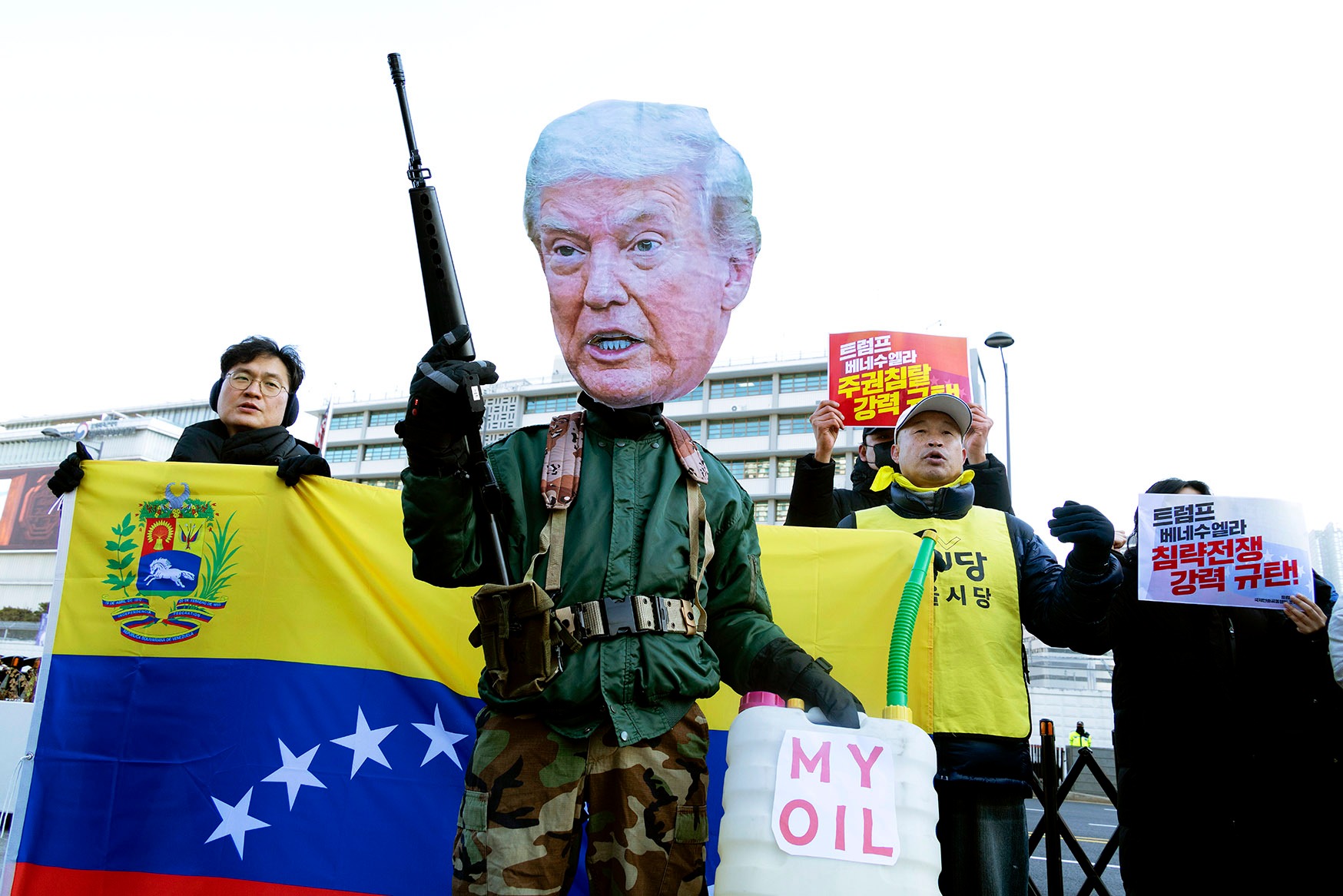
 A protester wearing a mask featuring the likeness of US President Donald Trump at a protest outside the US Embassy in Seoul, South Korea, on 5 January, against Trump and the US military actions in Venezuela. (Photo: Jeon Heon-Kyun / EPA)
 Even as the nations of the world reacted to the audacious 3 January US military strike on Venezuela, President Donald Trump was looking beyond that country to new horizons, doubling down on his ambition to annex Greenland and threatening to attack Colombia and perhaps even Mexico if they did not curb alleged drug trafficking to the US. He also threatened a second invasion of Venezuela if its interim president, Delcy Rodríguez, did not comply with US requirements.
Countries of the Global South have generally been sharply critical of the US, calling the attack “state terrorism”, “aggression”, “hegemonic behaviour” and “crossing an unacceptable line”.
A strong US military force attacked Venezuela early on Saturday, capturing President Nicolás Maduro and his wife, Cilia Flores, and transporting them to the US, where they appeared in a New York court on Monday, on several charges related to drug trafficking.
/file/attachments/orphans/GettyImages-2253959406_288074.jpg "Captured Venezuelan President Nicolás Maduro arrives at the Westside Heliport in New York on Saturday, 3 January. (Photo: Adam Gray / Bloomberg via Getty Images)")
SA condemns attack
South Africa and most of its partners in the BRICS-Plus forum condemned the attack on Venezuela, while a few said very little or nothing at all.
On Monday, South Africa’s acting deputy ambassador to the UN, Jonathan Passmoor, said the US action in Venezuela “wantonly violates the sovereignty, territorial integrity and independence of Venezuela. Once again, the belief that might is right is reinforced, and diplomacy is undermined.
“History has repeatedly demonstrated that military invasions against sovereign states yield only instability and deepen crisis,” he added, citing foreign interventions in Libya, Iraq and “countless cases in Africa”.
“South Africa stresses that allegations of internal governance challenges, human rights concerns or acts of criminality by a head of state cannot justify a breach of the [UN] Charter’s prohibition on the use of force.”
Passmoor said disputes should be resolved peacefully, including bringing a case before the International Court of Justice or seeking action from the UN Security Council.
“If we do not stand up to the sovereign rights of any nations/states being undermined and wantonly violated, then which one of us are safe or are guaranteed protection by the principles of the Charter and international law?” he asked, calling for decisive action against such violations.
/file/attachments/orphans/GettyImages-2254192261_553903.jpg "Ousted Venezuelan President Nicolas Maduro arrives at the Wall Street heliport ahead of his appearance in federal court in New York, US, on Monday, Jan. 5, 2026. The indictment released on Saturday accuses Maduro and others of partnering with groups including the Sinaloa Cartel and Tren de Aragua, which have been designated by the US as foreign terrorist organizations. (Photo: Michael Nagle/Bloomberg via Getty Images)")
Caution and criticism
The Indian foreign ministry issued a cautious statement that did not mention the US by name and merely added that “recent developments in Venezuela are a matter of deep concern…” calling on “all concerned” to address issues peacefully.
Read more: Trump says US will run Venezuela, South Africa calls on UN Security Council to urgently convene
Egypt, Ethiopia and the United Arab Emirates, which all joined BRICS in 2023, did not react publicly.
However, Brazil’s President Lula da Silva, a founding BRICS member, posted on X that the attack had “crossed an unacceptable line”, and that “attacking countries in flagrant violation of international law is the first step toward a world of violence, chaos, and instability”.
/file/attachments/orphans/13621248_668378.jpg "Protesters during a march in Caracas, Venezuela, on 4 January to demand that US President Donald Trump release President Nicolás Maduro and his wife, Congresswoman Cilia Flores. (Photo: Ronald Peña / EPA)")
Russia and China, also BRICS founding members, condemned the attack, which Russia called an act of armed aggression against Venezuela and added that the pretexts used to justify the strike were “indefensible”.
China’s foreign ministry slammed the “hegemonic acts” and condemned the US’s “blatant use of force against a sovereign state and action against its president”.
Iran, which joined BRICS in 2023, said, “The US military aggression against an independent state that is a member of the UN represents a grave breach of regional and international peace and security” and would affect the entire international system.
Indonesia, the newest BRICS member, which joined in 2025, issued a milder statement, emphasising “the importance of respecting international law and the principles of the UN Charter”, but going no further.
‘Reminiscent of colonial era’
Africa was generally also cautious. North African states Morocco, Tunisia and Algeria — as well as Egypt — all failed to respond
The African Union, on Saturday, urged restraint and respect for international law, particularly the principles of state sovereignty, territorial integrity and the right of peoples to self-determination under the UN charter.
Ghana issued one of the strongest African condemnations of the attack, saying the use of force violated the UN Charter. It criticised Trump’s remark that the US would “run” Venezuela “until such time as we can do a safe, proper and judicious transition” and that US companies would be asked to “go in”.
“These declarations are reminiscent of the colonial and imperial era. They set a dangerous precedent for the global order.”
/file/attachments/orphans/13617342_531287.jpg "A protest outside the White House in Washington, DC, on 3 January against the US raid on Venezuela. (Photo: Will Oliver / EPA)")
In Venezuela’s neighbourhood, Cuba’s President Miguel Diaz-Canel Bermúdez called the attack “state terrorism against the Venezuelan people and against our America”.
But Argentina’s right-wing President Javier Milei, a close regional ally of Trump, welcomed the development, writing on social media: “Freedom moves forward. Long live freedom.”
European response muted
Official European reactions were more muted about the US and also more critical of the Maduro regime.
The European Union’s foreign policy chief, Kaja Kallas, reaffirmed the EU’s long-standing position that Maduro “lacks legitimacy”, while European Commission President Ursula von der Leyen said the EU supported a peaceful and democratic transition.
British Prime Minister Keir Starmer said on X: “We regarded Maduro as an illegitimate president and we shed no tears about the end of his regime.”
German Chancellor Friedrich Merz posted on X that international law should remain the guiding framework, but that “The legal assessment of the U.S. intervention is complex and requires careful consideration.”
He accused Maduro of leading his country “into ruin”, with the country’s most recent election “rigged”, adding that like many other countries, Germany had not recognised his presidency.
France was more critical of the US action, saying, “No lasting political solution can be imposed from outside” and expressing concern about the increase in violations of the principle of non-use of force by permanent members of the UN Security Council.”
The French foreign ministry statement also condemned “the authoritarian excesses” of the Maduro regime, adding that “the legitimacy of Nicolás Maduro was not based on any credible democratic foundation”, and noting that the results of the last presidential elections on 28 July 2024 had never been published.
/file/attachments/orphans/AFP_20260103_89GZ2WH_v2_HighRes_VenezuelaUsConflictCrisis_607571.jpg "A fire at Fuerte Tiuna, Venezuela's largest military complex, after a series of explosions in Caracas on 3 January, when the US attacked Venezuela and seized its president and his wife. (Photo: AFP)")
Spain was the most critical European country. Prime Minister Pedro Sánchez said on X on Saturday: “Spain did not recognize the Maduro regime. But neither will it recognize an intervention that violates international law and pushes the region toward a horizon of uncertainty and belligerence.”
Ukraine’s foreign minister said his country “has consistently defended the right of nations to live freely, free of dictatorship, oppression, and human rights violations”, accusing the Maduro government of “violating all such principles in every respect”.
UN voices concern
In a debate on the crisis in the UN Security Council on Monday, UN Secretary-General António Guterres said he was “deeply concerned about the possible intensification of instability in the country, the potential impact on the region, and the precedent it may set for how relations between and among states are conducted”.
In remarks delivered by Under-Secretary-General Rosemary DiCarlo, Guterres noted that the panel of electoral experts which he had appointed had highlighted serious issues in Venezuela’s 2024 elections.
“We have consistently called for full transparency and the complete publication of the results of the elections,” he said. He added that the Office of the UN’s High Commissioner for Human Rights had catalogued “serious violations”.
But he said he was deeply concerned that rules of international law had not been respected in the US attack on Venezuela on 3 January.
He noted that the UN Charter prohibited the use of force or the threat of the use of force against the territorial integrity or political independence of any state.
Guterres said the situation in Venezuela was critical, but it was still possible to prevent a wider and more destructive conflagration.
He called on all Venezuelans to engage in “an inclusive, democratic dialogue in which all sectors of society can determine their future”.
He added that he was ready to support all efforts aimed at assisting Venezuelans in finding a peaceful way forward.
The meeting ended without any resolution or statement, presumably because member states were aware that the US would have vetoed anything which criticised its attack on Venezuela.
Trump’s next targets?
Trump shrugged off all criticism and appeared to be looking to new horizons of conquest.
After the Venezuela attack, he told The Atlantic: “We do need Greenland, absolutely”, claiming that the island — a semi-autonomous territory of Denmark — was “surrounded by Russian and Chinese ships”.
Danish Prime Minister Mette Frederiksen responded on Sunday that Washington had “no right to annex” Greenland and strongly urged the US “to stop the threats against a historically close ally”.
She added that Greenlanders had made it clear they were “not for sale”, that Denmark was part of Nato and that a defence agreement with the US already gave Washington “wide access to Greenland”.
Meanwhile, Katie Miller, the wife of Trump’s powerful adviser Stephen Miller, posted provocatively on X a map of Greenland, covered by the US flag under the caption “SOON”.
/file/attachments/orphans/GettyImages-2254498929_175661.jpg "(From left) White House Deputy Chief of Staff Stephen Miller, CIA Director John Ratcliffe, Secretary of State Marco Rubio, Secretary of Defense Pete Hegseth and chairperson of the Joint Chiefs of Staff Dan Caine listen as President Donald Trump addresses the media at his Mar-a-Lago club on 3 January in Palm Beach, Florida. (Photo: Joe Raedle / Getty Images)")
In his Sunday remarks to reporters on Air Force One, Trump also threatened Colombia, Cuba, Iran and Mexico. He particularly targeted Colombian President Gustavo Petro, saying: “Colombia is very sick, too, run by a sick man who likes making cocaine and selling it to the United States. And he’s not going to be doing it very long, let me tell you.”
Asked if he meant there would be military action against Colombia, Trump said, “Sounds good to me. Yeah.”
He also warned Mexico to stop alleged drug trafficking to the US.
Petro responded on X: “Stop slandering me, Mr Trump” and called on Latin America to unite against the US, saying that the region risked being “treated as a servant and slave”. DM