




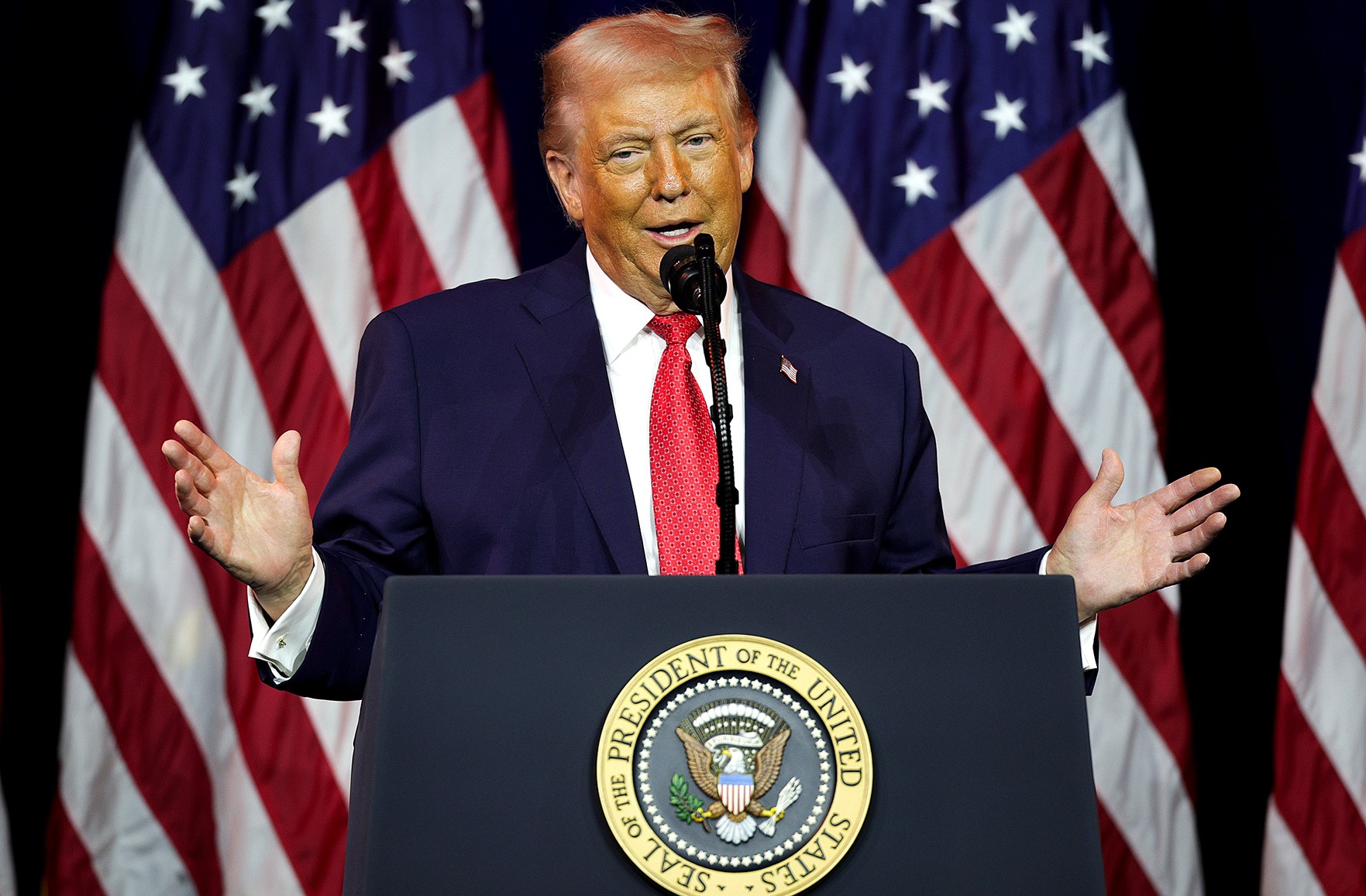
 U.S. President Donald Trump addresses a House Republican retreat at The John F. Kennedy Center for the Performing Arts on January 06, 2026 in Washington, DC. House Republicans will discuss their 2026 legislative agenda at the meeting. (Photo: Alex Wong / Getty Images)
 By Steve Holland, Bo Erickson and Gram Slattery
A White House official confirmed that Trump intends to keep the medal.
In a social media post on Thursday evening, Trump wrote: "Maria presented me with her Nobel Peace Prize for the work I have done. Such a wonderful gesture of mutual respect. Thank you Maria!"
Machado, who described the meeting as "excellent," said the gift was in recognition of what she called his commitment to the freedom of the Venezuelan people.
Machado's attempt to sway Trump came after he dismissed the idea of installing her as Venezuela's leader to replace the deposed Nicolas Maduro. Trump openly campaigned for the prize before Machado was awarded it last month and complained bitterly when he was snubbed.
Though Machado gave Trump the gold medal that honorees receive with the prize, the honor remains hers; the Norwegian Nobel Institute has said the prize cannot be transferred, shared or revoked.
Asked on Wednesday if he wanted Machado to give him the prize, Trump told Reuters: "No, I didn't say that. She won the Nobel Peace Prize."
The Republican president long expressed interest in winning the prize and has at times linked it to diplomatic achievements.
The lunch meeting, which appeared to last slightly over an hour, marked the first time the two have met in person. Machado then met with more than a dozen senators, both Republican and Democratic, on Capitol Hill, where she has generally found more enthusiastic allies.
While the visit was ongoing, White House press secretary Karoline Leavitt said Trump had been looking forward to meeting Machado, but that he stood by his "realistic" assessment that she did not currently have the support needed to lead the country in the short term.
Machado, who fled Venezuela in a daring seaborne escape in December, is competing for Trump's ear with members of Venezuela's government and seeking to ensure she has a role in governing the nation going forward.
After the U.S. captured Maduro in a snatch-and-grab operation this month, various opposition figures, members of Venezuela's diaspora and politicians throughout the U.S. and Latin America have expressed hope that Venezuela will begin the process of democratization.
HOPES OF A MOVE TO DEMOCRACY
Democratic Senator Chris Murphy, one of the senators who met with Machado, said the opposition leader had told senators that repression in Venezuela was no different now than under Maduro. Venezuela's interim President Delcy Rodriguez is a "smooth operator" who was growing more entrenched by the day thanks to Trump's support, he said.
"I hope elections happen, but I'm skeptical," said Murphy, of Connecticut.
Trump has said he is focused on securing U.S. access to the country's oil and economically rebuilding Venezuela.
Trump has on several occasions praised Rodriguez, Maduro's second-in-command, who became Venezuela's leader upon his capture. In an interview with Reuters on Wednesday, Trump said, "She's been very good to deal with."
Machado was banned from running in Venezuela's 2024 presidential election by a top court stacked with Maduro allies. Outside observers widely believe Edmundo Gonzalez, an opposition figure backed by Machado, won by a substantial margin, but Maduro claimed victory and retained power.
While the current government has freed dozens of political prisoners in recent days, outside groups and advocates have said the scale of the releases has been exaggerated by Caracas.
In an annual address to lawmakers, Rodriguez called for diplomacy with the U.S. and said should she need to travel to Washington, she would do so "walking on her feet, not dragged there."
She also said she would propose reforms to her country's oil industry aimed at increasing access for foreign investors.
(Reporting by Steve Holland, Bo Erickson, Gram Slattery and Nandita Bose; Additional reporting by Nolan McCaskill, Joseph Ax, and Ismail Shakil; Editing by Colleen Jenkins, Rod Nickel and Thomas Derpinghaus)