



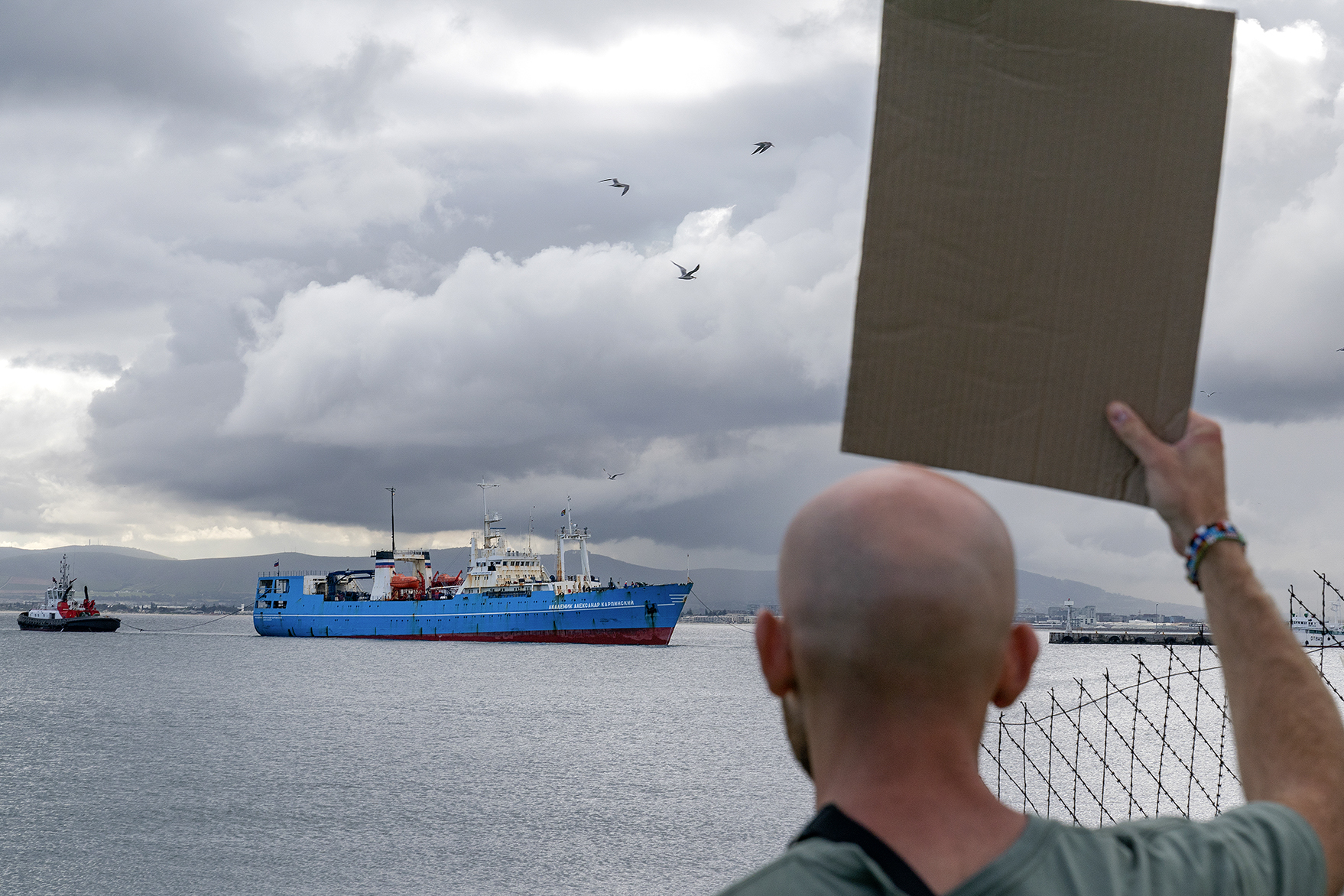
 The Akademik Alexander Karpinsky arrives in Cape Town's Table Bay harbour during environmental protests of April 2023, just weeks after it potentially spoofed its location from the South African city to Tallinn en route to Antarctica. (Photo: Nic Bothma)
The puzzling behaviour of a Russian state seismic survey ship with South African links is confounding maritime trackers in the Baltic Sea — all over again. The US-sanctioned Akademik Alexander Karpinsky, owned by the Kremlin mineral explorer Rosgeo, on Monday, 8 December, reported its location from an Estonian port — which it is banned from entering under EU war sanctions.
Monday’s Automatic Identification System (AIS) data reported the ship had now “stopped” somewhere in the Gulf of Finland.
Its “matched destination”? Vene-Balti — a port in the Estonian capital, Tallinn, which it is not allowed to enter because of sanctions imposed in response to Russia’s February 2022 illegal invasion of Ukraine. Marine Traffic noted that the ship had arrived in Vene-Balti on 22 November, but its position had not been received in at least 15 days. It was stationary with a speed of 0 knots.
To add to this confusing picture, the Karpinsky’s “reported destination” was listed as St Petersburg, Russia.
As documented by Daily Maverick’s investigative series since 2021, this so-called most controversial of Antarctic survey ships has voyaged to the Southern Ocean almost annually via Cape Town to conduct prospecting expeditions outlawed under the Madrid Protocol.
The protocol is the conservation constitution of the 1959 Antarctic Treaty. Russian state sources have at times described the vessel’s activities as both geopolitical and “legal” science.
The ship was first sanctioned by the US in February 2024 to “further constrain development of future energy and mining projects abroad”, the US embassy in South Africa told Daily Maverick at the time. In February 2020, the Karpinsky had issued a statement from the Port of Cape Town, claiming to have identified the equivalent of a potential 70 billion tons (500 billion barrels) of oil and gas in East Antarctica’s Southern Ocean. It currently remains a designated ship under the Trump administration.
A six-month phantom voyage from St Petersburg to Tallinn?
Remarkably, the Karpinsky had reportedly departed its home port of St Petersburg on 15 June 2025 for its suggested “arrival” at the Estonian port.
In other words, a voyage that should have taken the EU/US-banned ship a day or two has now been dragged out across nearly six months.
But the Karpinsky’s “reported estimated time of arrival” (ETA) — 1 June 2025 — appeared to defy the laws of physics. The ship’s ETA predated its “actual time of departure” by more than two weeks.
The Karpinsky, one might say, arrived before leaving — especially since this is a ship whose reputation seems to precede itself.
Experts: ‘Intentional manipulation’
The most logical explanation for these glaring inconsistencies, Estonian and Russian security experts told Daily Maverick, was that the ship was intentionally manipulating its data.
The data betrayed a likely spoofing incident: the act of broadcasting a false location in Estonia while possibly remaining in Russian waters.
“We confirm that the aforementioned vessel is not in Estonian ports, waters or maritime area of responsibility. According to our surveillance data, it has not left Russian waters since May 2024,” an Estonian Navy spokesperson told Daily Maverick.
Lieutenant Aleksander Espenberg said “databases that rely solely on AIS information, such as Marinetraffic.com, have not been reliable due to widespread AIS spoofing and manipulation of AIS data ... we cannot say if this is deliberate manipulation of AIS data, since we do not have any factual evidence of this”.
But Jaak Viilipus, an Estonian maritime expert and former seafarer who spent nearly 15 years at sea serving on different vessels, said the Karpinsky’s “arrival dates — which are quite recent — indicate intentional manipulation”.
“The picture clearly shows a mismatch — a Russian-flagged vessel in an EU port,” said Viilipus. “Russian-flagged vessels have been banned from entering EU ports for several years now, so the presence of such a vessel in an Estonian port is a red flag. This sanction is among the easiest to enforce compared to more complex ownership-related restrictions, which makes the situation immediately questionable for both authorities and private companies.”
/file/attachments/orphans/KarpinskyTallinnDecScreenshot_480304.jpg "AIS data reporting the Karpinsky's \"actual time of arrival\" in Tallinn on 22 November 2025. (Image: Marinetraffic.com screenshot)")
Moscow’s own ‘Flying Dutchman’
Further commenting on the AIS data, Viilipus said the “vessel is shown departing from St Petersburg in June 2025 and arriving in Estonia in November 2025. In reality, this voyage should take only one to two days, even for a research or special-purpose vessel, not several months. This discrepancy is a second red flag, suggesting potential problems with the vessel’s reporting and raising the possibility of AIS spoofing.
“The arrival dates — which are quite recent — indicate intentional manipulation. Normal seagoing practice, followed by the majority of vessels, is to use relatively simple AIS systems where the responsible officer manually enters the estimated arrival time.
“It is considered a must and good practice to keep this updated, even if delays occur during the voyage. Depending on the system configuration, and especially if the vessel is older, manual input is the most likely option. That makes the incorrect arrival data appear deliberate.”
Viilipus noted that Estonian authorities had “established procedures for such incidents”. He suggested that the Karpinsky’s signal had either been sent from onboard the ship or “from land”.
Mathieu Boulègue, a Russian Antarctic security expert and senior Fellow at the Center for European Policy Analysis, likened the Karpinsky to the Flying Dutchman — the alleged ghost ship that prowled South Africa’s Cape of Storms in the 1600s.
“The Karpinsky is now the modern-day Flying Dutchman. It is everywhere and nowhere at the same time, but it is always up to no good. Regardless, Russia’s shadow fleet of dual-use assets is constantly able, and enabled, to conduct intelligence gathering and low-intensity warfare operations.”
Cape Point Nature Reserve says the Flying Dutchman is reportedly “stuck in a limbo of timeless Sisyphean struggle”. Thus, unable to drop anchor in port, eternally destined to sail the Cape of Storms.
Previous ghost guest appearances
Monday’s episode has emerged as the latest in a pattern of apparent irregular activity for a ship previously flagged for potential “spoofing” behaviour by Estonian media in September 2024 — and by Daily Maverick in February 2023.
Commenting on the September 2024 incident on his LinkedIn page, Professor Klaus Dodds, then at Royal Holloway, University of London, described the Karpinsky as “the most controversial of ‘Antarctic survey ships’”.
Daily Maverick can now also confirm that, just weeks after the September 2024 incident, Russian authorities inexplicably added and removed the Karpinsky to and from the Antarctic Treaty’s shipping register several times in the 2024/25 summer research period.
That meant the Karpinsky was due to sail to the Antarctic under the official flag of the Russian Antarctic Expedition, Moscow’s state programme, before being removed from the register for the rest of the season.
On Monday, the Karpinsky did not feature on the register for the 2025/26 research period either. The most likely explanation? The Karpinsky seems busy with unexplained activity elsewhere.
Westminster’s answer to the Rosgeo ship
London issued its first publicly accessible Antarctic strategy on 1 December, the date that marks the treaty’s signing in 1959. The long-awaited strategy’s release and its response to Antarctic prospecting activity by Russia, a treaty founding signatory, also coincided with the Karpinsky’s apparent hide-and-seek activity of recent weeks.
The strategy cites the UK’s support for the mining ban and vows to “challenge those who seek to undermine it”. Judging by the UK Parliament’s recent inquiry recommendations on “commercial mining” in Antarctica, which London accepted, it is clear that the UK thinks that the Karpinsky is the type of actor that is undermining the ban.
The true “nature and intent” of the Karpinsky’ seismic surveys, the parliamentary recommendations note, “cast doubt on compliance with the [Madrid] Protocol’s prohibition and risk undermining its authority”.
To block “any unauthorised activities”, the parliamentary recommendations demand full data disclosure from Rosgeo under the treaty’s open-science rules.
Rosgeo’s subsidiary, the Polar Marine Geosurvey Expedition (PMGE), owns the Karpinsky. It abruptly stopped posting regular expedition reports in mid-2023 after small but high-profile Cape Town protests against the Karpinsky’s seismic airgun surveys drew international headlines.
To this day, that seems to leave the Weddell Sea’s hydrocarbon potential unknown to all but Moscow, which has conducted at least six annual prospecting expeditions in this West Antarctic region counterclaimed by Argentina, Chile and the UK.
/file/attachments/orphans/PavelLunevCCAMLR2025_915009.jpg "A screenshot of Russian Antarctic Expedition head Pavel Lunev, right, and a colleague, left, at the October 2025 meeting of the Commission for the Conservation of Antarctic Marine Living Resources. (Image: Screenshot / Arctic and Antarctic Research Institute Press Centre / Aari.ru)")
Former Karpinsky director shows up as adviser at top Antarctic meeting
Until April 2023 the director of none other than PMGE, Pavel Lunev, was since promoted to head the entire Russian Antarctic Expedition (RAE). A palaeontologist by training, the RAE head turned up at the controversial November meeting of the Commission for the Conservation of Antarctic Marine Living Resources (CCAMLR) in Hobart, Tasmania.
Meeting minutes indicate that Moscow’s CCAMLR delegation — habitually staffed with foreign affairs and fisheries officials — has not featured RAE officials in at least 10 years.
So, it remains unclear what exactly a palaeontologist was doing at this year’s fisheries and Marine Protected Areas (MPA) meeting in Hobart.
The meeting’s preliminary minutes list Lunev as an adviser to the Russian delegation, which this year again blocked Antarctic MPA proposals linked to areas that overlap with the Karpinsky’s seismic survey areas.
A Ukrainian government statement said Russian authorities had arrested the Ukrainian CCAMLR marine biologist Leonid Pshenichnov in Crimea just ahead of the meeting. According to copy of an alleged arrest warrant seen by both ABC Australia and Daily Maverick, Pshenichnov was reportedly charged with high treason for, among other reasons, proposing MPAs that would “result in the loss of opportunities for Russia to exploit hydrocarbon resources on the continental shelf of Antarctica”.
The government statement described Pshenichnov as “the first political prisoner in the history of Antarctica for opposing Russia’s overexploitation plans on the Southern Ocean”. Ukraine’s embassy to Australia issued a similar statement at the CCAMLR meeting.
Responding to the allegations at the CCAMLR meeting, Lunev and his colleagues “stressed that matters concerning Russian citizens are within the jurisdiction of the Russian Federation in accordance with internation [sic] law and should not be raised in the context of the CCAMLR framework”.
Australia’s Ukrainian ambassador, Vasyl Myroshnychenko, told Daily Maverick that Pshenichnov had been a passport-holding Ukrainian citizen since 1991. Russian authorities did not respond to immediate requests for comment sent on Monday. DM