



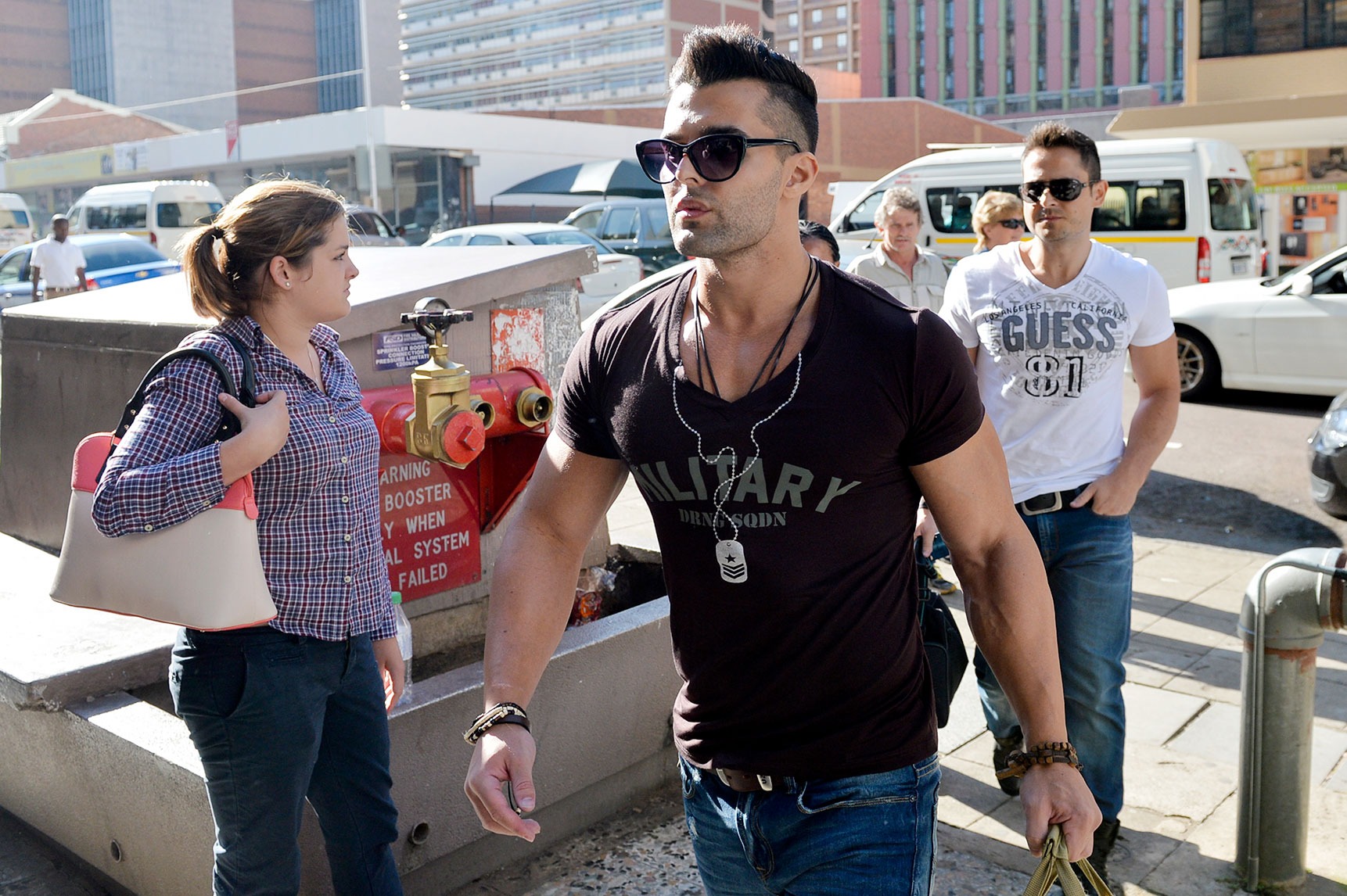
 Christoff Becker and Frikkie du Preez (rear right) arrive at the Department of Correctional Services on 11 February 2014 in Pretoria. The Waterkloof Four were released on parole after serving half their sentences. Christoff Becker, Reinach Tiedt, Gert van Schalkwyk and Frikkie du Preez were each sentenced to 12 years in prison for killing a homeless man in 2001. (Photo: Gallo Images / Foto24 / Herman Verwey)
“Former Waterkloof High principal’s son, Christoff Becker, accused of assaulting his dad and cop”, read the headline of an article originally published in Rapport on 10 January.
The implication seemed to be that Christoff Becker was newsworthy on account of his father, Dr Christo Becker, who was described as “a once-respected head of the prestigious Waterkloof High school”.
/file/attachments/orphans/0000206886_349619.jpg "Christoff Becker (centre) outside the Department of Correctional Services on 11 February 2014 in Pretoria. (Photo: Gallo Images / Foto24 / Herman Verwey)")
Inexplicably absent from the report was any mention of the fact that Christoff Becker hogged headlines for years in the 2000s, particularly in Afrikaans media, as one of the “Waterkloof Four”: four teenagers from Pretoria convicted of the brutal murder of a homeless man in December 2001.
Privilege and arrogance writ large
“For the Waterkloof Four, the future will never be carefree and bright again,” wrote Mia Swart in 2008, reflecting on a crime that had caused reams of condemnatory letter-writing to Afrikaans newspapers.
Swart was writing at the time when the four murder-convicted men – Becker, Frikkie du Preez, Gert van Schalkwyk and Reinach Tiedt – were finally entering prison for a murder committed seven years earlier.
The details were grotesque. After drinking at a Hatfield nightclub, the four 16-year-olds first used a racial slur and assaulted a passerby in Constantia Park, before hunting a homeless man in Moreleta Park. A friend who had been with them at the time testified in court how Becker and Van Schalkwyk took a set of carving knives from the BMW of Becker’s father before beating and stabbing him to death.
Frikkie du Preez also demonstrated his “Naas Botha kicks” on the victim, according to the witness. The identity of the homeless man was never confirmed.
It took more than two years for the case to be brought to court, and from the start the four, but particularly Becker, were treated with a mixture of morbid fascination and awe by the media – not dissimilar, in fact, to some of the media treatment given more recently to the likes of Thabo Bester or accused crime kingpin Vusimuzi “Cat’ Matlala.
Becker wore designer clothes to court, taunted photographers, and sang, I’m Too Sexy For My Shirt. The only one of the four to testify, he styled the teens as crime-fighting vigilantes inspired by a talk given by a policeman at his school.
In their initial hearing, Becker called the female magistrate “tannie”, while his mother Mariette had to be repeatedly asked not to speak on her cellphone in court. At one point during the trial, father Christo was ejected from the courtroom for “threatening gestures” towards the prosecutor, while there were persistent rumours of attempts to make the criminal docket disappear.
Resignation scandal
Christo Becker would resign as the head of Hoërskool Waterkloof in 2009 after accusations from parents that he was stealing the school’s money to fund his son’s expensive legal defence.
The Waterklood Four would ultimately end up serving around six-and-a-half years in prison, benefiting both from their youth at the time of sentencing and a nationwide Presidential Special Remission of Sentence granted under then president Jacob Zuma.
They also benefited from the wealth of their parents. A video leaked in 2014 showed Becker partying in a prison cell, which looked more like a university residence room, complete with a computer, cellphones and alcohol.
When Becker was released, one report read as follows: “Fashionably clad and with muscles bulging from the prison gym, Christoff Becker rode off to his new-found freedom on the back of a shiny black motorbike yesterday” – reflecting the strange tenor of much coverage at the time.
“There will be a lot of braaiing and swimming to welcome them back,” another friend told the media.
One thing that seemed clear was the extent to which the four seemed to maintain the support of family and friends. Gert van Schalkwyk was selected to play for the Mpumalanga Pumas, coached by his stepfather, even after his murder conviction (during the three years it took for the men to actually be jailed).
Becker’s mother, Mariette, told YOU Magazine in August 2010 that she was unwavering in her belief in her son’s innocence, saying, “My Chrissie would never do something like that”. Father Christo reportedly continued to maintain that the entire saga was a plot against the family.
So, what happened to the Waterkloof Four after release? Was Swart correct in her prediction that their “future will never be carefree and bright again”?
Leopard seemingly fails to change its spots
In the years immediately following their release, the Waterkloof Four largely disappeared from headlines. Under South African parole regulations, their 12-year sentences lapsed around 2019, after which they would no longer have been under correctional supervision.
Little public information emerged about their lives, although Afrikaans media occasionally still treated them as celebrities – as evidenced by a 2021 report from Maroela Media on the unexpected death of Becker’s mother, Mariette, which quoted Becker’s grief-stricken social media post on the subject.
Becker’s Instagram profile, however, is working hard to give the impression of a life of affluence and glamour, with his young family posing in a flashy orange Porsche and travelling internationally.
A far darker reality was suggested by Rapport’s recent report, however, which revealed that Becker had spent a week in Pollsmoor Prison after Christmas after being arrested for assaulting his now elderly father and a policeman who tried to intervene on Boxing Day (Day of Goodwill).
Residents of the beachfront complex in Gordon’s Bay, where Becker’s father now reportedly lives with Becker’s younger brother, told Rapport that Becker’s assaults on his father and brother are allegedly a regular occurrence, with one claiming that they previously had to “wash the blood” off Becker senior’s head.
The report included a disturbing video which appeared to record the sound of Becker’s father wailing and screaming.
The most telling detail, however: Becker’s father has refused to lay criminal charges against his son, once described by his mother as “God’s child”.
That a man once central to one of the country’s most notorious crimes can re-emerge stripped of that history would appear to speak less to rehabilitation than to a sustained unwillingness – by families, communities and parts of the media – to reckon honestly with the past. DM