



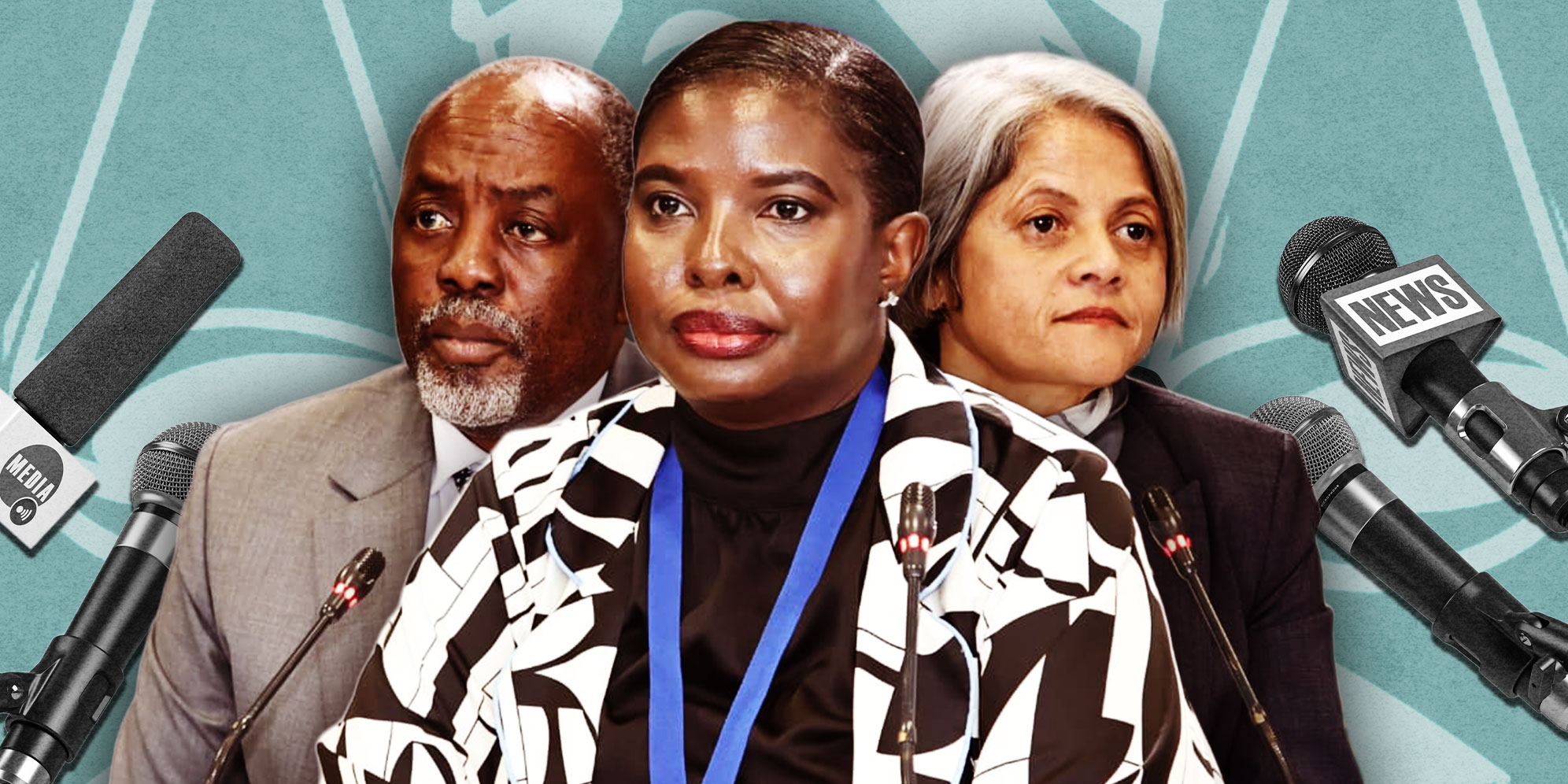
 Illustrative Image: Adv Xolisile Khanyile. | Adv Hermione Cronje. | Adv Menzi Simelane. (Photo: Lwandile Ngaxa/ GCIS) | Microphones. (Image: Freepik) | NPA Logo. (Image: Wikicommons) | (Composite: Daniella Lee Ming Yesca)
It is no longer possible to deny that South Africa’s National Prosecuting Agency (NPA) is riddled with very serious problems, said the former NPA Investigating Directorate (ID) head, Hermione Cronje, while being interviewed for the position of National Director of Public Prosecutions (NDPP), on Thursday, 11 December.
“You can ask: why am I back here if I think it’s so disastrous? I do think we are at a point in the country now where it’s undeniable that we have serious problems in the NPA, and that we need to actually come up with a diagnosis.
“I dispute the narrative that it’s only in complex corruption cases that we’re not doing so well. I utterly dispute that. And I think that if we look at the data that is coming out of the courts, it’s a problem across the board,” said Cronje.
Read more: WATCH: ‘Tell no lies, claim no easy victories’ — Is the NPA in crisis?
Cronje quit the NPA ID in December 2021, only 2½ years after her appointment. The official line was that she had resigned for “personal reasons”. Daily Maverick reported that she struggled with a limited budget, lack of competence and resistance to bringing in the right people.
On Thursday, Cronje said, “I left because I felt that … the space wasn’t there for me to implement the things that I thought should be implemented,” adding that she was “struck by the levels of dysfunction” within the NPA.
Read more: NPA’s Investigating Directorate boss no more: Hermione Cronje quits after frustrating 30 months
Cronje was an assistant to South Africa’s first NDPP, Bulelani Ngcuka, when the NPA was formed in 1998, after Ngcuka recruited her while they were both working in Parliament. She later held several roles in the NPA’s Asset Forfeiture Unit (AFU), resigning from the organisation in March 2011. She returned in 2019 as the inaugural head of the ID.
Seated before a seven-person advisory panel on Thursday, Cronje talked at length about the NPA’s many crises — and why she is the person to fix them.
NDPP Shamila Batohi, who retires in January 2026, went on record in August this year saying the NPA is “certainly … not in crisis”.
Cronje is one of six candidates competing for the NPA’s top post and was interviewed along with the chairperson of the Global Coalition to Fight Financial Crime and former Free State Director of Public Prosecutions, advocate Xolisile Khanyile, and a former NDPP under Jacob Zuma, advocate Menzi Simelane.
Read more: The best and worst moments from Day 1 of the interviews for the NPA’s top job
The panel, chaired by Justice Minister Mmamoloko Kubayi, will now recommend three candidates to President Cyril Ramaphosa for his final consideration.
Let’s look at some of the best and worst moments that emerged from the candidates’ interviews on Thursday.
Advocate Xolisile Khanyile
Best moments
Khanyile regarded herself as a key player behind getting South Africa off the Financial Action Task Force (FATF) grey list in October 2025. (However, sources have told Daily Maverick’s Rebecca Davis that Khanyile was not as proactive in this process as she may have suggested).
Regardless, Khanyile said South Africa has to prioritise dealing with organised crime to avoid SA being greylisted again. She told the panel, in response to a question from the Auditor-General, Tsakani Maluleke, that she would prioritise this ASAP. She would also prioritise dealing with the rate of sexual offences.
Read more: After the Bell: Off the grey list, on to the to-do list
On her vision for the NPA, Khanyile said the prosecuting authority could not use old ways to address current issues. She stressed the issue of capacity building. However, she had a more favourable view of the aspirant prosecutor programme than did the current Investigating Directorate head, advocate Andrea Johnson, and Cronje.
“I think advocate Batohi was able to push and be successful in getting prosecutors to be supported… You can’t prioritise crime if you don’t prioritise capacitating your prosecutors and police officers,” she said.
Khanyile added that she would be a “visible” NDPP. “I will be visible, and I will intervene if needed,” she said.
Worst moments
Khanyile, like Johnson on Wednesday, was also grilled on the issue of discrepancies in her CV. She struggled to account for certain inconsistencies regarding the dates of previous positions she had held, and her time in Pietermaritzburg and what she did there.
Khanyile asked whether the issue could be “parked” and returned to after the interview, but Kubayi belaboured the issue, telling her a CV “is a basic thing”. Khanyile later admitted that she should’ve paid more attention to it.
Khanyile also stumbled when, in describing her vision for the NPA, she told the panel that she believed the institution was doing good work in dealing with organised crime.
“In organised crime, minister, I think the NPA is doing very well,” she said.
Her comment comes as two simultaneous inquiries — the Madlanga Commission and Parliament’s ad hoc committee — are probing accusations of criminal cartels, interference and corruption in South Africa’s politics and criminal justice system.
Read more: ‘It’s like we’re powerless and watching criminals take over SA’ – NPA boss Shamila Batohi
Advocate Hermione Cronje
Best moments
Seated before the panel, Cronje detailed her extensive experience in the public service and as an international anti-corruption and asset recovery specialist. She showed off her institutional knowledge of the NPA and the criminal justice system.
Cronje outlined a clear vision for reform for the NPA. She said the “skills catastrophe” within the NPA “remains my enduring concern”.
“I’m prone to hyperbole, but what I meant is there was a skills crisis in the NPA. I still believe that,” she said. “That doesn’t mean there aren’t very good people in the NPA with very good experience.”
She explained that her international experience of looking at other prosecuting authorities had taught her that a prosecuting authority would never pay enough to attract good lawyers from the private sector to the state prosecution.
“It’s never going to be about the money,” Cronje said frankly.
“What the successful prosecuting authorities do is the training they offer is top class,” she said.
This means the NPA has to provide “excellent training to attract” prosecutors, according to Cronje. “It’s not a hard thing to do, it’s not an expensive thing to do… It’s a systemic solution,” she said.
Worst moments
Cronje’s honesty tripped her up at times.
Near the start of her interview, she admitted that she tends to be “quite impulsive” — referring to an instance where she considered tending her resignation from the AFU when Simelane torpedoed the AFU’s first-ever preservation order in another jurisdiction.
She later let slip that “most times the NPA doesn’t want to work with me”, and was challenged by Kubayi on what she meant.
At one point, the chairperson of the Commission for Gender Equality, advocate Nthabiseng Sepanya-Mogale, who is on the advisory panel, said she was “worried” about Cronje’s “problematic” diagnosis of the NPA. Sepanya-Mogale chastised her for what she called her “total gloom and doom” view of the institution.
But Cronje pushed back.
“If we are not prepared to interrogate the problems in the NPA — and brutally look at what’s working and what’s not working, and fix what’s not working, then we are forever going to be disappointed.
“So I hear you [that] I should temper my language and not call it a catastrophe. I’m trying to get attention to the issue. But it probably isn’t a catastrophe, because it’s fixable. I believe it’s eminently fixable. I’m just frustrated that we don’t take the steps to fix it,” she replied.
Advocate Menzi Simelane
Best moments
On time. Nice suit.
Worst moments
Simelane, who was the Competition Commission’s chief legal counsel from 1999 to 2005, did list some of his achievements at the commission, saying the systems that he set in place then are still running and functioning as “first-world institutions” today.
But they’re clouded by the fact that he shouldn’t have been interviewed in the first place.
Simelane received 28 public comments on his NDPP candidacy. Professor Somadoda Fikeni, chairperson of the Public Service Commission, said all but two were objections.
Fikeni put it frankly: “The issue of integrity keeps coming up again and again.”
As the then director-general of the Justice Department, Simelane gave testimony to the Ginwala Commission, which was probing the fitness of former NDPP Vusi Pikoli for the position. The Ginwala report later found that Simelane tried to mislead the probe.
His appointment by Zuma as NDPP in 2009 was later overturned by the Constitutional Court in October 2012, due to questions over his honesty and integrity, arising from his submissions to the Ginwala Commission.
Kubayi challenged Simelane on the reference in Frene Ginwala’s report, specifically his “dishonesty”. However, Simelane denied that this was a finding about him.
“It could not have been a finding, Minister, because the inquiry was not about me,” he said.
He was also grilled by the panel over Bosasa and his disbandment of the Scorpions (Directorate of Special Operations). He said that when he was NDPP, he refused to prosecute Bosasa because he did not trust the Scorpions at the time. DM