



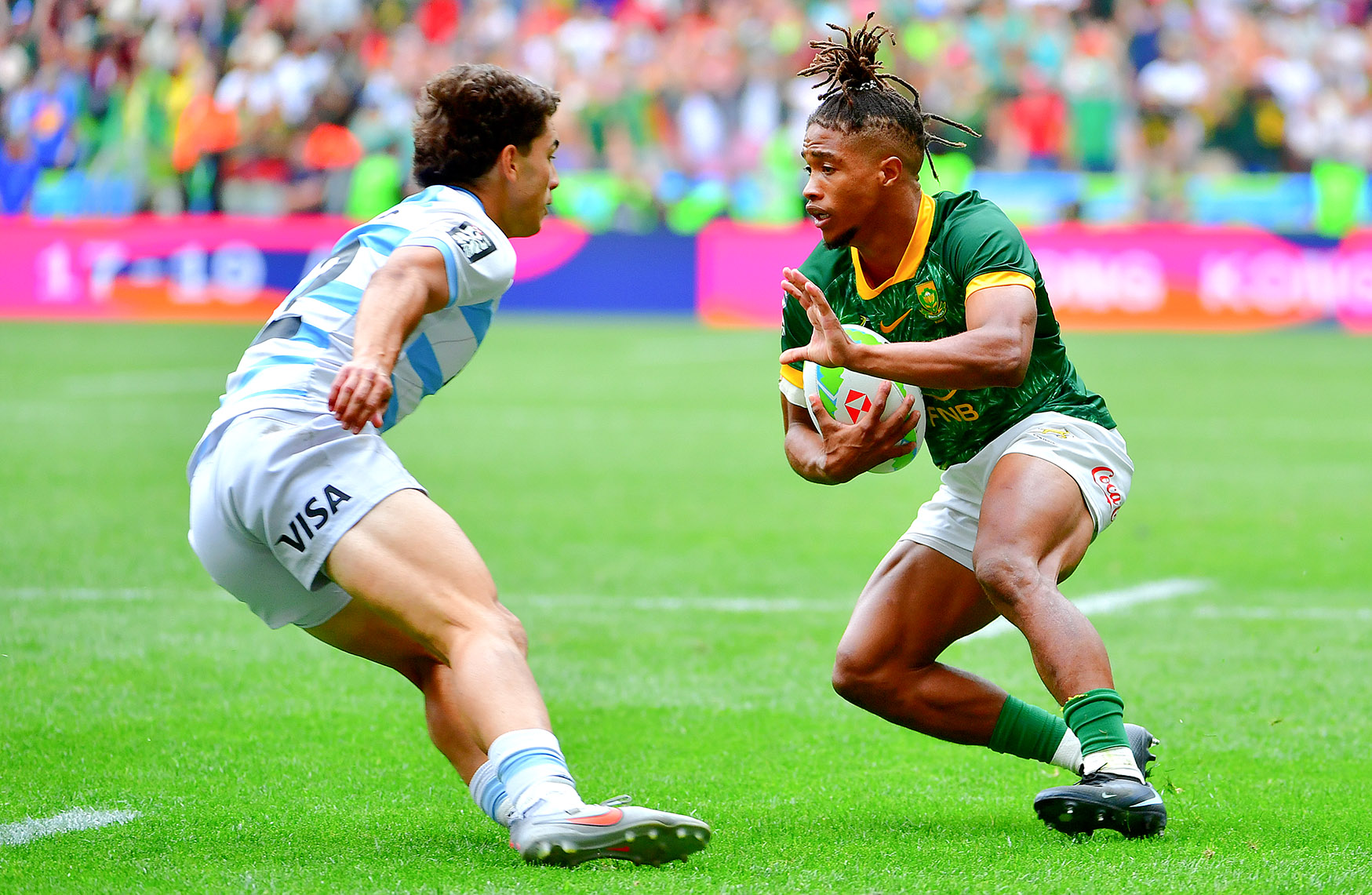
 Rising SA Sevens star Sonwabo Sakoyi, right, starred against Argentina in the final of the HSBC SVNS Cape Town. (Photo: Grant Pitcher / Gallo Images)
Rio 2016 was the first time ever that rugby Sevens was included as a sport in the Olympics. South Africa walked away with a bronze medal in the inaugural tournament with the likes of Kwagga Smith and Cheslin Kolbe participating.
It was seen as the catalyst for the rise in popularity of the sport and a platform for players to be noticed by their national 15s side. According to World Rugby, the Rio 2016 Olympic Games was the most socially engaged rugby Sevens event of all time, attracting 30 million new followers worldwide.
/file/attachments/orphans/TL_2496106_566865.jpg "Selvyn Davids catches the restart as the Blitzboks meet Argentina in the final of the Cape Town leg of the SVNS World Series. (Photo: Grant Pitcher / Gallo Images)")
Fast forward nine years, as Cape Town concluded its leg of the World Rugby HSBC SVNS Series, and the sustainability of the Sevens format is being called into question.
The Blitzboks pulled off a miraculous victory over Argentina on Sunday 7 December 2025 to become back-to-back champions in the Mother City. However, the celebration was enjoyed in front of sparse crowds as only a total of 68,124 spectators were in attendance, down from 75,000 in 2024 and 80,000 in 2023.
The decline in spectators is just one visible indicator of an ailing system. However, there are many facets contributing to this, including erratic restructuring, and financial and developmental concerns.
Financial issues
The SVNS World Series has undergone a new structure; a third restructure in five years, as previously reported by Daily Maverick. The restructuring has left a “bad taste” in the mouths of players and fans. The original 10-tournament structure in 10 major cities has been tweaked, creating a “convoluted and confusing” spectacle.
The Sevens circuit has expanded from 10 tournaments to 13, with three divisions that culminate into a three-event World Championship. The top eight teams for both men and women automatically go through to the World Championship.
Meanwhile, Division 3 is a standalone, regional tournament. The top two teams from each gender progress to Division 2 where a total of six teams will battle it out for the last four spots of the season finale. What a mouthful.
World Rugby claims the new tournament format is a way to increase competitiveness while cutting down on costs to ensure the financial sustainability of Sevens. While World Rugby establishes this new way forward, some Sevens teams are struggling to keep pace with the changes.
In May 2025, the Irish Rugby Football Union (IRFU) cut their men’s Sevens programme, citing financial constraints.
In their 2023/24 financial year, the union suffered a loss of €18-million, roughly R350-million.
“The financial situation we face is challenging, and it’s crucial that we take decisive action to secure the long-term success of Irish Rugby,” said IRFU High Performance Director, David Humphreys, in a statement.
After getting into contact with the IRFU, Aoife Clarke, the director of communications, said they “won’t be making any further comment on [their] decision”. This was via email and Daily Maverick was subsequently referred to the statement above.
What is more, in the same month, Great Britain (GB) announced that its men’s and women’s Sevens programme would be cut at the end of July. Essentially, the players will no longer enjoy the support of full-time contracts and will instead come together just before the SVNS Series to train and play.
As with Ireland, the union said the cut was due to financial pressure.
The implications were visible in both the Dubai and Cape Town legs when GB were annihilated by South Africa 35-0 and 41-7 respectively. During the fifth-place semi-final game in Dubai, the commentators mentioned that GB had only gathered for four training sessions before the tournament, and it showed.
/file/attachments/orphans/TL_2495951_116519.jpg "South Africa’s men and Australia’s women celebrate winning the cup finals of the HSBC SVNS Cape Town. (Photo: Grant Pitcher / Gallo Images)")
As it stands, GB men are second last in the Division 1 standings, and the women are last. The prospect of relegation coupled with the lack of funding might see GB follow Ireland’s lead.
The restructuring is no doubt an attempt to revive the timid heartbeat of Sevens in the long term; however, in the short term it risks opportunities for growth and development for some nations not included in Division 1.
Best versus best?
In an interview during the Los Angeles leg of the SVNS series back in May, World Rugby CEO Alan Gilpin said: “We’re going to see the best versus best so much more in the next couple of seasons, and give more teams the chance to be best prepared for the Olympic Games.”
While the new format has the potential to be exciting in the beginning with intense rugby between the best sides around the world, having fewer teams competing against one another could become boring and repetitive.
/file/attachments/orphans/TL_2496100_781267.jpg "Blitzbok flyer Christie Grobbelaar. (Photo: Grant Pitcher / Gallo Images)")
“We played Fiji (in Dubai). We’re going to play them again, and Great Britain... Because we analyse you. So by the sixth game, the seventh game, I’m going to know exactly what you’re going to do,” Blitzbok player Ronald Brown said.
Brown’s former teammate, Mfundo Ndhlovu, on the other hand, believes the new format is far more exciting and the high level of competitiveness encourages them to want to win more. However, he does recognise that it proves to be a longer journey for those in lower divisions to get to that competitive level.
When asked via WhatsApp what World Rugby’s thoughts were on the new format and the risk it had in hampering development, Dom Rumbles, chief communication officer for World Rugby, referred Daily Maverick to this statement: “World Rugby views Sevens as an important investment, and importantly, for unions, players and fans, the new model creates certainty and sets out a clear and exciting future for Sevens through to the LA 2028 Olympic Games, an important platform for the sport to generate investment from NOCs (National Olympic Committees) and governments.
“With new events in Valladolid and New York in the top division, and new host locations in SVNS 2 and 3, it is a model that enables greater hosting opportunity, greater playing opportunity and a platform for new stars to shine.”
Before the announcement was made earlier this year, Kenya were expected to qualify for the main SVNS series under the old format. Having placed ninth overall, they just missed the cut and now have to qualify through three Division 2 tournaments, despite being in the finals in Singapore last season.
The SVNS Division 2 will take place in Nairobi, Montevideo, and São Paulo in February and March, with four out of the six teams teams for men and women already decided. For the women it will be China, Kenya, Spain and Brazil, and for the men, Kenya, Germany, Uruguay and the United States (USA).
However, with more and more big Sevens tournaments dropping off the calendar, that is the Rugby Sevens World Cup and the Commonwealth Games, second and third division teams now have fewer chances to compete on the global stage outside of the SVNS World Series.
As it stands, Kenya, which will be hosting the first iteration of the SVNS 2 tournament, only have competitions such as the Safari 7s and Africa Men’s Sevens, which it has won six times.
The Africa Men’s Sevens is also one of the only ways Kenya could qualify for LA28, bar the SVNS 2 tournament.
For South Africa, aside from the SVNS Series and the Olympics, the Emirates Dubai invitational tournament, which happens annually, as well as the Africa Men’s Sevens are the only two major tournaments left for the Blitzboks to compete in.
Additionally, South Africa women, who are now under one banner with Women’s Rugby, won the Africa Women’s Sevens in early November and through that qualified for the 2026 challenger series, the third division of the HSBC SVNS tournament.
/file/attachments/orphans/TL_2485281_129288.jpg "SA’s Zintle Mpupha fends off a Ghanian opponent at the Rugby Africa Women’s Sevens Championship, in Nairobi, Kenya. (Photo: Hassan Wamwayi / Gallo Images)")
“The Sevens landscape has changed considerably over the past decade, with inclusion in the Olympic Games, the Covid-19 pandemic, a new world series structure and new tournament formats all playing a role,” said a spokesperson for SA Rugby.
“SA Rugby, like other federations, have had to amend our programmes and approach. World Rugby has locked in a structure for the next few years and we’re working within those parameters, with the Los Angeles Olympics in 2028 a major goal for our men’s and women’s teams.”
However, with so few tournaments on the roster, how are smaller nations meant to be competitive enough to reach the Olympics, and once they are there, how do they stand a chance against the bigger teams who have been playing more and against more developed sides?
Thus, it is difficult to defend “the opportunity for growth” argument. Smaller nations, in a dystopian-esque overtone, have to fight it out among each other so that only a few get to play against the elite.
In the end, this reduced team structure may keep “the best of the best” on their toes, but at the same time it does pose the risk of hampering opportunities for growth in more developmental sides.
There is a reason why the Springboks still played Wales even after knowing they would give a thumping, and captain Siya Kolisi said it best: “I know a lot of people in the Welsh public are saying ‘Why are they playing this game against the Springboks?’ I don’t like it when people question this. Who are [Wales] supposed to play to improve themselves?
“I know the first-choice players are not there, but to create squad depth you have to play against the best teams.” DM