



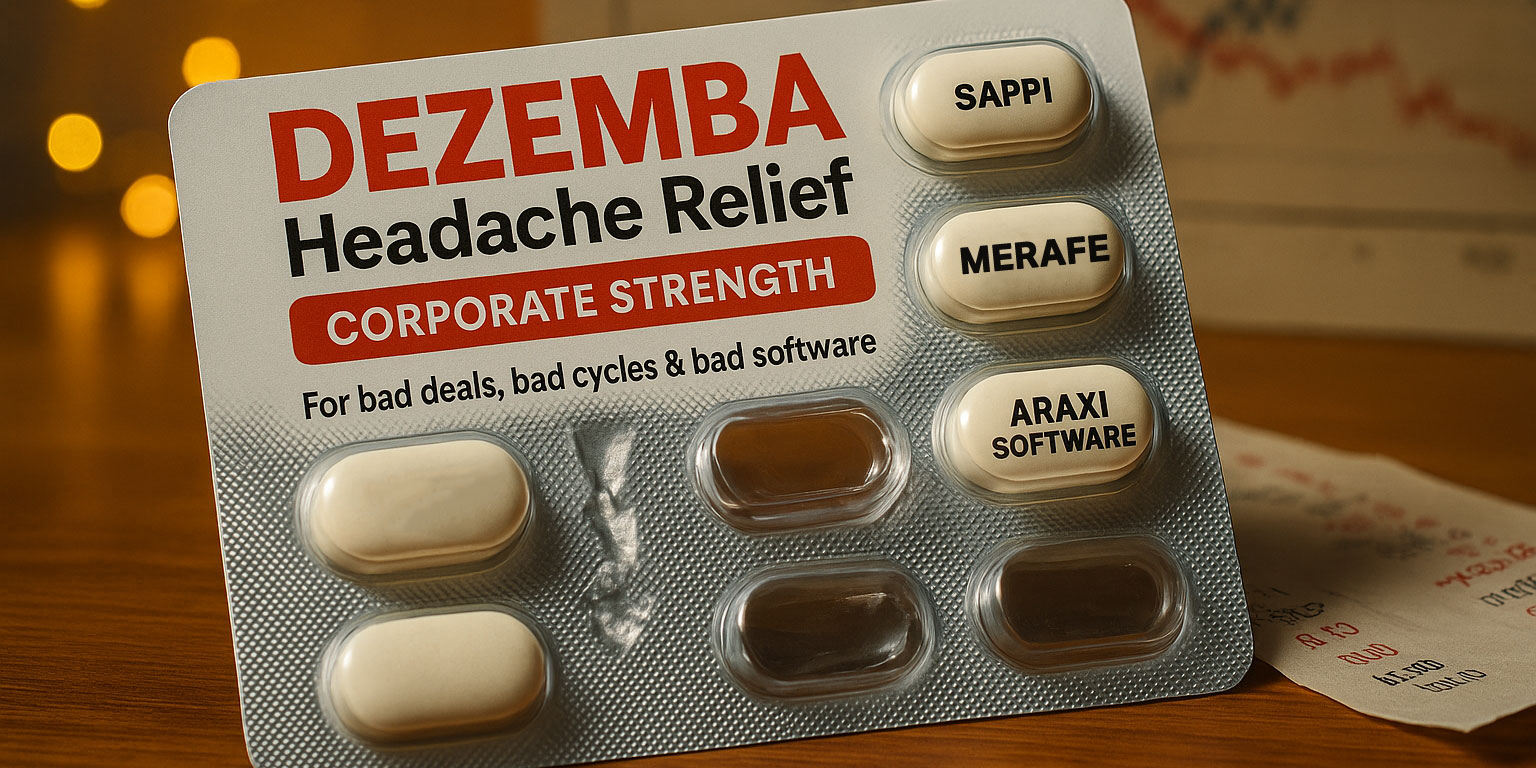
 bm ghost dezemba
It’s Dezemba! And for many South Africans, that means stocking up on headache tablets and getting ready to party their worries away. The stress will be back by 3 January when credit cards are stretched to breaking points, but that’s 2026’s problem. Such is life when you live in a high-stress country where the festive season happens to coincide with the warmest weather of the year.
As we get close to the end of 2025 and contemplate what 2026 could look like, we find no shortage of listed companies that also have Dezemba-strength headaches. The specifics vary, but it usually comes down to the same thing: companies being hurt by assets that they either shouldn’t have acquired or shouldn’t have held onto for so long.
Let’s begin with a particularly tough industry: paper.
Sappi’s European graphic paper nightmare
Sappi’s share price is trading in line with levels seen in 2009, 2011, 2013 and 2020. In other words, if you’re looking for a company with a share price that heads consistently towards the top right-hand side of the page, you should move right along from Sappi.
/file/attachments/2985/ChatGPTImageDec7202502_28_41PM_771902_f415c8768af5bfd8620263165a5653db.png)
(Source: Sharedata / graphic created using ChatGPT)
This is a cyclical stock that will eat you up and spit you right out if you get the timing wrong. If you get your timing right though, you can double your money in the space of a couple of years. Such is the risk/reward trade-off.
Sadly, 2025 has been more about the risk than the reward. The share price is down 50% year-to-date as Sappi has found itself at an ugly point in the cycle with a vulnerable balance sheet. The challenge for these cyclical stocks is that trying to time their capex correctly is really difficult. There’s a long lead time for capex, and by the time a particular programme has been completed, the world has probably changed.
To add to these challenges, Sappi operates in a sector that features structural weaknesses in certain products. Paper isn’t nearly as appealing as it once was, with the world becoming more digital every second of the day. This means that Sappi is constantly on a treadmill set at maximum gradient, where nothing is easy and cost efficiencies need to be found each year.
One of the biggest problems in the group is the European graphic paper business. To try to solve that problem (or at least limit the pain), Sappi has put in place a deal with UPM-Kymmene Corporation to create a joint venture that will hold Sappi’s European graphic paper assets and UPM’s communications paper business in Europe, the UK and the US. This effectively reduces Sappi’s exposure to these European assets, although it gives it exposure to other paper assets that might be just as bad. After all, it’s unlikely that UPM would be willing to reduce exposure to excellent assets in exchange for exposure to Sappi’s difficult European story.
Read more: From weed to wires, new fish and leaner paper empires
The circular to shareholders will have all the details on the underlying economics of the deal and the resultant joint venture. It will be an interesting read when it becomes available.
Raubex and Merafe’s chrome calamities
I’m no expert on the chrome space, but I do know that there are various steps in the value chain, ranging from mining the ore through to smelting it into ferrochrome. As with all commodity companies, chrome miners are vulnerable to chrome prices and demand. For the smelting businesses, the additional risk comes in the form of how energy-intensive the smelting process is.
Merafe, which focuses on smelting, hasn’t found a solution to the existential crisis facing the Boshoek and Wonderkop smelters. It simply cannot operate the smelters profitably at current energy prices in South Africa. There’s clearly a “greater good” argument here for the country, as I don’t think that allowing energy pigs to obtain energy at highly discounted prices is a net benefit to our economy. But this doesn’t help Merafe or the employees of Boshoek and Wonderkop, with Merafe putting both smelters on care and maintenance and issuing retrenchment notices to staff. This leaves Merafe with only the Lion smelter.
Read more: Of 0.5% growth and my undue optimism
Over at Raubex, the company has found itself caught in the chrome industry thanks to the misguided acquisition of Bauba Resources a few years ago. For some reason, the company felt that the smart thing to do was to layer mining risks on top of a business that faces infrastructure cycles and construction risks. In a story as old as time, illogical M&A has led to a situation where the company needs to get rid of the problematic asset before it does even more damage to the investment case.
At least it is acting decisively, so I’ll give credit to Raubex for that. Many companies would sit on the asset for another year or two while trying hard to convince the market that it remains a strategic fit.
This leads me to a company that is taking too long to make the tough decision about a division in its group.
Araxi’s awkward software business
Araxi (previously Capital Appreciation) has a great payments business. It features recurring cash flows, a growing estate of devices and all the elements that investors just love seeing in a fintech company. In fact, it’s so strong that it is considering a further acquisition in this space – a sensible idea if you ask me, particularly as it is sitting on more than R300-million of cash on its balance sheet and no debt.
Alas, it also has a software division that becomes harder to justify each year. The results for the six months to September show just how vast the difference in performance is between the two divisions. While payments grew revenue by 23.2% and earnings before interest, tax and depreciation (Ebitda) by 33.1%, software suffered a revenue decline of 20.2% and a horrible move in Ebitda of negative 82.7%.
Sure, there are once-off restructuring costs included in these numbers, but that doesn’t explain the drop in revenue. Software has been problematic for a couple of years now, and there’s always an explanation by management of how it will get better and why it still belongs in the group. Sadly, the reality is that this just isn’t an appealing sector unless it features a business model with recurring cash flows.
Investors only have so much patience, with Araxi’s share price performance of 15% in 2025 being much less than what it could’ve been if the software business was out of the system. There’s a lot to be said for that old adage of “your first loss is your best loss”. In other words, rather make the hard decisions earlier than later.
2026 is surely the last chance for this business to demonstrate a turnaround, particularly after the restructuring activities. Perhaps they will finally take a leaf out of Raubex’s book and do the hard thing. DM