



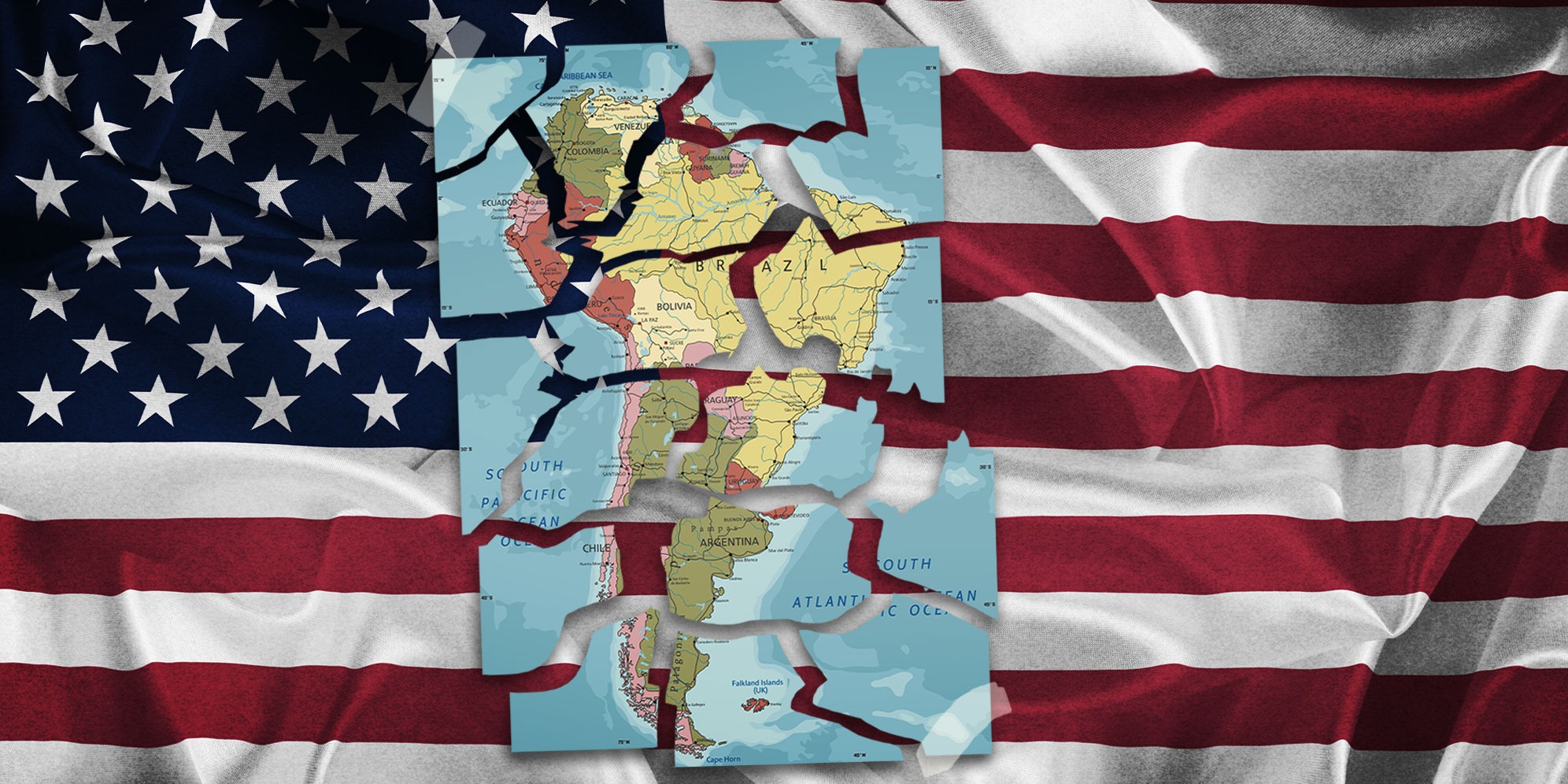
 Illustrative Image: Map of South America. (Image: iStock) | US flag. (Image: Freepik) | (By Daniella Lee Ming Yesca)
In 1823, America was a nation whose military was inferior to any of the major (or even minor) European powers and that military was focused on indigenes unwilling to be driven from their ancestral lands. But, in that year, the country first articulated a loftier vision for its future role in the Western Hemisphere.
Twenty years previously, America had purchased New Orleans and the Louisiana Territory from Napoleonic France, doubling the size of the country, but its potential antagonists were on all sides. To the north, the British were expanding westward from Lower Canada; to the south, the Spanish, less than two years earlier, had given way to the new nation of Mexico, following 300 years of colonial rule, but might be angling to return. More distantly, tsarist Russia was expanding its claims southward from outposts in Russian America (now Alaska and northern California).
In Central and South America, the Spanish empire had disintegrated into a half dozen new nations, and Brazil had also declared its independence, but it was under an emperor from the Portuguese royal family. But every one of the Caribbean islands remained Spanish, French, Dutch, British or Danish colonies, except for Haiti where slaves had overthrown French overlords after thousands of soldiers died from tropical diseases or combat.
The Monroe Doctrine — why it still matters
Thus, in this landscape there were real fears that European nations might attempt to recolonise the Western Hemisphere. In response, on behalf of the president, Secretary of State John Quincy Adams drafted a statement – the “Monroe Doctrine” – setting out two basic principles for US foreign policy. First was America’s non-interference in European affairs, but, henceforth, America would be the bulwark against future European adventures in the New World.
As Adams wrote:
“…[with] regard to Europe, which was adopted at an early stage of the wars which have so long agitated that quarter of the globe, nevertheless [our policy] remains the same, which is, not to interfere in the internal concerns of any of its powers; to consider the government de facto as the legitimate government for us; to cultivate friendly relations with it, and to preserve those relations by a frank, firm, and manly policy, meeting, in all instances, the just claims of every power; submitting to injuries from none. But, in regard to those continents [i.e. North and South America], circumstances are eminently and conspicuously different.
“It is impossible that the allied powers should extend their political system to any portion of either continent, without endangering our peace and happiness...”
This bold assertion of a wall against foreign intervention, however, required the tacit support of the British navy to give it stick, given America’s military weakness. There matters stood until the American Civil War.
Of course, this policy did not preclude America from wresting the vast American Southwest from Mexico in 1848, after Texas declared its independence from Mexico in 1836 and was annexed by the US in 1845. (Many Texans were actually American migrants determined to establish farms and ranches worked with slave labour – a practice the Mexican government had outlawed.) This animating idea of America’s “Manifest Destiny” – its future demanded its expansion unstoppably across the continent – was becoming a common understanding in the US.
During the American Civil War, France’s Napoleon III had conned Austrian Habsburg Prince Maximilian into accepting nomination as emperor of Mexico, backed by French troops. But, when the Civil War ended, the North, with its battle-hardened, modern army, indicated a disapproval of this new empire; the French quickly “read the room”, and cut their losses, leaving a trumped-up emperor to his fate. Mexicans soon ended this European adventure, under the leadership of the indigenous Zapotec politician, Benito Juárez. (A footnote: Juarez was the country’s first leader not from the Spanish elite.)
Building a tradition of intervention – Cuba
With the French out of the picture, the Monroe Doctrine was again the core of American policy in the region. In the latter half of the 19th century, the US would occasionally dispatch small military forces to various Central American and Caribbean states to protect American citizens and business interests amid local civil wars or insurrections, but these would become a template for more expansive efforts in the future.
With an increasingly powerful economy, America’s political leadership was beginning to see the Western Hemisphere as the natural arena where – besides waving off European adventures – it could flex muscle in a world where the ideology of empire was in the ascendant. There was the growing appeal of liberating Cuba from Spanish rule – or perhaps gaining control of it as an American dependency, given the geographical reality Cuba was just 140km from Florida. In fact, Cuba has continued to be an intense preoccupation for many American politicians right into the present, as we shall see below.
In 1898, an American naval vessel, the USS Maine, on a port call in Cuba, exploded at anchor. A rabble-rousing mass media immediately declared Spain was the culprit, justifying an American declaration of war against Spain and invasions of Cuba and the Philippines, Spain’s last major colonial possessions.
In the American victory, Spain ceded control over Cuba and Puerto Rico in the Caribbean. The latter became a US territory while the former gained a quasi-independent status. Cuba’s new constitution gave the US the right to intervene over domestic and international policies, troubling Cubans after its formal independence in 1903.
While sugar cane remained a key element of its economy, tourism from America began to grow in the 20th century. This eventually included casinos and the presence of American mafia gangs in collusion with corrupt elements of the ruling elite. Viewers of The Godfather film trilogy know this well.
A key provision of the island’s independence was the lease of a US naval base at Guantanamo that was a growing bone of contention after Fidel Castro’s guerrilla force had overthrown the Fulgencio Batista regime in 1959. The new government’s turn towards Soviet-style socialism and its expropriation of businesses generated waves of Cuban emigres to the US, the birth of a key voting block in Florida’s Republican politics.
/file/dailymaverick/wp-content/uploads/Brooks-Our-Castro.jpg "Fidel Castro. (Photo: Supplied)")
With Castro’s leftward turn, in 1961, the CIA, acting in tandem with a cadre of Cuban emigres, carried out an amphibious landing at the Bay of Pigs, designed to trigger a mass revolt against Castro’s government. But after the landing was defeated, Castro implored his Soviet backers for help to preclude such future efforts. In response, the Soviet Union installed nuclear-tipped missiles capable of hitting much of the US from launching pads in Cuba, an action aimed at altering the strategic balance between the two nuclear superpowers and thus a shield for the Castro regime. The resulting crisis became a hinge moment of the nuclear age.
America’s discovery of those missiles in October 1962 set off a major great power standoff until the Russians withdrew their missiles in the face of a US naval quarantine around the island and the possibility that the tension could lead to a nuclear war. (As part of the settlement, the US pledged not to aid future invasion attempts and withdraw obsolete missiles positioned in Turkey. The crisis led to the first nuclear test ban treaty between the powers.)
Interventionism gains traction – Venezuela and Panama
Returning to the end of the 19th century, as yet another sign of America’s growing presence and impact in the region, President Grover Cleveland elected to intervene in a dispute between Venezuela and Britain over Venezuela’s border with British Guiana. This effort was the US’s first engagement with Venezuela – a century before the crisis currently over Nicolás Maduro.
Cleveland’s engagement came three decades before the start of Venezuela’s oil boom, but the disputed territory was thought to be a major source of gold – an idea stretching back to the era of the conquistadors in the 1500s.
Although Cleveland’s decision largely supported the British claim, it did guarantee Venezuela’s clear access to the mouth of the Orinoco River, and that opened up a vast hinterland for economic exploitation – and eventually became the location of Venezuela’s oil boom. Cleveland’s engagement underscored a sense that anything in the hemisphere was a wide-open door for American involvement. Such a position should be finding an echo right about now.
Meanwhile, growing commercial shipping and a strong belief that America needed to be able to operate its navy globally without needing to sail around South America, renewed interest in building a canal across Central America. The French had earlier tried to build one, following their success with the Suez Canal, but this time they were thwarted by construction challenges and disease.
President Theodore Roosevelt was determined to build such a canal as part of a declaration of America’s arrival on the global scene. When the Colombian government declined the American approach, Roosevelt encouraged a declaration of independence from Colombia by the newly minted nation of Panama. Small detachments of US troops were sent to ensure everything went the right way and Panama promptly embraced the idea of a canal, ceding a zone across the isthmus to fall under US control.
/file/dailymaverick/wp-content/uploads/2024/03/12120883.jpg "A ship transits through the Panama Canal, in Panama City, Panama, 22 March 2024 (issued 25 March 2024). Transits through the Panama Canal increase to 27 daily, after a reduction, due to the drought, which is impacting international maritime trade at a time when it is also affected by the crisis in the Red Sea. EPA-EFE/Carlos Lemos")
New places for interventions – Mexico, the Caribbean and Central America
Still more American muscle flexing was taking place. Early in the 20th century, the US sent forces into northern Mexico to interdict bandit groups led by the legendary Pancho Villa from carrying out raids near the US-Mexico border. In 1917, the US purchased the Danish West Indies islands in an effort to forestall the possibility that Germany might use bases there as safe harbours for its submarines during World War I.
Whoa. A Danish colony, presumed foreign threats, and the offer by the US to buy the territory sounds rather familiar, today, doesn’t it?
Until the mid-1930s, a whole series of modest US military expeditions were dispatched to Central American and Caribbean nations, often when local governments were judged unable to maintain civil order or carry out the effective management of ports, tax collections and other government activities affecting American interests. Such interventions included multiple versions in Honduras, Cuba, Panama, the Dominican Republic, Nicaragua and Colombia, as well as Haiti and Mexico. Troops were also sent to Guatemala. The deployment in Haiti lasted for 19 years, in Panama for two, in the Dominican Republic for eight and in several parts of Mexico over three. Meanwhile, Nicaragua had US troops stationed there for seven years. US interventions often went hand in hand with the presence of companies such as the United Fruit Company and were carried out in cooperation with local – often kleptocratic – elites.
During World War 2, several British Caribbean possessions had US deployments stationed there, although those deployments were part of the bilateral Lend Lease Agreement trading 50 older US naval vessels to Britain for protection of their convoy lifeline across the Atlantic Ocean in exchange for basing rights in UK-held territories.
The US-Latin American relationship – the good neighbour policy
President Franklin Roosevelt, in an effort to steer the US and Latin America relationship away from military paternalism, articulated “The Good Neighbour Policy”, announcing that his government would reset relations with the nations of Central and South America on a more equal footing. The US would thereafter emphasise international cooperation and trade rather than military force to promote stability in the hemisphere, although the exigencies of World War 2 sidetracked some of that effort.
One little-remembered sidelight of this effort was the role of then-leftist author John Steinbeck. Roosevelt sent him on a mission across Latin America to assay the impact of fascist propaganda and Nazi Germany’s engagements with governments and citizens in the region. His troubling report led to the creation of the Office for Coordination of Commercial and Cultural Relations between the American Republics (OCCCR), with the young Nelson Rockefeller as head, to establish libraries, to send speakers (and artistic and cultural leaders) to engage with populations, and to arrange study tours of the US. This OCCCR became a progenitor of the US Information Agency and its USIS offices around the world.
Inevitably, this policy pendulum headed back the other way during the Eisenhower years, with interventions back on the agenda. Early on it was in Guatemala, and then, most visibly, it came with the Bay of Pigs invasion of Cuba – although the landing actually took place in the first months of the Kennedy administration.
In the aftermath of that failure, and as an attempt to swing that pendulum back the other way yet again, Kennedy’s “Alliance for Progress” initiative was the newest effort to build a positive partnership with Latin America. For Americans it was, inevitably, spurred on by fears that a Cuban “infection” would hit other Latin American nations.
/file/dailymaverick/wp-content/uploads/2022/08/OD-Oped-Chile-constitution_6.jpg "Chilean soldier and politician, Augusto Pinochet Ugarte. In 1973 he led a coup which ousted, and resulted in the death of, the Marxist President, Salvador Allende. Pinochet then took over the presidency. (Photo: Keystone / Getty Images)")
In 1965, to forestall a leftist government in the Dominican Republic, President Lyndon Johnson sent in the Marines to contain them and reassert the older elite’s control. Later on, throughout the Richard Nixon, Ronald Reagan and George HW Bush presidencies, amid the Cold War with the Soviet Union, support for coups such as those led by Augusto Pinochet against the Salvador Allende’s leftist government in Chile, or the Contras against a far-leftist Nicaraguan government strongly sympathetic to Cuba, were now back on America’s agenda. These were in addition to the backing of a repressive military government in Argentina. The pendulum had clearly shifted far to the other side yet again.
Still, a modest swing back towards concerns for human rights and democratic principles did take place during the Carter, Clinton and Obama administrations. Perhaps most consequentially, in policy terms, there was even a tentative reengagement with Cuba.
The Trump ‘Donroe Doctrine’ and what it may mean
But now, with Donald Trump’s second term, the oscillation back the other way has now become decisive.
Read more: Pouring oil on troubled waters, US capture of Maduro risks exacerbating turmoil
The Trump administration’s November 2025 National Security Strategy Memorandum (NSSM) has made this abundantly clear – twisting the original meaning of the Monroe Doctrine rather dramatically – when the Trump administration’s NSSM stated:
“After years of neglect, the United States will reassert and enforce the Monroe Doctrine to restore American preeminence in the Western Hemisphere, and to protect our homeland and our access to key geographies throughout the region. We will deny non-Hemispheric competitors the ability to position forces or other threatening capabilities, or to own or control strategically vital assets, in our Hemisphere. This ‘Trump Corollary’ to the Monroe Doctrine is a common-sense and potent restoration of American power and priorities, consistent with American security interests...
“… The United States must be preeminent in the Western Hemisphere as a condition of our security and prosperity – a condition that allows us to assert ourselves confidently where and when we need to in the region. The terms of our alliances, and the terms upon which we provide any kind of aid, must be contingent on winding down adversarial outside influence – from control of military installations, ports, and key infrastructure to the purchase of strategic assets broadly defined.”
Despite citing the Monroe Doctrine as its point of origin, this strategy is an assertion of a realpolitik sphere of influence strategy, based on resources and supply chains, and virtually absent of appeals to ideals and or democratic values. The word “democracy” has barely figured in the Trump administration’s rhetoric over Venezuela.
Or, put another way, as the New York Times reported on their recent two-hour conversation with him: “President Trump declared on Wednesday evening that his power as commander in chief is constrained only by his ‘own morality’, brushing aside international law and other checks on his ability to use military might to strike, invade or coerce nations around the world. Asked in a wide-ranging interview with The New York Times if there were any limits on his global powers, Mr Trump said: ‘Yeah, there is one thing. My own morality. My own mind. It’s the only thing that can stop me.’” John Quincy Adams and James Monroe would be astounded by this assertion of a Trumpian will to power.
With Trump’s recent threats to Honduras to cut off any future aid if his preferred candidate, Nasry Asfura, did not win in that country’s presidential election (he did); the swift military raid that took place in Venezuela to arrest that country’s leader in addition to seizing oil tankers and blasting putative drug-smuggling boats and crew out of the water; the harsh words directed towards Venezuela’s neighbour, Colombia, once Maduro and his wife were spirited away for a trial in New York City in March; and the harsh reality Cuba’s economy will soon be in real freefall as Venezuelan oil shipments are cut off, we are now witnessing the latest swing towards that old playbook of gunboat diplomacy. And there may be more to come.
Those are outcomes emanating from warping the ideas of the Monroe Doctrine into something called the “Donroe Doctrine”, exactly as Trump argued. But this new version grants the strong a free pass to push the weak around, as the Greek historian Thucydides first explained more than 2,000 years ago, and it is well suited for Vladimir Putin and Xi Jinping to use as well.
This is – once again – the swing of the pendulum back to the logic – and practicality – of interventionism in the Western Hemisphere. But where and how this approach will end, and what might bring its excesses to falter, is virtually impossible to predict, at least for now. Perhaps, soon enough, the Danes and Greenlanders will be able to help us figure out where Trump is headed. Or maybe the Canadians will advise us once they really feel the heat. DM