




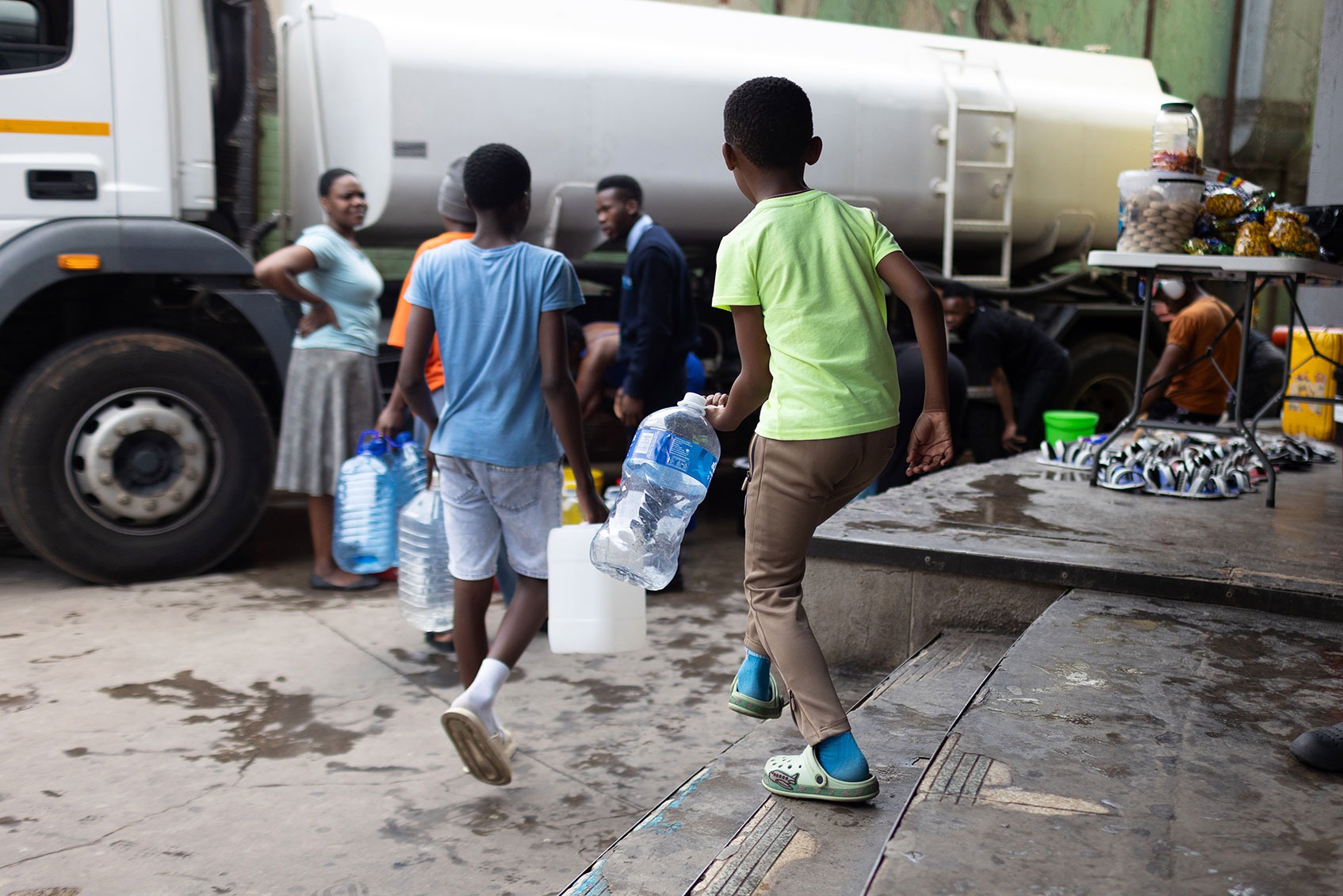
 Residents collect water outside the One Eloff building in Marshalltown, Johannesburg, in October 2025. (Photo: OUR CITY NEWS / Alaister Russell)
While attention has turned to Midrand, where there had not been water for six days, areas like Selby, Melville, Kensington, Bruma, Berea, Brixton, Bezuidenhout Valley and Claremont have faced extended water outages going back months.
Selby has had no running water for at least six months, as work on the Hector Norris pump station continues.
High-lying areas of Melville and Meldene have not had water since January 12. On Tuesday, the rest of Melville, supplied from the Hurst Hill 2 system, lost water. Ward Councillor Kyle Jacobs said he had not heard from city officials about the disruption in water supply.
In Bez Valley, schoolchildren were sent home twice last week because there was no water. Brixton’s high-lying areas have had no water for two weeks.
Some areas of Claremont have not had regular running water for 12 years.
/file/dailymaverick/wp-content/uploads/2025/10/Claremont_Water_JO_44aa.jpg "Claudette Abrahams has been leading efforts to restore water to her community. Some members of the Claremont neighbourhood have been living with extreme water shortages for 12 years. (Photo: OUR CITY NEWS / James Oatway)")
The Midrand water outage was caused by two power failures at Rand Water’s Palmiet pumping station, the latest on happening on 31 January. This was worsened by a leak at Rand Water’s Klipfontein Reservoir inlet, which meant the outlets were closed. Klipfontein (which serves Midrand), Brakfontein and Hartebeeshoek were all affected.
Read more: Midrand residents protest against six-day water outage
Johannesburg’s crumbling water infrastructure, and the slow pace at which it is being fixed, have contributed greatly to water outages all over the city.
At the Brixton reservoir and tower complex, one of the most fragile in the city’s water system, a pump broke down last week, but Johannesburg Water (JW) did not have spare parts on hand to fix it. Jacobs said he was informed on Thursday last week that there were no spare parts at the depot to fix the pump. The pump has still not been repaired, meaning reduced pumping. JW’s latest statement alludes to technical difficulties without giving a timeframe for the completion of the work.
/file/attachments/orphans/OCN_water_woes_02_586614.jpg "The construction of the new Brixton reservoir in Johannesburg, 10 September 2025. (Photo: OUR CITY NEWS / Ihsaan Haffejee)<br>")
On Tuesday, water to most of the areas supplied by the Commando system ran dry. A status update by JW painted a grim picture for the thousands of people drawing water from the system: out of the eight reservoirs and towers serving the area, only the new Brixton reservoir was supplying water, but this came with a warning that supply was declining due to planned maintenance.
No water was expected from the other seven systems. This meant that Melville, Brixton, Vrededorp, Mayfair, Hurst Hill, Westbury, Jan Hofmeyer, Auckland Park and Parktown West were left dry from Tuesday.
JW said this happened because initial backup maintenance at the new Crosby backup pump station could not go ahead without the isolation of the Commando system supply. On Wednesday, JW said work was expected to finish on Thursday at 4pm. It would then take three to five days for the system to recover. JW will provide an alternative water supply, the entity said.
Executive Mayor Dada Morero, speaking at a press conference in Midrand on Tuesday, assured residents that the Midrand water issue was being resolved, and reservoir levels were slowly increasing. “We regret this massive outage,” he said.
At the media briefing, he also announced that JW was building three new reservoirs and one new tower to deal with the rapid expansion and development in the Midrand area. The tower was “almost completed”, he said.
/file/dailymaverick/wp-content/uploads/2025/11/ED_584977.jpg "Johannesburg mayor Dada Morero address a water crisis protest outside the Johannesburg Council Chambers on 1 November 2025. (Photo: Gallo Images / Fani Mahuntsi)")
The lack of communication from city officials has outraged communities affected by the water outages. At a virtual Midrand meeting on Tuesday, residents expressed their frustration over the lack of timely information from JW.
The same applies to communities across the city, prompting WaterCAN, a national water advocacy nonprofit, to call on authorities to institute daily briefings.
“Johannesburg Water has repeatedly failed to communicate consistently about the repeated failures in its ability to deliver reliable water to consumers. Civil society and residents are not peripheral stakeholders. They are the end users who bear the full social, economic and health costs of these decisions. Excluding them from direct communication is unacceptable,” said WaterCAN’s executive director, Dr Ferrial Adam.
“We are calling on the Minister of Water and Sanitation to actively encourage Rand Water to engage directly with the public during periods of prolonged disruption and for (Morero) to ensure the same for the city utility,” she said.
Read more: Joburg’s water woes continue in 2026 with 22 major outages in two weeks
Adam said the daily briefings should provide clear, consistent updates on outages, recovery timelines and system constraints. They should also explain technical issues in simple, accessible language.
“Transparent communication is not a nice-to-have. It is essential to maintaining public confidence, preventing panic, and ensuring accountability. Residents are not only angry because there is no water; they are angry because no one is explaining honestly and clearly what is going on,” said Adam.
As of Wednesday afternoon, only the Roodepoort and Randburg water systems were providing a fair supply. All the other water systems faced constraints. In the South, the Ennerdale reservoir was critically low, while the Lenasia High Level reservoir was empty.
In Soweto, four reservoirs were undergoing some stress. Naledi extension 2 has had no water for four days. The Orange Farm reservoir was running low, and customers in Drieziek 1 and 3 had no water. JW said it was closing the reservoir from 1pm to 5am daily to allow recovery.
Midrand appeared to be recovering, but residents in Vorna Valley, Crowthorne and Kyalami still did not have water on Wednesday morning. DM
This story is produced by Our City News, a non-profit newsroom that serves the people of Johannesburg.
/file/attachments/2985/WhatsAppImage2025-11-21at1946001_346702_1cea9e715c05dc0a538fc79753ac3401.jpeg)
Comments
Scroll down to load comments...