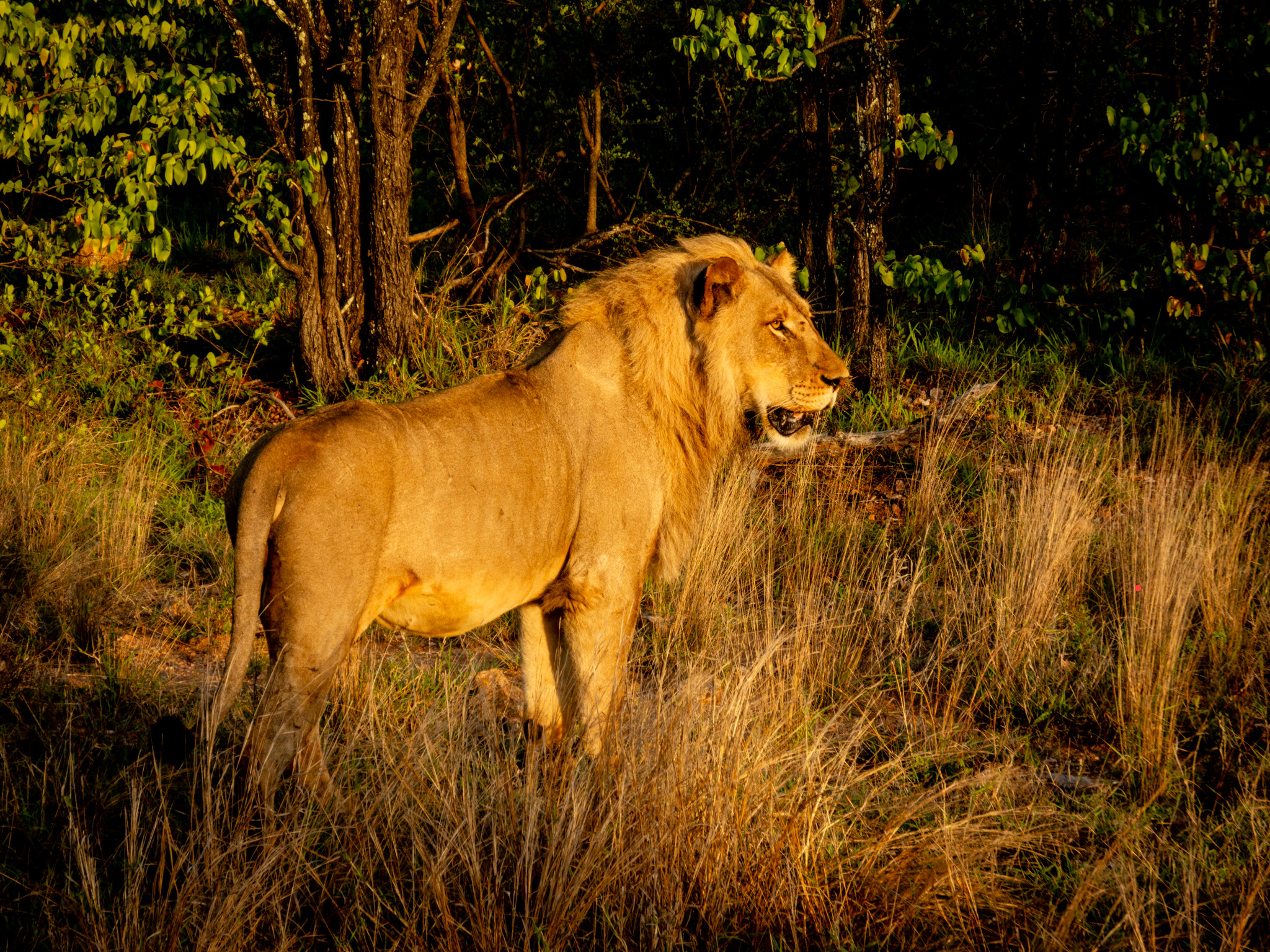
 Whether lions survive the challenge of poaching depends on human commitment to their future. (Photo: Supplied)
Africa’s lions have always lived on the edge of human worlds. They roam landscapes shaped by farms, roads, villages and borders — admired, feared and contested in equal measure. They face shrinking habitats, declining prey and conflict with people living alongside them.
But a new danger is emerging — one that could undo hard-won conservation gains if it is not confronted quickly.
A major new study, led by Dr Peter Lindsey and Dr Samantha Nicholson and supported by 19 other lion specialists, shows that targeted poaching of lions for their body parts is increasing across Africa and may now pose an existential threat to the species.
Unlike other pressures on lions, this one is difficult to detect, poorly reported and often linked to organised wildlife crime.
However, Nicholson stresses, this is not a story of inevitability. It is a warning — and an opportunity. “We’re seeing a serious threat emerge,” she told Maverick Earth. “But we’re also still at a point where action can make a real difference.”
Species decline
The Red List of the International Union for the Conservation of Nature (IUCN) was recently updated, classifying lions as Vulnerable. According to Nicholson, who manages the IUCN SSC Cat Specialist Group’s African Lion Database, the decision reflects a steady decline across much of the species’ range over the past two decades.
“There are somewhere between 22,000 and 25,000 adult and subadult lions left in Africa,” she says. “Significantly fewer than when you consider where the species once was.”
The decline has been driven by a familiar mix of habitat loss, reduction of natural prey and conflict with people. But illegal wildlife trade is now becoming a significant additional pressure – one that conservationists are racing to understand.
/file/attachments/2987/lLonmortalitiesacrossAfricainvolvingtheremovalofbodypartsfromthereport_931096.jpg "Lion mortalities across Africa involve the removal of body parts (from the report).")
This threat is different
Lions have always been killed by people, but not always in this way. Traditionally, they were mostly killed in retaliation — after attacking livestock or threatening human lives — or accidentally, caught in snares intended for bushmeat species.
These remain major problems. Lions are particularly vulnerable to snares, which are cheap, indiscriminate and widespread. What has changed in recent years is intent.
“In the last five years or so, we’ve seen a shift,” says Nicholson. “Lions are now being specifically targeted for their body parts.”
Those parts — including claws, teeth, skulls, skin, fat and internal organs — are entering illegal wildlife trade networks. They’re used for traditional medicine, spiritual practices, status symbols and adornment, both within Africa and further afield.
/file/dailymaverick/wp-content/uploads/2025/10/Lion-bones-Blood-Lions.jpg "Lions are increasingly being killed for their body parts, including skulls. (Photo: Blood-Lions)")
The research documents how poachers are increasingly using poisoned bait to kill lions. Because they feed together, a single poisoned carcass can wipe out many animals at once. This method is not only devastating to lion populations but also kills other species, including vultures and other scavengers.
Why data matter
The continent-wide study was possible because of years of behind-the-scenes work pulling together fragmented information from across the continent.
“Because we have contacts across all lion range states, we were able to identify where incidents were happening and reach out directly to people on the ground,” says Nicholson.
Nicholson manages the African Lion Database, which consolidates critical information on lion populations, their distribution and all known human-related deaths — from conflict killings to vehicle collisions to poaching.
Researchers and conservation practitioners contributed case records, building a continent-wide picture that had never been assembled before.
“This wasn’t just one team,” Nicholson emphasises. “It was a collective effort.”
Understanding the markets
One of the key findings of the study is that there’s no single “lion trade”. Instead, there are potentially overlapping markets, driven by different cultural, spiritual and commercial motivations.
/file/attachments/2987/Lionproducts_240878.jpg "Lion skins in a market in Dakar, Senegal (Photo: Philipp Henschel / Panthera)")
Across Africa, lion body parts have long been embedded in belief systems that associate the animal with strength, protection, power and ancestral authority. “What we’re seeing is a wide range of body parts being used,” Nicholson explains. “Claws, phalanges, skulls, teeth — and in some cases internal organs.”
These uses span large parts of the continent and often cross borders. In some regions, traditional practices have merged with urban demand, creating commercialised markets for spiritual services. Even in countries where lions have been extinct for decades, lion parts are still found openly for sale.
Beyond Africa, demand also exists in parts of Asia, where lion parts have been used as substitutes for tiger products. As trade restrictions on tigers tightened, lions entered the picture, linking African poaching to global wildlife trafficking routes.
/file/attachments/2987/poachingconnexions_672002.jpg "Links in the chain of lion poaching (from the report)")
Hotspots and blind spots
So, where is this happening? According to Nicholson, southern Africa appears to be a major hotspot — but that may partly be because it is better monitored.
“Mozambique was a key concern between about 2015 and 2019,” she says. “Several studies showed dramatic lion population declines that were largely attributed to targeted poaching for parts.”
More recently, the threat has spread. Northern Kruger National Park and parts of Botswana, Zimbabwe and Namibia have all recorded poaching incidents. At the same time, reports from west, central and east Africa suggest the trade is far more widespread than previously understood.
“In some areas, we’re probably only detecting around 20% of illegal lion killings,” Nicholson explains. In large, remote landscapes with little on-the-ground monitoring, carcasses may never be found.
By contrast, in well-funded and intensively managed areas, detection rates are much higher — sometimes close to 100%. This uneven visibility means the true scale of the problem is probably underestimated.
Not all bad news
Despite the severity of the findings, Nicholson and the authors of the report are careful not to frame this as a lost cause. “There are still real conservation successes happening,” she says.
Lions have been reintroduced to areas where they were previously extinct, including Akagera National Park in Rwanda, Majete Wildlife Reserve in Malawi and Liuwa Plain and Nsumbu in Zambia. In many of these cases, improved park management and strong partnerships have made recovery possible.
Organisations like African Parks have played a key role, demonstrating that with adequate funding, governance and local support, lions can thrive again. “These stories matter,” Nicholson says. “They show what’s possible.”
The authors point out that many protected areas across Africa could support three to four times more lions than they currently do, if properly funded and managed. Tools that already exist — collaborative park management, targeted anti-poaching units and lion-specific monitoring — have proved effective.
Community engagement is equally critical. As the study notes, when local people are meaningfully involved in conservation — through employment, governance and conflict mitigation — they often become the strongest deterrent to poaching. Programmes that reduce livestock losses and employ community “lion guardians” have shown particular promise.
The central message of the study is not just that lions are under threat, but that this threat is still preventable.
Targeted poaching for body parts has not yet reached the levels seen in elephants or rhinos. Markets are emerging, not entrenched. That means early, coordinated action could stop them from becoming permanent.
The authors outline a clear path forward: better monitoring of lion populations, focused protection of high-risk prides, stronger engagement with communities living alongside lions, improved intelligence-led enforcement and serious attention to demand reduction.
Crucially, Nicholson stresses that this is not just a conservation issue. “This is about governance, justice systems, livelihoods and how we value wildlife.”
Africa’s lions have survived extraordinary pressures over the past century. They have adapted, retreated, and endured. Whether they survive this next challenge, the report notes, depends on human commitment to their future as wild creatures. DM
The IUCN SSC Cat Specialist Group’s African Lion Database is funded by National Geographic and the Lion Recovery Fund. It consolidates and standardises critical data on Africa’s lions, including population size, distribution and mortality.