



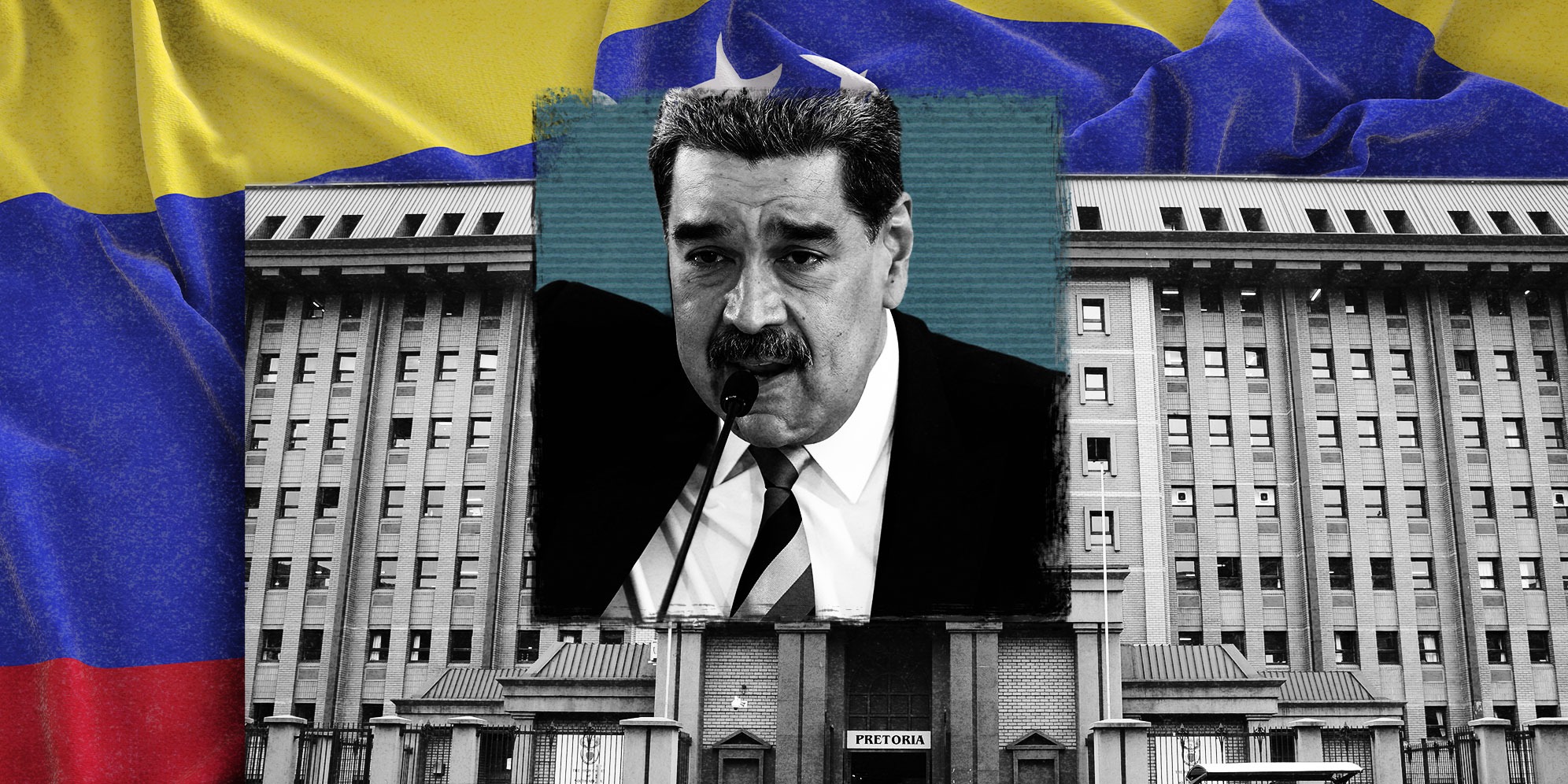
 Illustrative image: Venezuelan President Nicolás Maduro. (EPA / Ronald Pena) | Pretoria High Court. (Photo: Raymond Mrare) | Venezuelan flag. (Image: Freepik) | (By Daniella Lee Ming Yesca)
 /file/dailymaverick/wp-content/uploads/2025/10/label-Op-Ed.jpg)
South Africa faces a defining foreign policy test in responding to the 3 January US military operation that extracted Nicolás Maduro from Caracas. The action presents Pretoria with an uncomfortable choice: Defend international law against a superpower whose investment it desperately needs, or remain silent on a violation that undermines the multilateral order it claims to champion.
The facts are stark. US Delta Force operatives seized Venezuela’s sitting president from sovereign territory without UN Security Council authorisation. This is a clear breach of article 2(4) of the UN Charter.
Yet Maduro is no innocent victim. His government oversaw Venezuela’s GDP collapse from $375-billion in 2012 to $40-billion by 2020 – an 80% contraction. Roughly eight million Venezuelans fled political persecution and economic collapse as hyperinflation peaked above 1,000,000% in 2018.
Maduro’s democratic and human rights record is shocking. Following July 2024’s stolen election, where opposition candidate Edmundo González secured 67% (which excludes the eight million Venezuelan refugees abroad), Maduro’s forces killed at least 24 protesters and detained more than 2,000 people, bringing political prisoners to a 21st-century high.
South Africa’s foreign policy predicament stems from its foundational principles. The government positions itself as a defender of international law, sovereignty and human rights – values forged in its own liberation struggle. Yet Venezuela under Maduro represents everything South Africa claims to oppose: electoral fraud, economic mismanagement and systematic repression that UN investigators determined constitutes crimes against humanity.
While countries across the western hemisphere and Europe recognised González’s victory in July 2024, Pretoria did not formally recognise him as Venezuela’s legitimate president, despite credible evidence that he won by a significant margin. This tacit acceptance of Maduro’s fraudulent mandate sits uneasily alongside South Africa’s professed commitment to democracy. If South Africa acknowledges Maduro stole the election, then US charges that he lacks legitimate authority gain credibility, complicating condemnation of his capture.
Read more: Trump says US will run Venezuela, South Africa calls on UN Security Council to urgently convene
/file/attachments/orphans/13616089_410363.jpg "Venezuelan President Nicolas Maduro and his wife Cilia Flores arrive at the Federal Legislative Palace in Caracas, Venezuela, 15 January 2024 (reissued 03 January 2026). (Photo: EPA / RAYNER PENA R.)")
The geopolitical calculations are equally complex. The US remains South Africa’s third-largest trading partner and a crucial source of foreign direct investment. Relations have deteriorated following South Africa’s stance on Gaza and perceived closeness to Russia and China. The Ramaphosa administration has been working to repair these ties. A strident denunciation of Washington’s Venezuela operation could undo this delicate diplomatic repair work.
Yet silence carries its own costs. South Africa hands over the G20 presidency having positioned itself as a voice for the Global South and champion of reformed multilateralism. The Venezuela operation represents precisely the kind of unilateral action by powerful states that middle powers like South Africa have long protested against.
And what of the immediate future of Venezuela? Experts have referenced a “similar” operation of extraction in Panama in 1989, when US forces captured General Manuel Noriega, the de facto military dictator at the time, on drug trafficking and money laundering charges.
Yet the Noriega precedent merits examination but not emulation. That 1989 operation, like this one, violated international law despite Noriega’s criminality. The subsequent chaos in Panama, while ultimately transitioning to democracy and one of the best-performing economies in the region, demonstrated that military intervention without comprehensive planning creates dangerous power vacuums.
President Donald Trump’s declaration that America will “run” Venezuela shifts what was framed as law enforcement into clear regime change. His dismissal of opposition leader María Corina Machado and failure to endorse González leaves Venezuela’s political future dangerously uncertain, creating a vacuum of power struggles between regime remnants and opposition forces.
Read more: Pouring oil on troubled waters — US capture of Maduro risks exacerbating turmoil in Venezuela
/file/attachments/orphans/GettyImages-2254498929_175661.jpg "(L-R) White House Deputy Chief of Staff and Homeland Security Advisor Stephen Miller, CIA Director John Ratcliffe, U.S. Secretary of State Marco Rubio, U.S. Secretary of War Pete Hegseth and Chairman of the Joint Chiefs of Staff Dan Caine listen as U.S. President Donald Trump addresses the media during a news conference at his Mar-a-Lago club on January 03, 2026, in Palm Beach, Florida. President Trump confirmed that the U.S. military carried out a large-scale strike in Caracas overnight, resulting in the capture of Venezuelan leader Nicolas Maduro and his wife, Cilia Flores. (Photo:Joe Raedle / Getty Images)")
South Africa will need to follow the events and leading voices of the region closely, for its own calibrated response.
First, clearly state that the military operation violated international law and sets a dangerous precedent, regardless of Maduro’s character. International order cannot function if powerful states conduct extraterritorial raids whenever convenient.
Second, acknowledge Venezuela’s legitimate grievances: Maduro demonstrably lost the previous election and has governed as an illegitimate dictator presiding over a humanitarian catastrophe.
Third, call for Venezuela’s democratic transition under UN supervision, with support for González, whom the opposition and much of the international community recognise as the rightful president-elect.
Fourth, urge the US to clarify its intentions and share its vision with the transitional plan as the leading power in the western hemisphere.
This approach defends multilateral principles while avoiding reflexive solidarity with an indefensible regime. South Africa learnt hard lessons about liberation movement solidarity trumping human rights in previous examples, notably Zimbabwe under President Robert Mugabe. Crucial moments like these require bold international leadership. Ideology does not trump pragmatism. Anti-imperialism cannot become a shield for every government claiming Western victimisation.
Strategic maturity requires recognising that defending international law and opposing Maduro’s dictatorship are not contradictory positions. Venezuela’s catastrophe – economically, politically and socially – resulted from Maduro’s misrule, not solely external pressure. The US violated sovereignty, but Venezuelans seeking change from a stolen election deserve support.
South Africa’s international credibility depends on consistent principle application, not selective outrage based on Cold War alignments. As it concludes its G20 presidency, Pretoria must demonstrate that Global South leadership means defending both sovereignty and democracy, alongside economic progress and prosperity across the board, and especially for the large majority residing in the Global South. That is the diplomatic sophistication expected from a serious middle power seeking action and impact beyond dated ideological pandering. DM
Professor Lyal White is a faculty member at the Gordon Institute of Business Science (GIBS), University of Pretoria.