




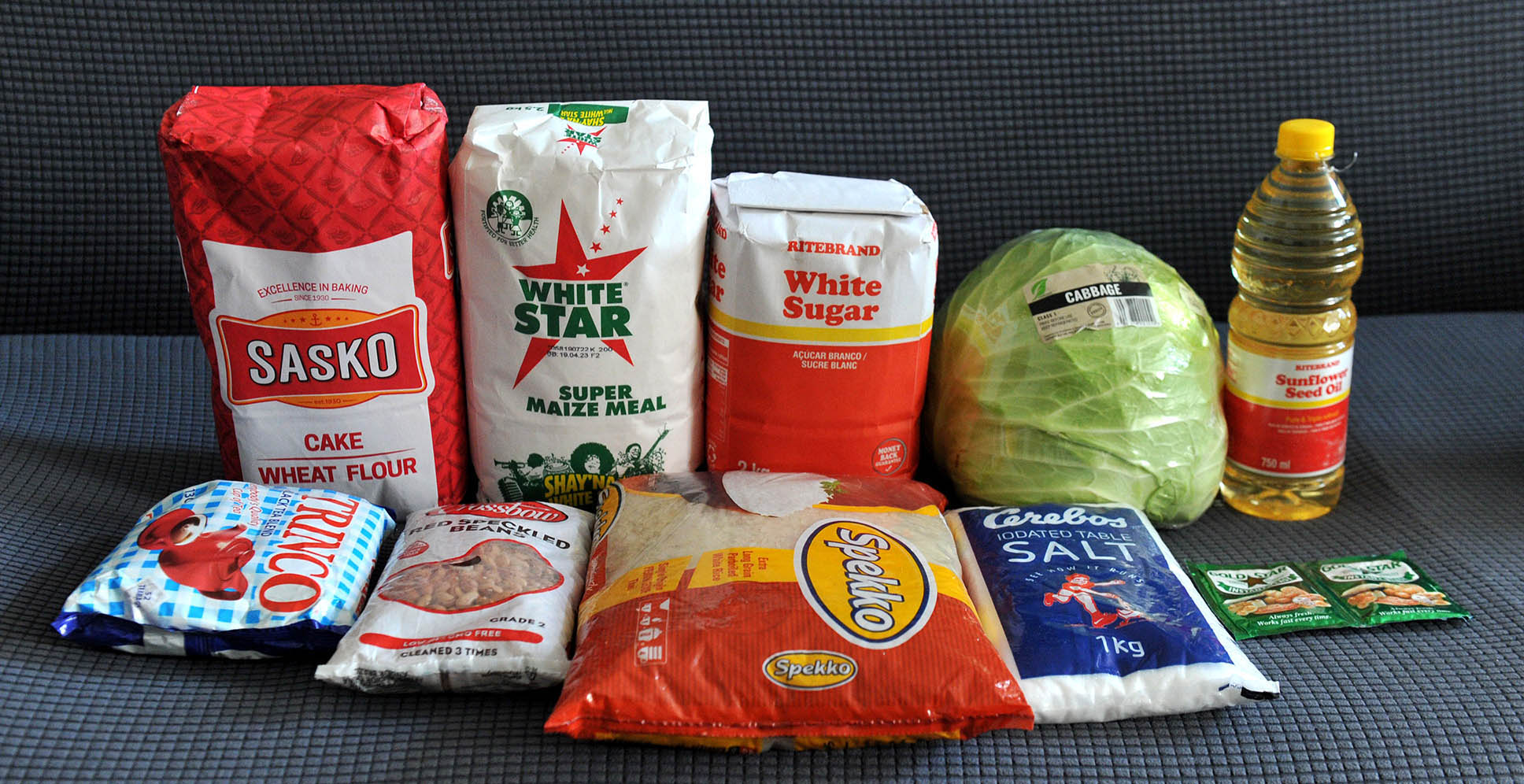
 Since April 2022, Daily Maverick has been buying 14 essential food items every month to measure food inflation for Social Relief of Distress Grant recipients. (Photo: Denvor de Wee)
 When Maverick Citizen began tracking the cost of 14 basic food items in 2022, the gap between what it takes to access nutritious food and the Social Relief of Distress (SRD) grant was already large. The question was, is the grant enough to buy a basket of basic food essentials? Four years later, the answer is: it is not, especially when factoring in the transport costs to access the grant, and beneficiaries spending a portion of it on other necessities, such as airtime and data to apply for jobs.
This month the basket costs just over R370, a slight decrease, due to lower prices of flour, cabbage and flour.
/file/attachments/orphans/Maverick-Citizen-Food-oct-dec-1-1_457626.jpg)
Annual inflation for food and non-alcoholic beverages rose for the first time in four months, to 4.4% in November from 3.9% in October, according to the Consumer Price Index released on 17 December.
Meat prices increased on average by 12.2% in the 12 months to November, the highest annual rate since January 2018 (13.4%). Beef products have experienced high inflation rates for several months. Other meat products have now joined the fray, with the prices of pork, mutton, lamb, and sausage rising fast.
“The ‘milk, other dairy products and eggs’ category recorded its sixth successive month of deflation. The rate has slowly crept higher, though, from -1.6% in September to -1.5% in October and -1.2% in November. Full-cream and low-fat fresh milk have occupied deflationary territory for most of 2025. Similarly, eggs have registered negative annual price changes since November 2024,” reads the report.
/file/attachments/orphans/1000158167_587797.jpg "Percentage change indices in November. (Image: Supplied)")
Reflection
In the last four years, the basket has highlighted how malnutrition is perpetuated in low-income households, where people buy ultra-processed food, starch, oil and sugar, and use ingredients like soup powder, stock and salt to make the food taste better. This is reflected in other food baskets, such as that of the Household Affordability Index (HAI), which has been a regular feature of our price tracking.
Although the latest HAI food basket of 44 items cost R5,413.53, the Pietermaritzburg Economic Justice and Dignity Group (PMBEJD), which compiles the HAI, has created a core food basket to track what people prioritise when they have a limited budget. That basket costs R2,825.33.
The basket has 17 items, including rice, flour, maize meal and samp, that are the basis of daily meals and help keep people full. Potatoes and onions are the only two vegetables, and frozen chicken portions are the only source of protein on the list.
The PMBEJD said the foods prioritised in the basket “ensure that families do not go hungry, whilst ensuring that meals can be cooked. When the prices of core foods increase, there is less money to secure other important, mostly nutritionally rich foods, which are essential for health and wellbeing and strong immune systems (viz meat, eggs and dairy, which are critical for protein, iron and calcium; vegetables and fruit, which are critical for vitamins, minerals and fibre; and maas, peanut butter and pilchards, good fats, protein and calcium essential for children).
“Core foods contribute 52% of the total cost of the food basket. At an average cost of R2,825,33 in November 2025, these foods are relatively very expensive in relation to the total money available in the household purse to secure food.
“These foods must be bought regardless of price escalations. The high cost of core staple foods results in a lot of proper nutritious food being removed from the family plates. The consequences of high costs on the core foods has a negative impact on overall household health and wellbeing, and child development.”
/file/attachments/orphans/1000158188_697112.jpg "(Image: Supplied)")
A call to action
Civil society organisations, including the Union Against Hunger, the General Industries Workers Union of South Africa (Giwusa) and the Institute for Economic Justice, have advocated for action towards ensuring food security for all.
Giwusa has called for urgent and radical measures to confront the food inflation crisis.
“The union demands strict price controls on essential food items to halt profiteering, alongside the nationalisation of major farms, food manufacturers and retail monopolies, placing them under democratic worker and community control,” said the union.
It called for the introduction of a R1,500 universal basic income grant and inflation‑linked increases for all social grants to protect the poor from rising costs. It also called for a transformed Competition Commission that can effectively crack down on corporate collusion and price‑fixing in the food value chain. To secure long‑term food sovereignty, it advocated for land redistribution and significant investment in small‑scale farming.
“We demand a living wage of R15,000, with coordinated union bargaining to secure above‑inflation increases, ensuring that workers can afford to feed their families,” said the union.
These demands reflect a push for systemic change to prioritise human dignity over corporate profit and are echoed by organisations such as the Union Against Hunger, which have called for big food retailers such as Shoprite to lower food prices for staple foods, and for the government to fulfil the right of all in the country to food.
In an article titled “Hunger is a crime. Who are the criminals?” Stephen Devereux and Mark Heywood wrote:
“It is all too easy to blame the poor and hungry for being poor and hungry, by labelling them lazy and irresponsible. But the poor live in a country where structural unemployment leaves millions of people unable to find jobs, the education system is failing pupils, the health system is failing the sick and malnourished, and social grants provide inadequate assistance. Not all of us live in that South Africa, but millions do. These intersecting inequalities reproduce their poverty and hunger across generations, while preserving and growing the wealth of the privileged minority.”
The Institute for Economic Justice (IEJ) has long been advocating for a universal basic income (UBI), which would provide regular, unconditional cash transfers to all adults to tackle poverty, inequality and unemployment, building on the SRD grant.
In a report titled “A system that lifts everyone up: Universal Basic Income”, the IEJ states:
“Right now, poverty is holding millions of people back from realising their potential to create, contribute, and serve their communities. Many people in poverty simply don’t have enough money to even search for a job or pay for transport to get to work. By giving every working-age adult a secure income floor, UBI helps people move from survival mode into productive employment and entrepreneurship.”
These organisations and many others are focusing on different parts of the puzzle, highlighting that hunger and malnutrition in South Africa need a multipronged approach.
In his speech at the seventh Social Justice Summit, President Cyril Ramaphosa stated that fulfilling the right of all to food was a priority for the South African government, listing the social grants, school nutrition programme and other interventions that the government does to alleviate hunger.
“The ultimate measure of the success of our democratic dispensation lies in our ability to ensure that no person goes hungry,” said Ramaphosa. DM