




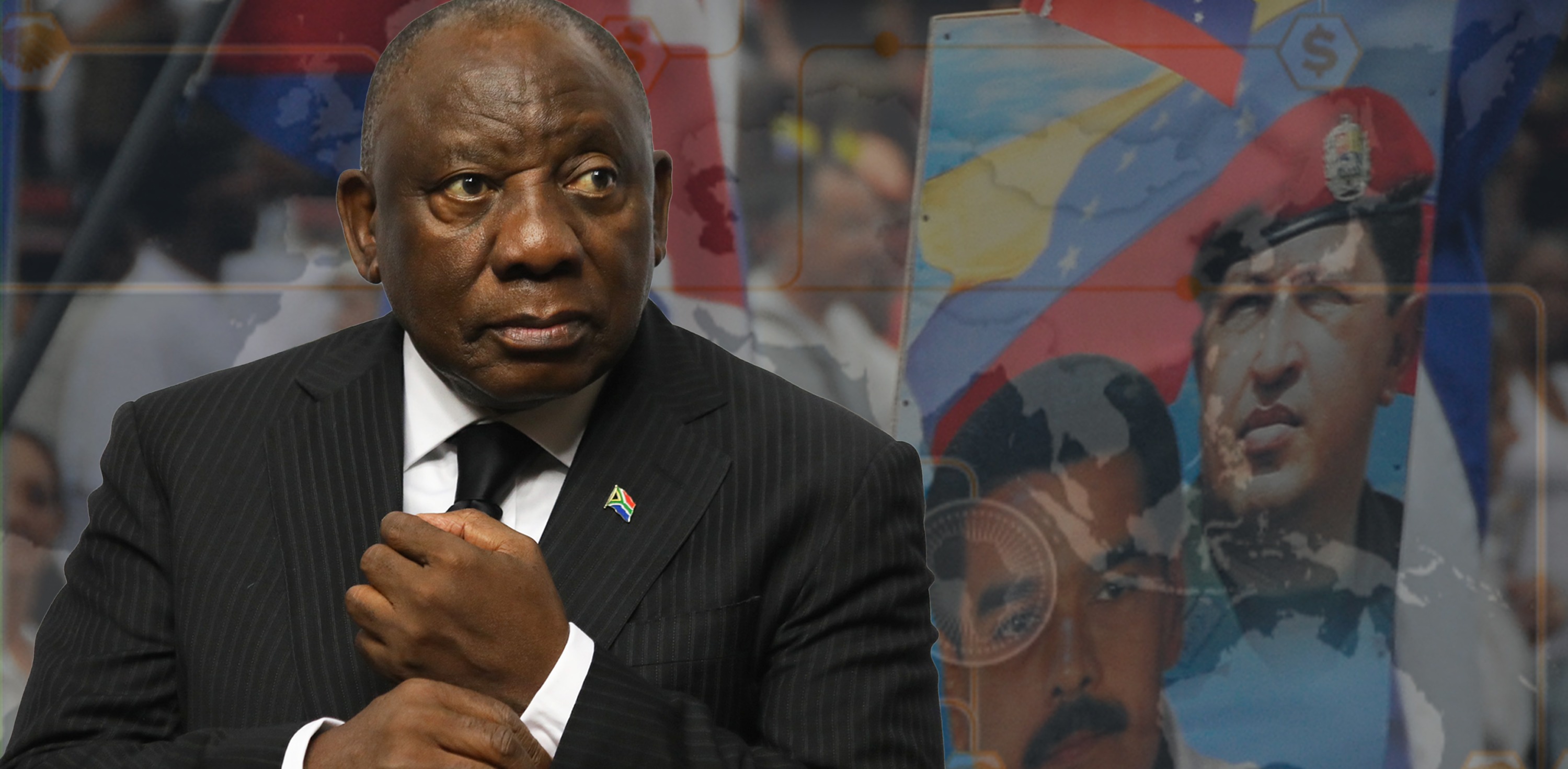
 Illustrative image | Sources: Citizens attend a May Day parade at Revolution Square in Havana, Cuba. (Photo: Joaquin Hernandez / NurPhoto via AFP) | President Cyril Ramaphosa. (Photo: Dwayne Senior/Bloomberg via Getty Images) | Map.( Oxford Analytica)
 /file/dailymaverick/wp-content/uploads/2025/10/label-Op-Ed.jpg)
Since 1994, SA’s foreign policy has been shaped by a powerful moral inheritance. Emerging from apartheid, the African National Congress (ANC) carried into government the diplomatic relationships forged during decades of exile and struggle. Those alliances with Cuba, Iran, Libya, Venezuela and the Palestinian cause were not merely strategic; they were existential. They represented who stood with the ANC when much of the West did not.
Three decades later, however, the world in which those loyalties once made sense has changed profoundly. SA now finds itself navigating an increasingly unforgiving international system, one less tolerant of ambiguity, neutrality or historical sentiment. The tension between liberation-era foreign policy identity and a Western-integrated economy has long existed, but it is now reaching a point of strain that can no longer be easily managed.
Renewed international scrutiny
Recent developments have brought this contradiction into sharper focus. SA’s decision to take Israel to the International Court of Justice, its public solidarity with Venezuela, and its continued engagement with states viewed by Washington as adversarial have placed Pretoria under renewed international scrutiny. These moves have occurred at a moment when geopolitical competition is intensifying, sanctions are increasingly normalised, and foreign policy has once again become closely tied to economic discipline.
Read more: When farce meets applause — the Venezuela spectacle and authoritarian longing in SA politics
The roots of SA’s diplomatic posture are understandable. During the Cold War, the ANC relied heavily on the Soviet bloc and a network of revolutionary or non-aligned states for political, military and moral support. These relationships formed the backbone of the movement’s international legitimacy. After 1994, continuity felt both natural and principled. Foreign policy became a means of preserving historical memory and honouring solidarity.
System eroded
Yet the international system that once accommodated such continuity has eroded. The post-Cold War era marked by globalisation, multilateralism and relative tolerance for diplomatic hedging is giving way to a harsher environment of power politics. Financial systems, trade access and even international law are increasingly weaponised. Middle powers like SA now face far narrower margins for manoeuvre.
The Israel–Palestine case illustrates this shift clearly. SA’s ICJ application has been widely welcomed across parts of the Global South as a principled stand rooted in international law and historical experience. At the same time, it has placed Pretoria in direct opposition to the US, Israel’s principal ally and still the central node of the global financial system.
Whether one views SA’s action as morally justified or diplomatically risky, it undeniably represents an escalation with tangible geopolitical consequences.
A similar pattern is evident in SA’s engagement with Venezuela, Cuba and Iran. These relationships are consistent with ANC tradition, but they now carry different weight. In an era of renewed bloc politics, symbolism is read as alignment. Solidarity diplomacy, once largely cost-free, now signals strategic positioning whether intended or not.
What makes this moment particularly delicate is SA’s economic reality. The country remains structurally embedded in Western-dominated systems: dollar-based finance, global capital markets, trade access and foreign investment. Even without formal sanctions, shifts in perception can influence credit ratings, investor confidence and trade relationships. Foreign policy does not need to provoke punitive action to produce economic consequences.
Separation increasingly fragile
For years, SA managed to separate its economic pragmatism from its ideological diplomacy. That separation is becoming increasingly fragile. As global competition intensifies, powerful states are less willing to tolerate ambiguity from strategically significant middle powers. Strategic autonomy, once celebrated, is now more tightly policed.
Read more: Beyond viral outrage — the need for proactive governance in South Africa
The emergence of coalition politics adds another layer to this debate. While the ANC remains the dominant force in shaping foreign policy, SA is no longer a single party political space. Its population, business community and political class are more plural than ever. This raises an important question: should SA’s foreign policy continue to reflect primarily the historical identity of a liberation movement, or should it evolve to reflect a broader national consensus?
This is not an argument for abandoning solidarity with the Global South, nor for aligning unquestioningly with Western interests. Rather, it is a call for strategic coherence. Liberation history can inform foreign policy, but it cannot be its sole compass. States must adapt as their environments change.
SA now stands at a crossroads. The choices it makes will shape not only its diplomatic standing, but its economic resilience and political autonomy in an increasingly polarised world. A deliberate and inclusive review of foreign policy grounded in national interest rather than inherited allegiance may no longer be optional. It may be overdue. DM
Lungisani Mngadi is an independent policy researcher focusing on governance, state capacity and democratic accountability in Africa.