



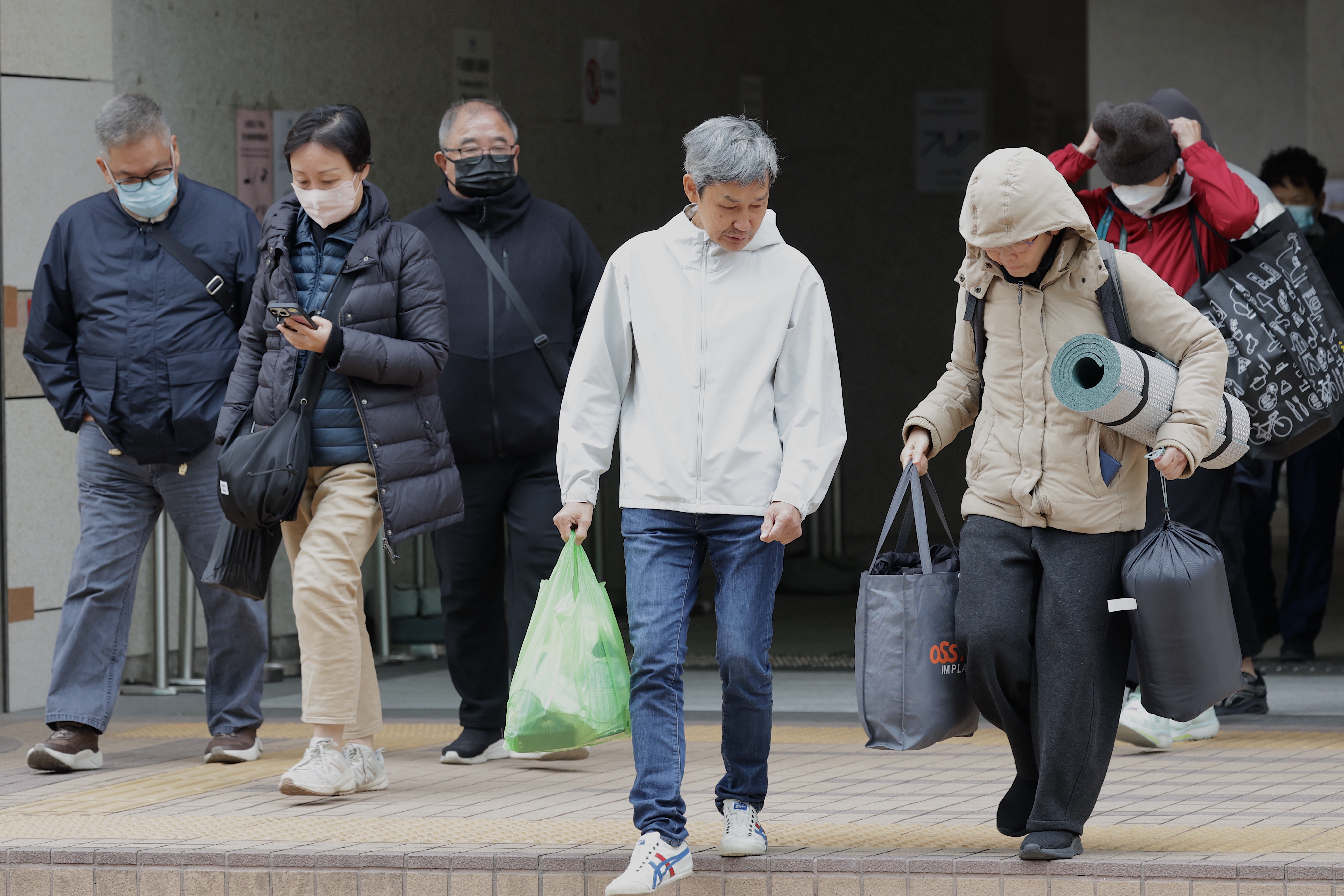
 Members of the public leaves the West Kowloon Law Courts Building, sitting as the High Court, following the scheduled opening of the national security trial of the now-disbanded Hong Kong Alliance in Support of Patriotic Democratic Movements of China in Hong Kong, China, 22 January 2026. The Alliance, along with its former chairperson and vice-chairpersons ? Chow Hang-Tung, Lee Cheuk-Yan and Albert Ho Chun-Yan ? are charged with inciting subversion of state power under the Beijing-imposed national security law. The three former leaders were arrested in 2021, and the Alliance later disbanded. The case examines whether the organization?s long-standing political platform and annual commemorations of the 04 June 1989 Tiananmen crackdown amount to subversion. EPA/MAY JAMES
The Paris-headquartered advocacy group said journalists Wu Yingjiao and Liu Hu, who gained national recognition more than a decade ago for uncovering graft among high-profile figures, were detained on Sunday in the province of Sichuan.
"We call on the international community to intensify pressure on the Chinese regime, rather than pursue a normalisation of relations that only enables further repression," said group official Aleksandra Bielakowska.
Such repression allowed authorities to continue targeting reliable reporters, added Bielakowska, RSF's advocacy manager for the Asia-Pacific region.
The detention of the two journalists highlighted a "restrictive and hostile" environment for independent reporting in China, she said in a statement.
China's foreign ministry did not immediately respond to a request for comment on the report or another, with a global perspective, issued on Wednesday by New York-based Human Rights Watch.
In a statement on Monday, police in the provincial capital of Chengdu said they were investigating a 50-year-old man surnamed Liu, a 34-year-old surnamed Wu and others on suspicion of "making false accusations" and "illegal business operations".
The men were placed under "criminal coercive measures", the statement added, using a legal term that typically refers to detention.
Several Chinese media and RSF identified the two detained reporters as Liu Hu and Wu Yingjiao.
Police in Chengdu did not immediately respond to a Reuters request for comment.
The arrests followed the January 29 publication of a joint investigative report on social media platform WeChat that examined alleged corruption involving Pu Fayou, the Communist Party secretary of the Sichuan county of Pujiang.
Pu could not be immediately reached for comment.
The report has since been deleted from WeChat, a common step by censors in cases involving sensitive government exposes. Liu is a former investigative reporter of the New Express newspaper, based in the southern city of Guangzhou.
He was detained by Beijing police in 2013 on charges of "picking quarrels and provoking trouble" for allegedly "fabricating and spreading rumours", but released on bail after 364 days in detention, RSF said.
Leaders of democratic nations such as Canada, South Korea and Britain have visited Beijing this year, seeking better ties amid trade and security tension with the United States.
While human rights issues figured in some of the talks, they were not a prominent feature.
China ranked 178 of 180 countries in the 2025 press freedom index of Reporters Without Borders, which identifies the country as the world's largest jailer of journalists.
In its 2026 world report released on Wednesday, Human Rights Watch flagged the global impact of China’s censorship, going beyond curbs on domestic media to apply pressure in foreign countries.
It said leaked documents showed a major Chinese company had exported some domestic internet censorship and surveillance technologies to countries such as Pakistan and Myanmar.
"The Chinese government controls all major channels of information and implements one of the world’s most stringent surveillance and censorship regimes," HRW said.
The legal system, controlled by the ruling Communist Party, encompassed punishment for critics and measures such as forcible disappearance or jail, it added.
(Reporting by Liz Lee and Beijing Newsroom; Editing by Antoni Slodkowski, Michael Perry and Clarence Fernandez)