



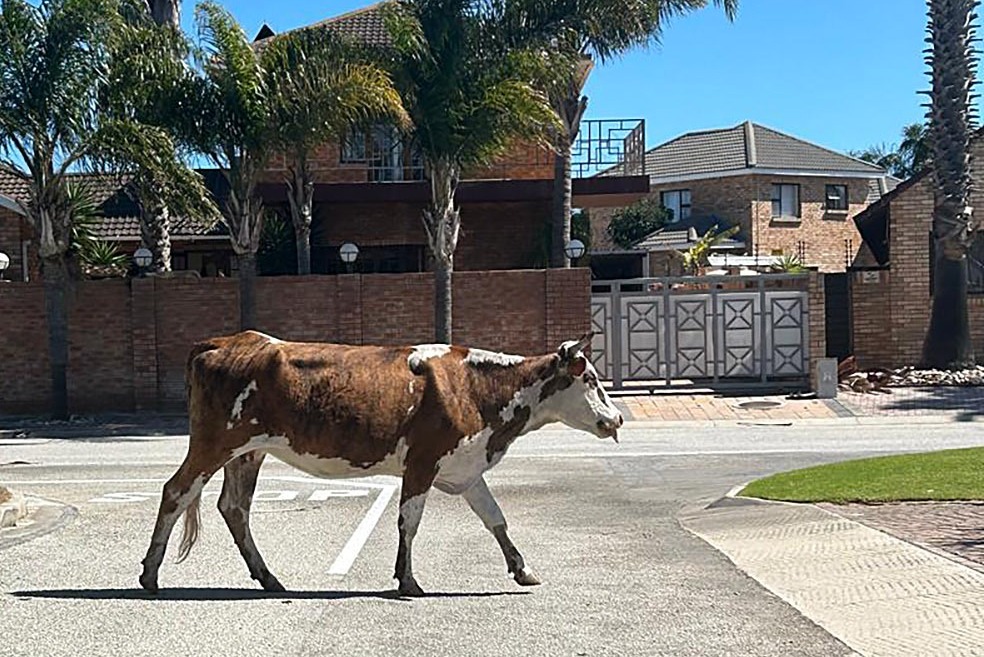
 A cow crosses the road in Solomon Street, Summerstrand, Gqeberha. (Photo: Laura Webb)
The Nelson Mandela Bay metro’s claims that the municipality now has a new “fully functional pound” are untrue.
What it does have is yet another “emergency deviation”, four staff members, no truck and a strategy that entails chasing stray animals into the bushes.
Also in dispute is who owns the infrastructure where the animals are kept.
On Wednesday, there was an urgent meeting at the metro’s Public Health Directorate to discuss the “fully functional pound”.
The Democratic Alliance’s Mthokozisi Nkosi attended this meeting and has clarified a few issues. The municipality has not yet answered Daily Maverick’s questions.
Not the R2m pound
First, the property where the municipality keeps stray animals is not the new pound for which R2-million was set aside in the infrastructure budget — it is yet another instance where the metro, ignoring warnings from the Treasury and the Auditor-General, used emergency procurement procedures. The Nelson Mandela Bay Civil Society Coalition says the metro’s procurement practices are a major stumbling block to good governance.
/file/attachments/orphans/WhatsAppImage2026-01-15at134351_518004.jpeg "Cows take a breather on a grassy patch in Tiran Road, Summerstrand, Gqeberha, on 15 January. (Photo: Angela Daniels)")
The contract for the pound states that it will run for “six to 12 months” or until the funds run out. Meanwhile, the municipality still owes the SPCA R240,000 for running the municipal pound until October last year.
At best, the “new pound”, according to information provided to councillors at the meeting, is a temporary solution to replace the SPCA’s lapsed contract. On 8 January, the metro claimed that it had a “fully functional pound”, which it had appointed a new service provider to manage under a three-year contract. However, no contract was in place, and the metro is still working on the tender procedures.
Nkosi said, “At this moment, there is no tender issued. The appointed service provider is working on a deviation, on a temporary basis, while the municipality is working on a three-year tender that they have yet to finalise. This poor contract management is shocking for such a large institution.”
/file/attachments/orphans/WhatsAppImage2026-01-15at143510_655637.jpeg "A herd of cattle walk past the Air Force Museum in Forest Hill, Gqeberha, on 14 January. (Photo: Riaan Marais).")
The temporary contract necessitates experience in managing a municipal pound; however, it is understood that the selected contractor lacks this experience and only has expertise in animal care and health. Another complicating factor is that the infrastructure being used by the service provider belongs to the SPCA. Nkosi said these issues would have to be resolved before the property was handed over, which was scheduled for the end of this week.
Currently, during this transition period, there are no interim plans in place, resulting in a lack of legal grounds for the SPCA to maintain operations until the new contractor assumes control.
Another critical issue is the potential eviction of the SPCA, which has occupied the land for more than 50 years, predating the municipal pound’s construction. This threatens its vital role in animal welfare and community services, including significant investments in infrastructure.
The SPCA’s contract to operate the municipal pound expired in October last year.
Livestock chased into bushes
Because of a shortage of vehicles to transport animals, officials are merely chasing them into the bushes, which Nkosi said “defeated the purpose”.
In its media statement on 8 January, the municipality said: “Under the Directorate of Public Health, the Municipal Animal Control Unit is equipped with trained animal rangers whose responsibility is to enforce these by-laws. Rangers are authorised to remove animals found in contravention of municipal regulations and place them in the Municipal Pound.”
Rangers are municipal officials who bring animals to the pound, and not those who work at the pound.
After the urgent meeting on Wednesday, Nkosi said that despite claims that the pound was “fully functional”, it was still beset by significant operational failures.
He said the pound was understaffed, with just two staff members on duty per shift, and had only two bakkies and a trailer, with promises of a “new truck” later this month to fetch stray animals.
“This limits capacity, meaning large herds cannot be properly managed. Officials may resort to merely chasing animals away. In fact, that’s what they are currently doing.
“At the moment, the pound can accommodate a maximum of 30 cattle, with potential for extension. This is despite R2-million allocated in 2023/2024 to build a new municipal pound, which remains available, yet no business plan exists to utilise these funds effectively. This raises serious doubts whether all reported stray animals will be impounded and all complaints attended to,” said Nkosi.
He said they were promised that all issues would be resolved by Friday, 16 January.
Can you still report stray animals?
Residents of Nelson Mandela Bay can use the numbers below to report stray animals. The municipality has assured that all stray animals will be impounded and all calls will be attended to.
- Primary contact number: 070 079 7489, which can be called at any time.
- Manager responsible: Buyiswa Deliwe at 070 704 2250 (for escalation if calls to the primary number are unanswered).
- Animal Control: 070 700 3736.
Animal activist Marizanne Ferreira said that after the announcement of the “fully functional pound”, she had tried to report stray cattle.
“The public is appreciative of the fact that the SPCA is available after hours, public holidays, weekends and that all calls are personally handled.
”It seems to me that the metro is trying to fix something that is not broken. Maybe this effort should rather be focused on the municipal animal control units (domestic and livestock). They need vehicles, ramps, cattle bars, catching poles and books to write out fines.
“I tried to report roaming cattle on Le Roche Drive, Summerstrand. The 041 number rang twice, and then the call was cut off. The 0800 number took me through six options and then the usual automated answer that no one is available, and I was cut off once again.
“This took 57 seconds. Cattle are on their way to the beach, endangering their own and human lives.”
She said that the person who answered the number for reporting stray animals told her that they don’t fetch cows, but chase them away. Ferreira said she was also told that they don’t pick up dogs and cats.
What did the municipality say?
In its statement on 8 January, the municipality said, “This programme strengthens the municipality’s ability to create safer communities while ensuring that animals are cared for in a regulated and humane environment.
“The service provider was appointed in the first week of January 2026, following a thorough and compliant Supply Chain Management process. The municipal pound will accommodate animals such as dogs, cats and livestock, including cattle, sheep, goats and pigs, that are found roaming illegally outside of protected farming areas or beyond legally designated residential boundaries.
“The municipality is currently working with the Department of Agriculture, Veterinary Services to upgrade the pound to add a fully functional animal clinic at the pound precinct. Once the upgrades are completed, the clinic will be registered with the South African Veterinary Council. However, for now, a state veterinarian is available on call to attend to any animal health emergencies and assessments.”
Previously, the municipality operated its pound facilities in partnership with the SPCA. However, the completion of a competitive bidding process has resulted in the conclusion of that interim arrangement and the appointment of a dedicated service provider to manage municipal pound services.
The municipality said the appointment of the service provider marked a critical step in improving public safety and animal welfare in Nelson Mandela Bay.
“The uncontrolled movement of animals, particularly livestock, poses a serious risk to road users and residents. This appointment allows the municipality to respond more effectively, lawfully and humanely to these challenges,” it said.
The Nelson Mandela Bay Municipality has a legal responsibility to ensure a safe, healthy and secure environment for residents and animals. This responsibility is guided by various legislative and regulatory frameworks, including the Nelson Mandela Bay Municipality Animal Control By-law, the Animals Protection Act (Act 71 of 1962), the Municipal Systems Act (Act 32 of 2000), and applicable road safety legislation that prohibits livestock from roaming on public roads, highways and spaces.
In terms of these by-laws and laws, owners are required to keep their animals confined within approved and designated areas and to exercise proper control. Livestock are prohibited from roaming freely in public spaces, while domestic animals such as dogs and cats must be kept in a manner that does not pose a danger or nuisance to the public.
The municipality emphasised that enforcement was not punitive but aimed at ensuring compliance and protecting people and animals.
“We urge residents to take responsibility for their animals. The enforcement of these by-laws is not about punishment, but about preventing accidents, protecting public health and ensuring the humane treatment of animals,” it said
The Municipal Animal Control Unit, which falls under the Directorate of Public Health, employs trained animal rangers who are authorised to remove animals found in contravention of municipal regulations and place them in the municipal pound.
Impounded animals can be reclaimed by their owners upon payment of the prescribed impoundment fees, which serve as a penalty for non-compliance with the applicable by-laws and contribute towards the care, feeding and welfare of the animals while in the pound.
Do the numbers supplied by the metro work?
They do not. The metro promised: “Animal Control rangers operate across the metro, and residents are encouraged to report stray animals or by-law transgressions by contacting the municipality on 041 506 5413 or the 24-hour service delivery line on 0800 20 50 50.” While the service delivery line works, the 506 number is not answered 24 hours a day, and several callers said the person who does answer the phone was unable to assist them. DM