
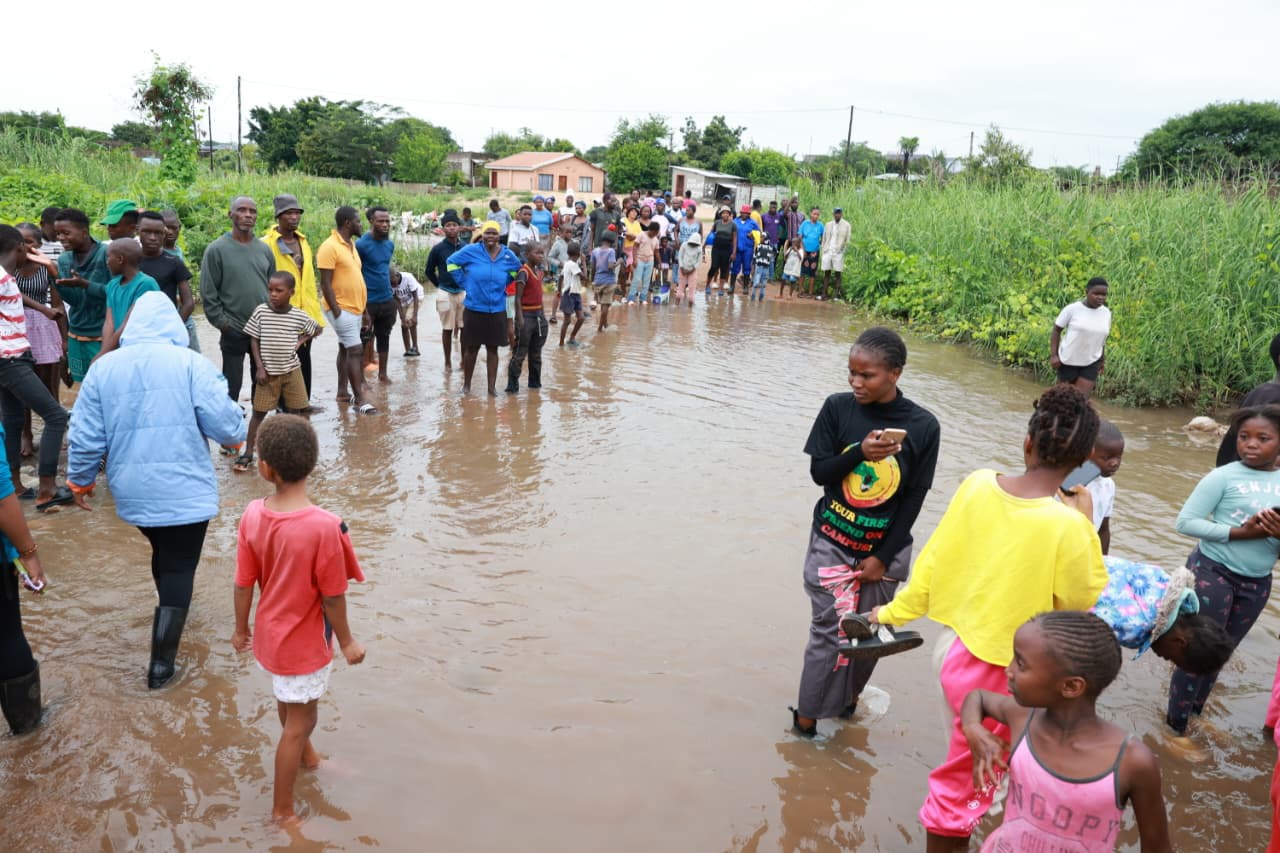
 President Cyril Ramaphosa visits flood-affected areas in Nkomazi Local Municipality, Mpumalanga, including Mjejana and Orlando villages, on Monday, 19 January 2026. (Photo: Elmond Jiyane / GCIS)
 After a week of heavy rain, driven by a low-pressure system that began in Mozambique but quickly progressed into the neighbouring South African provinces of Mpumalanga and Limpopo, the unrelenting rain, which saw up to 400mm fall in a couple of days, is finally beginning to show some level of improvement.
On Monday, 19 January, the South African Weather Service downgraded the Orange Level warning from 10 ( the highest warning a country can issue) to 5, predicting disruptive rain in Limpopo and Mpumalanga.
The National Weather Service said the lowveld of Limpopo, as well as the eastern parts of the province, would probably experience significant impacts as a result of persistent overnight rainfall — 30mm to 60 mm of rain was expected to fall over the course of the day.
Read more: Ekurhuleni councillor missing in Mozambique amid catastrophic flooding crisis
Floods declared a national disaster
The government has declared the severe flooding a national disaster. It has claimed the lives of 37 people and caused more than R4-billion in infrastructure damage.
/file/attachments/orphans/G-eG_tBWkAAPjCL_560001.jpeg "Heavy rain hit in Venda, Limpopo. (Photo: Artist Trevor / X)")
Minister of Cooperative Governance and Traditional Affairs (CoGTA) Velenkosini Hlabisa welcomed the declaration on Monday, following its initiation by Dr Elias Sithole, the head of the National Disaster Management Centre (NDMC).
Under the Disaster Management Act, the declaration of a national disaster allows the government to mobilise resources to support relief and recovery efforts.
“Accordingly, all organs of State across the three spheres of government are required to strengthen support to disaster management structures, implement contingency measures, submit progress reports to the NDMC and ensure a coordinated, multi-sectoral approach to prevention, mitigation, relief and rehabilitation,” Hlabisa said.
President Cyril Ramaphosa was again on the ground on Monday, this time visiting flood-affected areas in Mpumalanga.
While he walked in flood-stricken areas in the Nkomazi Local Municipality, where he assessed the extent of the damage, the President called on the affected provinces’ leaders to avail themselves to communities in distress.
/file/attachments/orphans/WhatsAppImage2026-01-19at165806_838314.jpeg "President Cyril Ramaphosa visited flood-affected areas in Mpumalanga’s Nkomazi Local Municipality, including Mjejana and Orlando villages, on Monday, 19 January 2026. (Photo: Elmond Jiyane / GCIS)")
“It’s important that, as leaders, we should be able to go and meet our people and see exactly what has befallen them. And that’s the important thing, because when people are in need, they want to have a sense that those that they have elected in key positions are there with them,” Ramaphosa said.
Ramaphosa said the frequency and intensity of weather, probably linked to climate change, required the government to strengthen its disaster response capabilities.
“We’re now in an era where climate change is quite evident to everyone, and we are now developing our own disaster responses so that when we have disasters like these floods and fires and other forms of disasters, we are able to respond as quickly and as effectively as possible,” he said.
/file/attachments/orphans/WhatsAppImage2026-01-19at171239_535020.jpeg "President Cyril Ramaphosa visits flood-affected areas in Nkomazi Local Municipality, Mpumalanga, including Mjejana and Orlando villages, on Monday, 19 January 2026. (Photo: Elmond Jiyane / GCIS)")
When asked about the response time and the early warning system, Ramaphosa admitted that the government could have done better.
Limpopo Premier Phophi Ramathuba also welcomed the declaration of a national disaster, adding that the extent of the infrastructure damage was becoming more apparent as access to areas previously cut off by the flooding was slowly opening up.
“We need all the assistance we can get to rebuild Limpopo after these devastating floods, and the help we need from national departments and agencies would be made possible through this classification,” Ramathuba said.
Kruger lifts day visitation restrictions
Given the improved conditions, the Kruger National Park, which closed its gates four days after significant flooding, reopened its southern gates to day visitors on Monday.
/file/attachments/orphans/WhatsAppImage2026-01-16at105757_838785.jpeg "H14 at Letaba low-water bridge (connecting Phalaborwa Gate and Mopani Rest Camp), Kruger National Parkat 9:15am on 16 January 2026. (Photo: SANParks)")
“Guests entering the park are advised to exercise caution and are strongly requested not to venture on to gravel roads, as some sections may still be affected by recent rainfall,” said SANParks spokesperson JP Louw.
Louw said the northern parts of the park remained inaccessible as several roads and bridges were washed away during the week of intense rainfall. Those areas will remain closed until it is safe to reopen them.
/file/attachments/orphans/IMG_7822_621433.jpg "Conditions in Limpopo and Mpumalanga, including areas in the Kruger National Park, have improved significantly. Day visitation to the park resumed on Monday, 19 January 2026, said SANParks. (Photo: SANParks)")
Day visitors can use the following gates to access the southern region:
- Paul Kruger Gate;
- Numbi Gate;
- Malelane Gate; and
- Phabeni Gate.
“Please note that Phabeni Gate is being closely monitored due to fluctuating water levels in the nearby stream and may be closed at short notice should conditions change,” Louw said.
Crocodile Bridge Gate remains closed. DM