



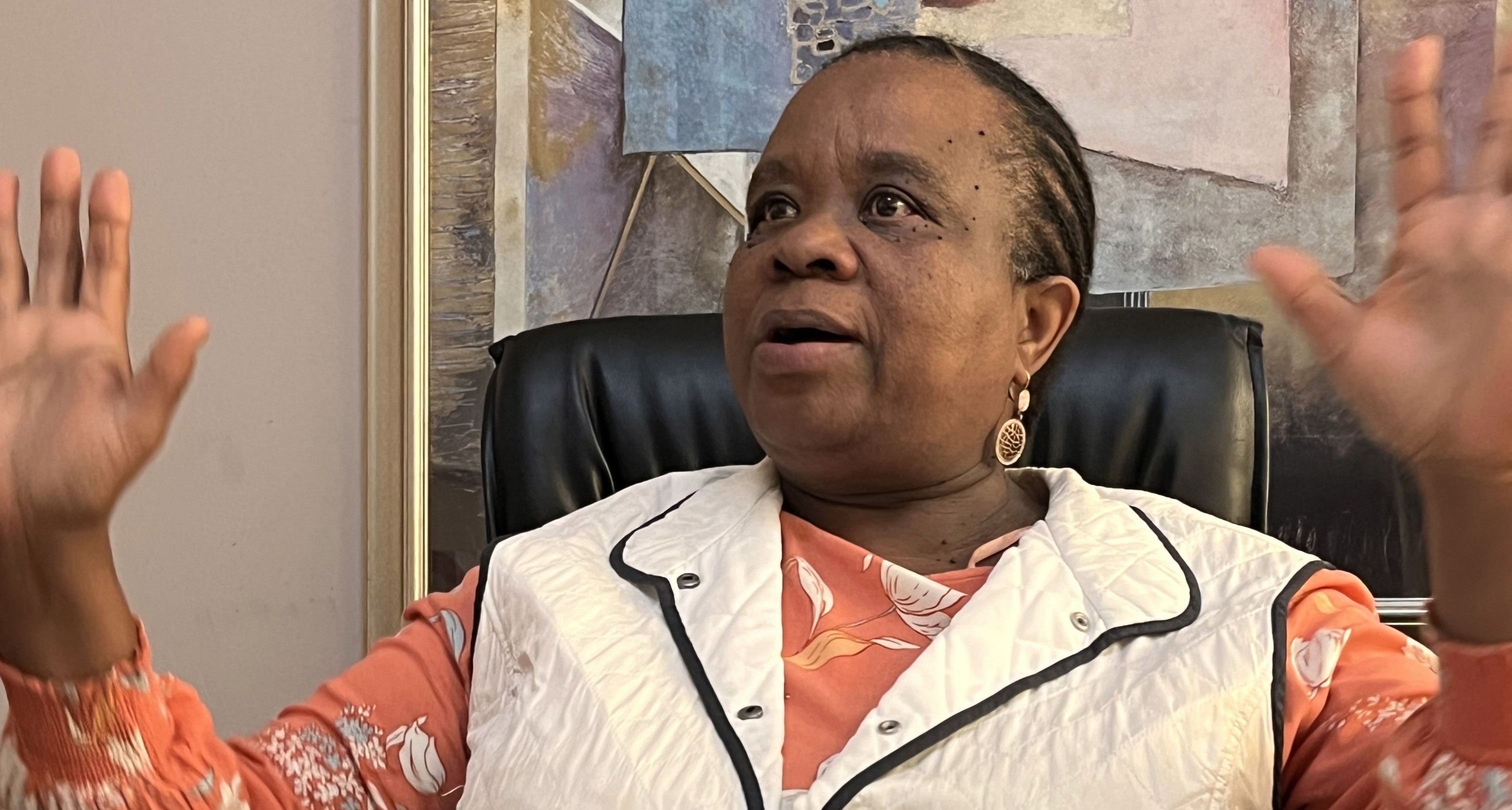
 Martha Mente, the principal of Yeoville Community School. (Photo: Mark Potterton)
Every morning, as the sun rises over Johannesburg’s inner city, thousands of children make their way to overcrowded schools. Teachers do their best in schools that have become pressure cookers of overcrowding, underfunding and systemic neglect. These schools are caught in a perfect storm of urban migration, bureaucratic inertia and financial shortages.
Walk into any inner-city school in Johannesburg today and you’ll find classrooms designed for 30 students now accommodating 40, 50, or even more. Teachers must raise their voices to be heard over the background noise. Children sometimes sit three to a desk meant for two. During break, the playground becomes a sea of bodies and queues of children wait to use the toilets.
This crisis has unfolded over the years because of demographic shifts that the education system has struggled to deal with. As Johannesburg’s inner city becomes home to an increasingly diverse population of migrants from all over South Africa and the continent, the schools have taken in wave after wave of new enrolments.
Some schools now operate at two or three times their designed capacity, even though the infrastructure hasn’t grown to match.
A quintile trap
Part of the reason for this is the quintile funding system. Designed to direct resources towards the neediest schools, this system classifies schools based on the socioeconomic status of their surrounding communities.
In theory, it’s progressive and fair, but in practice, for Johannesburg’s inner-city schools, it has become a trap. Many of these schools are in areas that were once middle-class neighbourhoods, but this is no longer the case. They are classified as affluent schools that should charge fees and receive less government funding.
But the children who arrive each morning tell another story: they come from families living in overcrowded flats, from parents working multiple jobs for minimum wage, from homes where there is little spare cash.
Schools classified as quintile 3 or 4 are expected to charge fees and operate with limited state support, even though they’re now serving quintile 1 populations. The scary thing is that the allocations to quintile 5 schools will be far less in 2026. Inner-city schools are trapped between their geographic reality and the demographic truth.
For principals and school governing bodies, this creates an impossible situation. The school desperately needs money for textbooks, maintenance and the basics of education. Yet the families they serve simply don’t have it. Some schools set fees as low as possible and then watch helplessly as only a fraction of families can pay.
Others apply for exemptions for most of their learners, drowning in paperwork while their budgets bleed. A few, driven to desperation, enforce fee payments strictly, knowing this means excluding children.
Getting a school reclassified to a more appropriate quintile should be straightforward, especially because the demographic evidence is clear. But the appeals process is bureaucratic, slow and opaque. Schools must gather extensive documentation, navigate provincial education department procedures, and then wait.
If this does not happen, then thousands of children will continue to be taught in overcrowded, underresourced schools that are doing their best with far too little. Their teachers will continue to perform minor miracles daily, stretching meagre resources to cover gigantic needs. Families will continue to make painful choices between education, food and rent – choices no one should have to make when our Constitution guarantees the right to basic education. The children arriving every morning deserve better.
Justine Kimbala, an inclusive education expert, notes: “What makes this crisis particularly painful is that it affects children who have already faced significant barriers.
“Many are from immigrant families navigating a new country and language. Others have moved from rural areas or other provinces, seeking better opportunities in the big city. They arrive with hope, only to find schools that cannot serve them adequately.”
Ageing buildings that haven’t been properly maintained for years develop leaks, cracks and hazards. The few computers the school has are becoming outdated and unusable, and teacher morale wanes as they’re asked to do the impossible. Toilets break and aren’t repaired.
A community-centred school
Martha Mente, the principal of Yeoville Community School, has been at the institution since 1993 when it was established. She explains that since its inception, the school has provided comprehensive support through a unit that offers psychological and social services to students facing challenges.
“This holistic approach, combined with excellent teachers, produced outstanding academic results, and many early students became highly successful professionals,” Mente says. “Today the school serves 900 students from diverse areas and challenging socioeconomic backgrounds, including child-headed families and children’s homes.”
Despite the school’s size, it is quiet and orderly, with a sense of calm as the teachers go about their business. As Yeoville’s demographics have changed, so too has the composition of the classes. Where there were once manageable class sizes, teachers now face overcrowded rooms filled with students whose families increasingly struggle to make ends meet. The community’s transformation has brought with it a wave of economic hardship that ripples through the school’s corridors.
“Each day our teachers navigate a web of complex challenges that extend far beyond traditional teaching. They manage large classes where individual attention becomes a luxury, and they see the faces of hungry children who struggle to concentrate on lessons when their stomachs are empty. The social problems that follow our students from home into the classroom create obstacles to learning which are hard to address.”
Mente’s story is one of resilience in the face of an education system stretched thin and a community in transition.
The crisis in Johannesburg’s inner-city schools is not just about buildings and budgets. It’s about the futures being shaped. It’s challenging to deliver quality inside those overcrowded walls. As South Africans, we need to be honest and say what we mean when we say every child deserves a quality education, regardless of where they live or how much money their parents have. DM
This story first appeared in our weekly DM168 newspaper, available countrywide for R35.
/file/attachments/2985/DM-05122025-001_235765_0a22b1f55bb436e135cf6720fe4ef77d.jpg)