




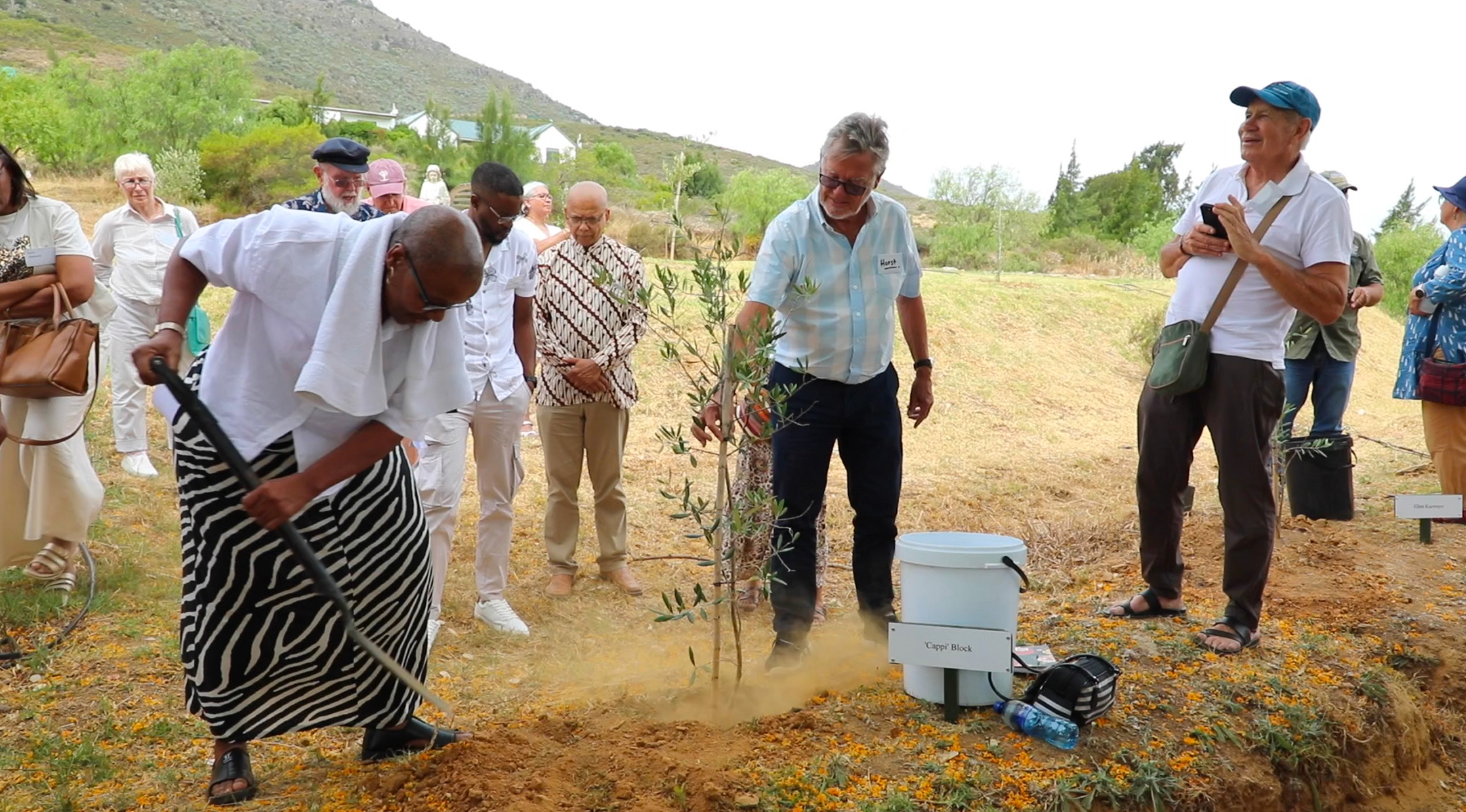
 Elizabeth Block plants the tree for her brother ‘Cappi’ Block. In the distance Imam Farid Essack, holding the tree in position Horst Kleinschmidt. On the right Malcolm McCarthy. (Photo: Owen Poggenpoel)
 /file/attachments/orphans/9copy_930859.jpg "A tree for Bishop Colin Winter. The planting of the tree was done on behalf of the family by former parishioners of his from Simon’s Town. Here Warren Conrad speaks when the tree for Winter was planted. The Winter family lives in England and could not be present. (Photo: Owen Poggenpoel)")
/file/attachments/orphans/8copy_535048.jpg "Two olive trees were planted for Rev Chris Wessels and his wife ‘Nabs’ Wessels. Facing the camera is their daughter Thandi Wessels, her son on the left and her husband on the right. (Photo: Owen Poggenpoel)")
If you take the slow, winding road into the Riebeek Valley early in summer, you may miss one of the quietest but most radical acts of public memory unfolding in South Africa today. It is not taking place in Parliament. It is not curated in a state archive. It is happening on a hill beside a small interfaith chapel, where people gather not to install statues or unveil monuments, but to plant olive trees as an act of defiance.
The Christian Institute of Southern Africa (CI) was founded in 1963 by clergy and laypeople who refused to accept the silence of the churches in the face of apartheid. Under the leadership of figures such as Beyers Naudé, Peter Randall and John Rees, the CI became one of the most courageous ecumenical voices for justice in the country. It challenged the theological justification of apartheid, supported families of detainees, documented human rights violations and built networks of solidarity across racial and denominational lines – despite the deep personal risks.
The apartheid state recognised the CI as a direct moral threat. In 1977 the organisation was banned alongside several Black Consciousness movements, its leaders restricted and its offices raided. Yet the CI’s influence endured: its work helped to seed the anti-apartheid church struggle, inspired global solidarity campaigns and shaped a moral bridge between the 1960s resistance and the mass democratic movement of the 1980s. The grove at Goedgedacht honours this lineage – people who chose conscience over convenience and truth over silence.
On Sunday, 7 December 2025, families, theologians, activists and community members returned to Goedgedacht to honour those who resisted apartheid under the banner of the Christian Institute (CI). What unfolds here each December is more than commemoration.
It is an act of political recovery – a refusal to allow a country built on silence to forget those who spoke when it was dangerous to do so.
A grove where memory refuses erasure
South Africa forgets quickly. That forgetting is not accidental. The apartheid state tried not only to kill its dissidents but to erase them – names, stories, the communities that carried them.
At Goedgedacht, that attempted erasure is undone, tree by tree.
When the grove began three years ago, it felt like a fragile idea:
one olive tree for every CI member or moral witness whose courage sustained a movement from 1963 to 1977.
On the first day, portraits were hung of Des Adendorff, Steve Biko, Reverend François Bill, Dr Manas Buthelezi, June Chabaku, Dot Cleminshaw, Cosmas Desmond, Anne Hope, Dr Wolfram Kistner, Beyers and Ilse Naudé, Reverend Cedrick Mayson, Margaret Nash, Bishop David Russell, Vesta Smith and many others. Twenty-seven olive trees were planted.
Someone whispered: “We thought we were forgotten.” But they were not. Not anymore.
/file/attachments/orphans/7copy_119523.jpg "The family of Peter Kerchhoff planting the olive tree. In the middle, Peter’s daughter Gillian. (Photo: Owen Poggenpoel)")
/file/attachments/orphans/5copy_159764.jpg "The daughters of Mapetla Mohapi, killed in detention on 5.8.1976. Daughter Konehale (or Kone)facing the camera.(Photo: Owen Poggenpoel)")
A name is a world, and South Africa needs its names back
In a country still drowning in selective amnesia, speaking a name aloud is a political act.
Especially Steve Biko.
When Biko’s name is spoken at the grove, a hush falls. His friendship with CI leaders, the shared moral clarity and the state repression that targeted both made the connection visceral. Black Consciousness shaped the very courage the apartheid state feared most.
Yet the grove does not privilege the already famous.
To say the names of Des Adendorff, Tsankie “Ali” Modiakgotla, Alex and Khosi Mbatha, Trudy Thomas or Bishop Patrick Matolengwe is equally an act of justice.
At one tree, a family read aloud a fragile, handwritten testimony of torture – kept alive only through memory. At another, a daughter touched the young bark and said softly: “Finally.”
Here, memory is not ornamental. It is restorative.
Why olive trees and not statues?
At this year’s gathering, Dr Thandi Gamedze – scholar, educator and poet at the University of the Western Cape’s Desmond Tutu Centre – offered a lens that reframed the moment:
Statues tower. Trees accompany. Statues dominate. Trees endure. Statues freeze memory. Trees grow it.
In an age when statues are toppled, defended, weaponised or ignored, olive trees suggest a gentler but deeper politics of memory – one rooted in humility, renewal and responsibility.
And as Gamedze reminded the gathering, memory is never only local.
From Sudan to Palestine to Cape Town’s forced removals, our struggles echo each other. Memory must be capacious enough to hold them all.
/file/attachments/orphans/4copy_700644.jpg "The Robb family planting the olive tree for Noël Robb. Son, David Robb on right. (Photo: Owen Poggenpoel)")
When memory becomes confrontation
The day was not comfortable – and was never meant to be.
Dr Frank Chikane, theologian, former director-general in the Presidency and veteran of the anti-apartheid struggle, delivered a warning with the clarity of someone who has seen the consequences of moral drift.
South Africa, he said, stands again on dangerous ground: corruption, inequality, violence and political decay threaten the democratic foundations secured at enormous cost.
“This is not only remembrance,” Chikane insisted. “This is instruction.”
Playwright and cultural activist Mike van Graan followed, reading from Samaritan, confronting Gaza, empire and the global weaponisation of religion. The discomfort in the barn was tangible, but necessary.
This grove does not allow memory to become nostalgia. It demands engagement.
A national archive growing in an old manor house
The Christian Institute Justice Library is taking shape not in a formal gallery but in the old manor house at Goedgedacht – an unexpected cradle for a national archive. Inside its thick walls and cool rooms an extraordinary collection is beginning to gather:
- Christine Crowley’s charcoal portraits;
- Letters from Berlin, Auckland, Vienna and Johannesburg;
- Biographies of the banned, detained and exiled; and
- Family testimonies carried quietly for decades.
The Southern Africa Documentation and Cooperation Centre in Vienna wrote: “A well-deserved tribute to people of hope.”
In truth, this growing archive is becoming something South Africa should have built long ago but never did – a repository of moral courage preserved not by the state, but by those who refuse to let memory die.
The grove refuses religious borders
Though rooted in the CI story, this grove is not limited by religious identity. The CI included Christians, agnostics, Muslims, Jews and secular radicals. Future trees may honour Imam Abdullah Haron or Franz Auerbach, a German-Jewish educator who fled Nazism and spent his life fighting apartheid in South Africa.
This is not a grove of dogma. It is a grove of courage.
Where young people learn the names
Some of the most powerful rituals are the quietest:
A teenager reading a portrait line by line. A girl from Riebeek West whispering: “I want to bring my class here.” A grandson saying: “Now people know who she was.”
This is how countries heal – not only through policies or commissions, but through inheritance.
Horst Kleinschmidt’s challenge to the present
Former CI leader Horst Kleinschmidt, whose vision drives the grove, offered a sober warning: South Africa is again “skating on thin ice”. Inequality deepens. Unrest rises. And justice once more grows fragile.
Repression never succeeds, he said – but neither does nostalgia. Memory must become mobilisation.
Justice must be replanted in every generation
At the centre of the grove stands a dedication: Remember. Reflect. Honour. Learn. Act.
These are not gentle invitations. They are imperatives, carved not into stone but into the lives of those who defied violence and refused silence.
Years from now, when today’s crises have faded, a child will sit beneath these olive trees and ask: “Who were these people?” And the grove will answer:
Because we planted justice – not as a symbol, but as a responsibility. DM