



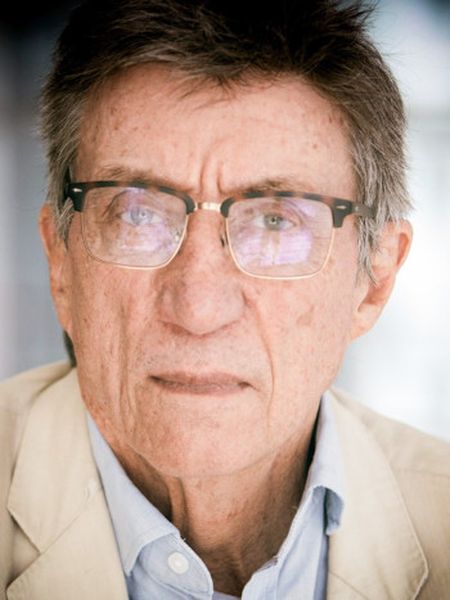
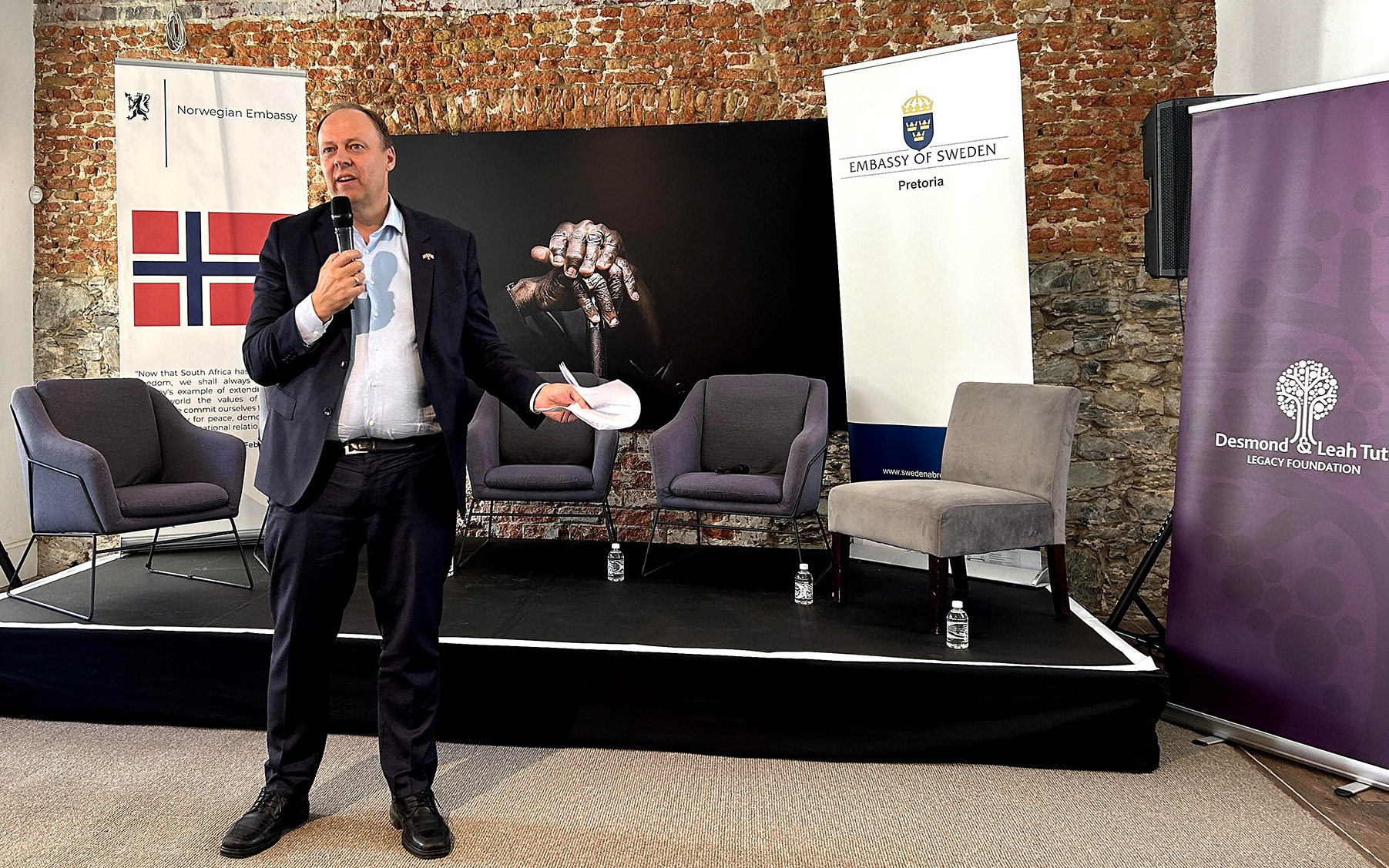
 Norway’s outgoing ambassador to South Africa, Gjermund Saether, addresses an event held with the Swedish embassy and the Desmond Tutu Foundation in Cape Town in February 2025. (Photo: Supplied / Gjermund Saether)
 Gjermund Saether has concluded his term as Norway’s ambassador to South Africa on a high note, lifted by his country’s full participation in a year of meetings of the G20 forum, as a special guest of South Africa.
Saether signed off last week by skiing homewards – sort of. In a droll video posted on X – which has gone viral – he said his only complaint about South Africa was the poor “skiing conditions”. But, undeterred, he turned and propelled himself from Waterkloof towards OR Tambo International Airport on roller skiis, powered by Nordic ski poles.
Saether had told Daily Maverick earlier that President Cyril Ramaphosa’s invitation to Norway – not a G20 member – to participate fully in the G20 as a guest had raised relations between the two countries to a “new high”.
Saether said it was “very unfortunate” that the US boycotted most of the G20, including the summit, last month and that the reason President Donald Trump had given for the US not attending the summit – that Afrikaners were being “slaughtered and their land and farms are being illegally confiscated” – was in the words of the Norwegian prime minister “really not acceptable”.
Norway also found it “very unfortunate and very difficult to comprehend” that Trump had refused to invite South Africa to the US-led G20 of 2026, which began on 15 and 16 December with a meeting of the G20 sherpas in Washington, DC.
/file/attachments/orphans/Norway1_632696.jpg "Norway’s outgoing ambassador to South Africa, Gjermund Saether. (Photo: Supplied / Gjermund Saether)<br>")
America’s absence from South Africa’s G20 inevitably did detract something from its success, particularly by diminishing the importance of Africa, since this was very much an African G20, Saether said.
He saw the US boycott as a symptom of a wider decline in support for multilateralism. Argentina, for instance, also dissociated itself from the declaration of the Johannesburg G20 Summit. Saether thought South Africa did well in the circumstances, first by getting a summit declaration at all (which had been in doubt), and second by not giving too much space to viewpoints held by just a few countries, by foregoing some ministerial declarations on the road to the summit rather than agreeing to declarations which would have taken the world “in the wrong direction and contradicted important principles and rights”.
“Norway and South Africa share a deep belief in multilateralism and the close cooperation during G20 was a perfect illustration of that,” he said.
Norway also liked South Africa’s focus on the UN’s Sustainable Development Goals, on financing for development, and the focus on Africa more generally, including the African Engagement Framework (AEF) which the summit had adopted. The AEF focused on improving the continent’s economies and governance, including how to boost regional infrastructure to facilitate the African Continental Free Trade Area.
And Saether said South Africa’s G20 had done “very important work” in addressing illicit financial flows such as the tax dodges which cost Africa at least $80-billion a year in lost revenue. And he said the two expert panels South Africa had commissioned – one headed by American Nobel economic laureate Joseph Stiglitz on inequality and the other headed by former South African finance minister Trevor Manuel on African debt and development – had put very important issues on the agenda.
Saether also mentioned proposals on disaster risk reduction, on the renewed impetus to the G20 Compact with Africa and on improving the G20 Common Framework on debt relief, as particular important achievements of the G20 for Norway.
In short, he said, “the world has a problem with poverty, so obviously we think that’s very, very important to discuss”.
/file/attachments/orphans/Norway2_528820.jpg "Norway’s outgoing ambassador to South Africa, Gjermund Saether (left), with Norway’s sherpa to the G20, Henrik Harboe, and sous-sherpa <br>(deputy sherpa) Marit Lillealtern. (Photo: Supplied / Gjermund Saether)</p>
<p>")
(deputy sherpa) Marit Lillealtern. (Photo: Supplied / Gjermund Saether)
He said the many Norwegian government ministers who took part in the G20 meetings had helped Norway “stay up to speed” on global issues such as the environment, energy transitions and food security.
And Norway had also in turn contributed to the debate, especially in its areas of expertise such as women’s rights, renewable energy and illicit financial flows.
And Saether said the many visits of Norwegian ministers for G20 meetings had also added huge value to Norway’s bilateral relationship with South Africa in fields where they cooperate, including scientific research, the environment and climate, just energy transition and gender equality.
Saether said the most important element of Norway’s bilateral relationship with South Africa now was the several billion dollars of investment by Norwegian companies in building renewable energy plants in this country – with several billion dollars more to come, and perhaps even more if they won contracts which would soon be awarded to build transmission lines to link renewable power plants to the national grid.
Tension, then convergence
In 2022, Russia’s invasion of Ukraine shocked Norway and Europe. This did create some tension in South Africa’s warm friendship with Norway, dating back to the country’s substantial support for the anti-apartheid Struggle he noted.
Norway – like almost all Nordic, European and Western countries – was surprised by South Africa’s lack of an unequivocal condemnation of Russia’s illegal invasion, at the UN or anywhere else.
But Saether said there had been some convergence since then, with the two countries moving cl together in defence of international law.
He cited as an example South Africa and Norway and others voting in the UN General Assembly this month for Russia to return the Ukrainian children it had kidnapped.
He also noted South Africa’s public rebuke in September of Russia’s “indiscriminate” air strike on civilians in the village of Yarova in Ukraine, which killed 24 people queuing for their pensions.
Norway had also welcomed the African Peace Mission which Ramaphosa led to Ukraine and Russia in June 2023 and Ukrainian President Volodymyr Zelensky’s visit to South Africa in April 2025.
In the Middle East, Norway and South Africa were already “largely on the same page” in defending international law, Saether said.
He noted for example that South Africa had worked closely with Norway when Norway referred Israel to the International Court of Justice for denying humanitarian assistance to Gaza.
A two-state solution was the only viable path forward, he said, a view shared by South Africa and so many other countries in the world.
Norway supported Trump’s Gaza peace initiative because “at least it reduced the killing and starvation”, but many challenges remained. “Now it is important to focus on the next phase of the peace plan to secure continued progress and ensure Palestinian involvement.”
Another example of South Africa and Norway collaborating to defend international law was their signing in March this year of a statement, with 75 other countries, supporting the International Criminal Court after the Trump administration had imposed sanctions on it.
/file/dailymaverick/wp-content/uploads/2023/11/DSC_4554.jpg "Head of Mission-Designate of the Kingdom of Norway, Gjermund Saether, presents his Letters of Credence to President Cyril Ramaphosa at the Sefako Makgatho Presidential Guesthouse in Tshwane in March 2023. (Photo: Siya Duda / GCIS)")
“The divisions in the world are not really so much about North and South but about who is promoting multilateralism and trying to defend international law and who is more for this ‘might is right’ approach, basically saying that the biggest countries can do as they please,” Saether reflected.
He also noted that although the West had been guilty of applying double standards in terms of international law – as in the invasion of Iraq in 2003 (which Norway did not support), double standards were everywhere.
He offered the example of the declaration of the summit of the BRICS group in Rio in 2025 which made no mention of the scores of deadly Russian missile attacks on Ukrainian civilians and only condemned a rare Ukrainian attack inside Russia. It was obvious which country had proposed this language, but that kind of double standard in the declaration undermined the support of multilateralism that the BRICS countries otherwise claimed.
Saether remarked that although South Africa’s position on Ukraine had recently been more principled in support of international law, “I think about 30% to 35% of the politically active in South Africa have a view that anything against the West is good. So they don’t seem to care about what’s right or wrong. “
He had gone out of his way to talk to all these forces. He was thankful for their willingness to engage and he “hoped some of them maybe see things a bit differently now”.
He told them that although Africa had experienced a lot of imperialism and colonialism, “let’s not forget that Europe had centuries and centuries of the same thing”.
For instance, Norway itself had only won full independence from Sweden in 1905 and Norway was occupied by Nazi Germany from 1940 to 1945. “We also recognise it when we see imperialism and this is a war of imperialism,” he said, referring to Russia’s illegal invasion of Ukraine.
“One needs to call it out where you see it.”
Norway’s good relations with South Africa were solidly founded on Norway’s substantial support for the anti-apartheid Struggle, and that history still resonated “with politicians above the age of 50”. But younger politicians and younger people in general didn’t know the history.
“But what is maybe more serious is that they don’t seem to know much about apartheid in general,” he said.
And so he had been surprised to discover that the name of former prime minister Hendrick Verwoerd – “a Nazi and the chief architect of the apartheid system” – was still commemorated in some places, for instance in the main avenue of the town of Brits near Pretoria and a tunnel north of Louis Trichardt.
“On the one side, I agree with those who say one should not dwell on the past, but on the other hand there are also some debates that one should have about the past.
“Maybe one of those more important discussions should be why do we still have a Verwoerd Avenue?
“It’s not that I’m telling South Africa what to do. But it’s more like I’m surprised.”
Saether was leaving after three and a half years in Pretoria, six months earlier than scheduled because his wife, also a diplomat, had been promoted to an important position at head office in Oslo and had already left South Africa with their daughter in August.
Saether said he would miss the smiling, cheerful and friendly people of this country and was not expecting to see too many smiling faces in the winter he was returning to. DM