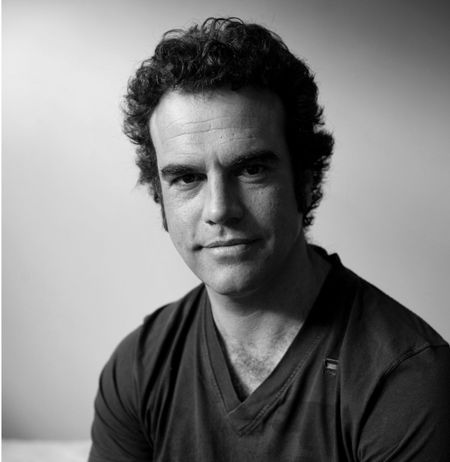
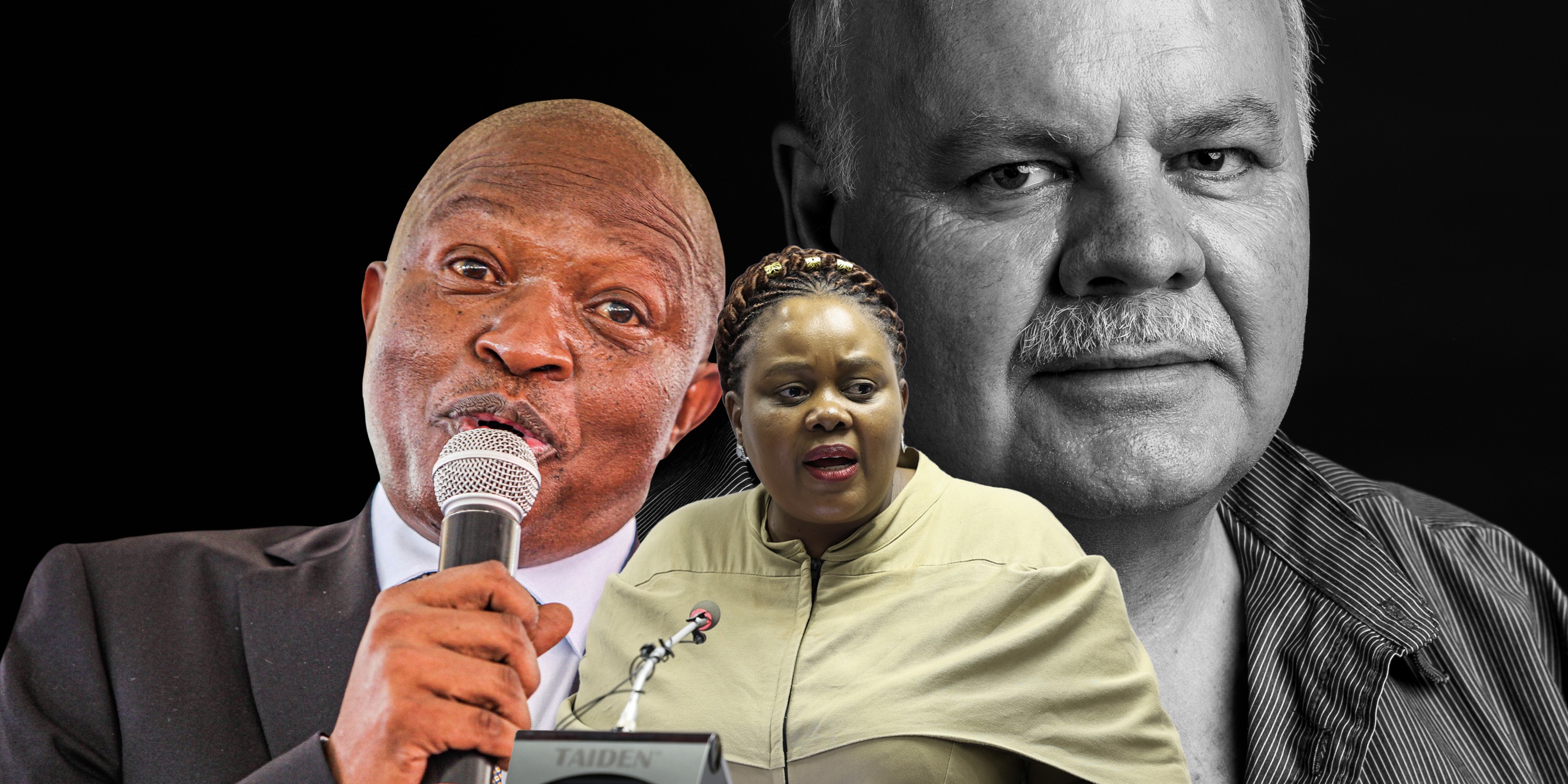
 From left, former South African deputy president, the late David Mabuza. (Photo: Gallo Images / Sharon Seretlo) | Minister of Justice and Constitutional Development Mmamoloko Kubayi. (Photo: Gallo Images / Luba Lesolle) | Conservationist Fred Daniel. (Photo: Supplied)
 The absurdity of further delays
“So, the application for my recusal must fail at the first hurdle, which is that there is no person associated with these proceedings who believes I was biased,” said Judge Neil Tuchten, in all seriousness, on 27 February 2025. “It would be absurd for a litigant to say, personally, I do not believe that the judge was biased, but a reasonable person would so believe.”
As implied in the judge’s words, the “absurd” scenario had just come to pass — despite the fact that the affidavits of both parties had praised the jurist as “distinguished,” the government defendants had sought his recusal anyway. The “double requirement of reasonableness” for a judge’s recusal, which demands an assumption of prejudice by at least one of the litigants, had set the stage for a blatant own goal.
Effectively, the legal team for the Mpumalanga Tourism and Parks Agency (MTPA), the first defendant in case number 34502/2010 of the Gauteng Division of the High Court in Pretoria, had argued that the hypothetical “reasonable person” was somehow more reasonable than any of them.
But as absurd as it was, it appeared to be simply more of the same. The case, which had been lodged in July 2010, had so far worked through two high court judges (Tuchten was its third judicial officer), hundreds of days of lawfare-inspired delays and around R30-million in legal fees for the MTPA alone (see below). As Daily Maverick had concluded in a number of in-depth reports, the taxpayer was funding a strategy to indefinitely defer the judgment.
And so Judge Tuchten, by all accounts, was having none of it — the MTPA’s application for his recusal was dismissed with costs. The next day, lead plaintiff Fred Daniel returned to the witness box. Seven months later, on 30 September 2025, the judge handed down his historical ruling, which decreed, for the first time, that Mpumalanga strongman David Mabuza — South Africa’s former deputy president, who had died in early July — was a primary architect of the so-called “land claims scam”.
As Daily Maverick noted at the time, not only had the ruling vindicated Daniel, it had cemented his standing as one of the most courageous and effective whistleblowers of the post-apartheid era. Significantly, near the end of the 181-page judgment, Judge Tuchten ruled that Mabuza’s successful campaign to destroy Daniel’s conservation project had depended on the support of a vast state-sponsored criminal network.
“This was no single act by a single state actor,” the judgment declared on page 162. “It was a concerted campaign over several years by members of the executive in the province, in league with high officials in at least two organs of state which, by the public powers vested in them by law, were in a unique position to intimidate Mr Daniel and frustrate the realisation of his dream. They enlisted in their scheme a criminal mob and instructed the SA Police [Service] to stand aside while the mob did its work.”
As recompense for this “collusive agreement” between state actors, Judge Tuchten awarded Daniel the sum of R306-million (minus interest and costs) in damages. And yet, of the 25 government defendants listed in the court papers, it was ultimately only the MTPA and the Regional Land Claims Commissioner (RLCC) that were “jointly and severally” held liable.
“I have said that this case is, as far as I know, unique in our jurisprudence,” Tuchten noted on page 178. “The wickedness of the conduct of the MTPA and the RLCC, acting in concert with the other parties I have found to have banded together to oppress Mr Daniel and drive him from the district, is profound.”
In light of such scathing pronouncements, it was perhaps unsurprising that the office of the state attorney — in a series of letters to Daniel’s attorney, dated November 2025 — would notify the plaintiffs of the intention to take the matter to the Supreme Court of Appeal. To Daily Maverick, however, what was surprising was what had been revealed in the latest iteration of the MTPA’s annual report, signed off on 30 August 2025.
“The MTPA has made a payment arrangement with the [Department of Justice and Constitutional Development] of reasonable monthly instalments towards settling these owing legal fees,” the report noted, on page 25, with respect to case number 34502/2010. “The future payable fees are not known but would be substantial given the complex nature of this matter and the likely period it may take to finalise this court case. The legal fees incurred in this case are not affordable for the MTPA.”
Further detail was provided on pages 186 and 267, where the agency laid out what would happen if the judge was to rule in Daniel’s favour — the “portion [of damages] computed to be payable by the MPTA” would, the report noted, be very close to the entire amount. It was also stated that the agency had paid more than R14.7-million in legal fees to date, with another R15.5-million in “current outstanding legal fees”.
By Daily Maverick’s reckoning, although the report was signed off only a month before Judge Tuchten handed down his ruling, the content would almost certainly have been written earlier in 2025.
And so if the legal fees were “not affordable for the MTPA”, as the report stated, who had been instructing the agency’s lawyers in their “absurd” strategy to delay the trial further by seeking Judge Tuchten’s recusal?
Back where we started
Against the backdrop of the government’s intention to take the matter on appeal, the MTPA’s annual report for 2024/2025 begged a few more questions that demanded answers — and here, as far as Daily Maverick was concerned, the Department of Justice and Constitutional Development (DoJ&CD) was best placed to furnish an official response.
To begin, what were the terms of the “payment arrangement” that the MTPA had made with the department for settlement of the “owing legal fees”? Also, in the context of the “future payable fees” mentioned in the report, could DoJ&CD provide us with an updated total on the legal costs it had so far incurred on the MTPA’s behalf?
Next, given that the report had stated that the legal fees were “not affordable” for the MTPA, had the agency’s financial position been given due consideration in the decision to take the matter on appeal? And again, given that the MTPA had stated that the legal fees were “not affordable,” was it correct to assume that DoJ&CD would have been liable for almost all of the damages (R306-million excluding interest and costs) if the matter had not been taken on appeal?
These four questions, along with another five that emanated from different documentary sources (see below), were sent to Terrence Manase, ministerial spokesperson for DoJ&CD, on 15 January 2026. The next day, after Manase did not respond to a request for confirmation of receipt, Daily Maverick reached out via text to Steven Mahlangu, the deputy director of media liaison for the department, who informed us that he was “currently on leave” and referred us to Mandla Mathebula, a departmental colleague.
Mathebula, for his part, acknowledged receipt and promised to “facilitate a response” by our deadline — noon on Tuesday, 20 January. On Monday 19 January, in answer to our request for an update on progress, Mathebula informed us that he was “awaiting a response from the relevant section” and that he was “not sure” whether the department was able to meet the deadline. The next day, after noon had come and gone, Daily Maverick offered DoJ&CD an extra 24 hours, which Mathebula acknowledged with the “prayer hands” emoji. On Wednesday, 21 January, at a few minutes past noon, we informed Mathebula that if a response was not forthcoming by 5pm, we would, unfortunately, have to write our report without the input of DoJ&CD.
But still, Daily Maverick’s editors, to ensure full accountability, insisted that we reach out directly to the ultimate boss of DoJ&CD, Minister Mmamoloko T Kubayi. At around midday on Thursday, 22 January, we made contact, telephonically, with Nompumelelo Tshaba, the minister’s personal assistant. After we informed her of the frustrations above, Tshaba promised to alert the minister. At around 2.30pm on Friday, 23 January, we asked Tshaba whether we could expect answers from Minister Kubayi. Tshaba replied, at 4.06pm, that she would “check with Terrence [Manase]” and ask him to revert.
And so, much like Daniel himself, we were back where we started. As of this writing, Daily Maverick had heard nothing further from DoJ&CD. The lack of transparency on the affordability of the appeal for the government defendants was, to our minds, particularly urgent in light of the fact that they had so far failed to settle the cost orders issued against them in three interlocutory applications — an amount that totalled R700,000 (excluding interest) for a) the plaintiffs’ application to force the defendants’ discovery in 2019, b) the defendants’ application to force the recusal of Daniel’s advocate, Jacques Joubert, in 2023, and c) the defendants’ application to force the recusal of Judge Tuchten in 2025.
By the most generous interpretation, then, it appeared that the government defendants were unwilling to reap the consequences of the Stalingrad tactics they had sowed since the start of the case. But there was also a less generous interpretation — one that had its genesis in a specific paragraph from the MTPA’s annual report of 2015/2016.
On page 198 of the report, it was noted that the office of the Mpumalanga premier had taken over “management” of case number 34502/2010, although “liability for legal fees” remained with the agency. At the time, as DoJ&CD would have been aware, the Mpumalanga premier was Mabuza. Given that a decade later, just a few months after his death, Mabuza would be confirmed as the lead racketeer in Judge Tuchten’s ruling, was it still possible that the office of the Mpumalanga premier was behind the decision to take the matter on appeal?
/file/dailymaverick/wp-content/uploads/2025/07/Ferial-Mabuza-obit-copy.jpg "Illustrative image | Sources: Deputy president and former Mpumalanga premier David Mabuza. (Photo: Gallo Images / Sunday Times / Masi Losi) | Gauteng High Court. (Photo: Gallo Images / Lefty Shivambu) | Hippo from Wikimedia | Mpumalanga sign from Twitter | Currency from Adobe Stock")
As it turned out, it did not seem possible — particularly because, in late 2024, Premier Mandla Ndlovu had approached Daniel to settle the matter out of court. According to Daniel, the premier was very keen to clear case number 34502/2010 from his desk.
“But then he went cold,” Daniel informed us. “He told me it was a political issue, and that it was out of his hands.”
No room to manoeuvre
The evidentiary support for Premier Ndlovu’s attempt to settle the matter was contained in an article by veteran Mpumalanga journalist Sizwe sama Yende, published in The People’s Eye in September 2024. “Maybe if we engage,” Ndlovu told the journalist, “[Daniel] will understand that we don’t have the billions he is claiming.”
And so the questions, once again, were pressing. Could DoJ&CD confirm or deny that the decision to take the matter on appeal was made by the office of the current Mpumalanga premier? If DoJ&CD confirmed that it was the premier’s office, could clarity be provided as to the apparent discrepancy with the facts as outlined in The People’s Eye report? If DoJ&CD denied that it was the premier’s office, which government entity had made the decision?
On 15 January 2026, the same day that the full list of questions was initially sent to DoJ&CD, Daily Maverick sent the three questions above to Premier Ndlovu’s spokesperson, George Mthethwa. As was the case with the various employees of the justice ministry, Mthethwa acknowledged receipt, asked for an extension to the deadline (which was granted) and then — after the final hour had come and gone — turned silent.
As a last-gasp attempt, the office of the state attorney was approached for answers. But the state attorney, for whatever reason, did not bother with confirmation of receipt.
“No, they will never answer your questions,” said Bushang Jacques Modipane, the former CEO of the MTPA, during a telephonic interview with Daily Maverick on 22 January 2026. “They will just put them aside. Because there is no room for them to manoeuvre, they are cornered. Fred [Daniel] has cornered them.”
By almost any measure, we knew, Modipane’s authority to make such statements was beyond reproach. As we reported in June 2023, his testimony at the close of the fifth session of the trial had delivered a devastating blow to the government defendants. At the start of his testimony, after informing the high court of the spate of political assassinations in Mpumalanga, he had revealed how two of Mabuza’s henchmen had warned him against taking the stand. Then, for the next few hours, he had methodically detailed the corruption and fraud that he had uncovered between 2012 and 2014, while he was at the helm of the MTPA.
“I’m seeing the hidden hand of national here,” Modipane told us, repeating his belief that forces beyond the provincial level had been manipulating the case — an assessment that squared with Daniel’s version of why Premier Ndlovu had been unable to settle the matter.
For us, in the context of the final pair of unanswered questions that we had put to DoJ&CD, this was where the threads came together. Could the department explain why no attempt was made to negotiate a settlement with Daniel after Judge Tuchten had handed down his ruling? Why did the department believe that running the appeal was in the best interests of the South African taxpayer?
After all, whoever it was that had been issuing the instructions, the letters from the state attorney to Daniel’s attorney were unequivocal — the appeal was based on legal technicalities; the core findings of Judge Tuchten were not up for debate.
“An appeal is not a retrial,” said Modipane. “They are hoping that one day they will wake up in the morning and the case will just disappear.”
By “they,” of course, Modipane was referring to the members of the state-backed criminal syndicate cited in the high court judgment. Meanwhile, as justice for Daniel was delayed yet again, interest and costs on the R306-million damages award were accruing by the month. DM