



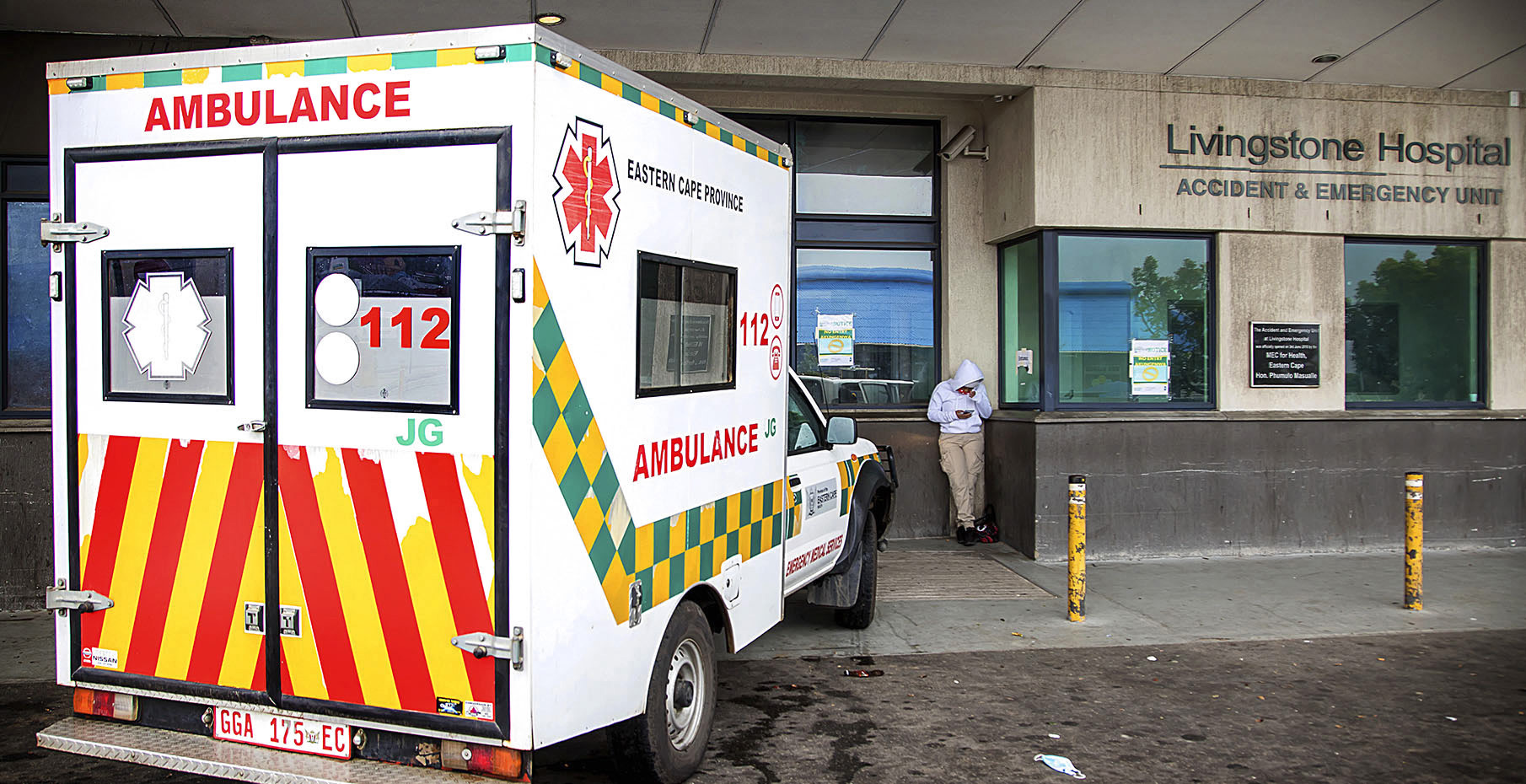
 The Accident and Emergency Unit at Livingstone Hospital, where a fire broke out in December 2025. (Photo: Donna van der Watt)
In December 2025, a patient in a section of Livingstone Hospital’s Physician on Call section set his bed alight while trying to sneak a smoke.
It was only then that the medical teams covering the busy section and those from adjacent sections, including the very busy Accident and Emergency Unit, discovered that neither the smoke alarms nor the fire alarms and fire panels were working, and the service dates on the fire extinguishers had expired.
The fire was extinguished by a member of the public who was accompanying another patient. Due to heavy smoke in the building, patients had to be moved elsewhere.
But clinical teams, who raised the issue with the department, said in correspondence they feared that unless something drastic was done to improve fire safety at the hospital, a big catastrophe, that could claim the lives of doctors, nurses and patients, would become inevitable.
Livingstone Hospital is the tertiary hospital for the western area of the Eastern Cape, where specialist services are housed. The busy hospital has 400 unfunded beds and has seen an alarming exodus of clinical personnel in the past two years, and several reports of dire shortages of equipment and orthopaedic implants.
While the December fire was extinguished quickly, the patient was unharmed and damage to the building was negligible, the incident revealed shocking shortcomings in fire safety at the hospital. These included:
- A fire alarm that did not activate because it had a loose fuse;
- All the fire extinguishers had expired service dates;
- Fire panels did not work;
- No smoke detectors; and
- Fire doors did not close.
Most disconcertingly, according to a series of letters seen by Daily Maverick, nobody on duty knew where to turn off the oxygen to the unit – but Eastern Cape Department of Health spokesperson Siyanda Manana said they had now shown personnel how to do this.
/file/dailymaverick/wp-content/uploads/MC-Oxygen-Estelle-2.jpg "A bulk storage oxygen tank at Nelson Mandela Bay’s Livingstone Hospital. (Photo: Mike Holmes)<br>")
Neither of the two fire marshals appointed for this part of the hospital was on duty at the time of the fire, Eastern Cape Department of Health spokesperson Siyanda Manana confirmed.
Daily Maverick has seen subsequent reports following the incident, highlighting several failures in ongoing fire safety at the hospital.
The hospital has been without a permanent CEO for seven years. In 2018, unions forced out of the hospital the highly regarded Thulane Madonsela and his management team.
Read more: Seven years later, still no permanent CEO for NMB’s Livingstone Hospital
Manana said the faulty smoke detectors, fire alarm and panels were “immediately repaired” after the incident, and an emergency process is under way to have the fire extinguishers serviced.
While he would not be specific about any steps to be taken to hold officials accountable, he said “all relevant measures” were being deployed to make sure fire safety was given top priority. He said the fire caused no significant damage.
“Hospital staff cleaned the ceiling and the walls, and the cost of the mattress that caught fire was negligible,” said Manana.
He said that before the incident, three fire drills had been held at the hospital – but only for security guards and at the nurses’ home. Doctors, nurses and other personnel had been trained after the December fire.
In 2014, after a mentally unstable patient set himself on fire at the hospital, an instruction was issued that patients had to be searched for matches and lighters, but Manana said security checks were performed.
“Security has been tightened, with higher levels of vigilance and awareness,” he said.
The timing of the training at the nurses’ home coincides with an inspection in June last year, when the Public Servants Association raised serious concerns about conditions at the hospital after a fire broke out at the nurses’ home.
“The origin of the fire remains undetermined, and no clear safety measures have been communicated to staff,” the union said in a statement at the time.
At the time, the Department of Labour issued a contravention notice and gave the Department of Health 60 days to fix maintenance issues at the hospital.
Manana said that a fire drill had also been conducted at the Accident & Emergency Unit at that time, and they could provide the attendance register as proof. DM