




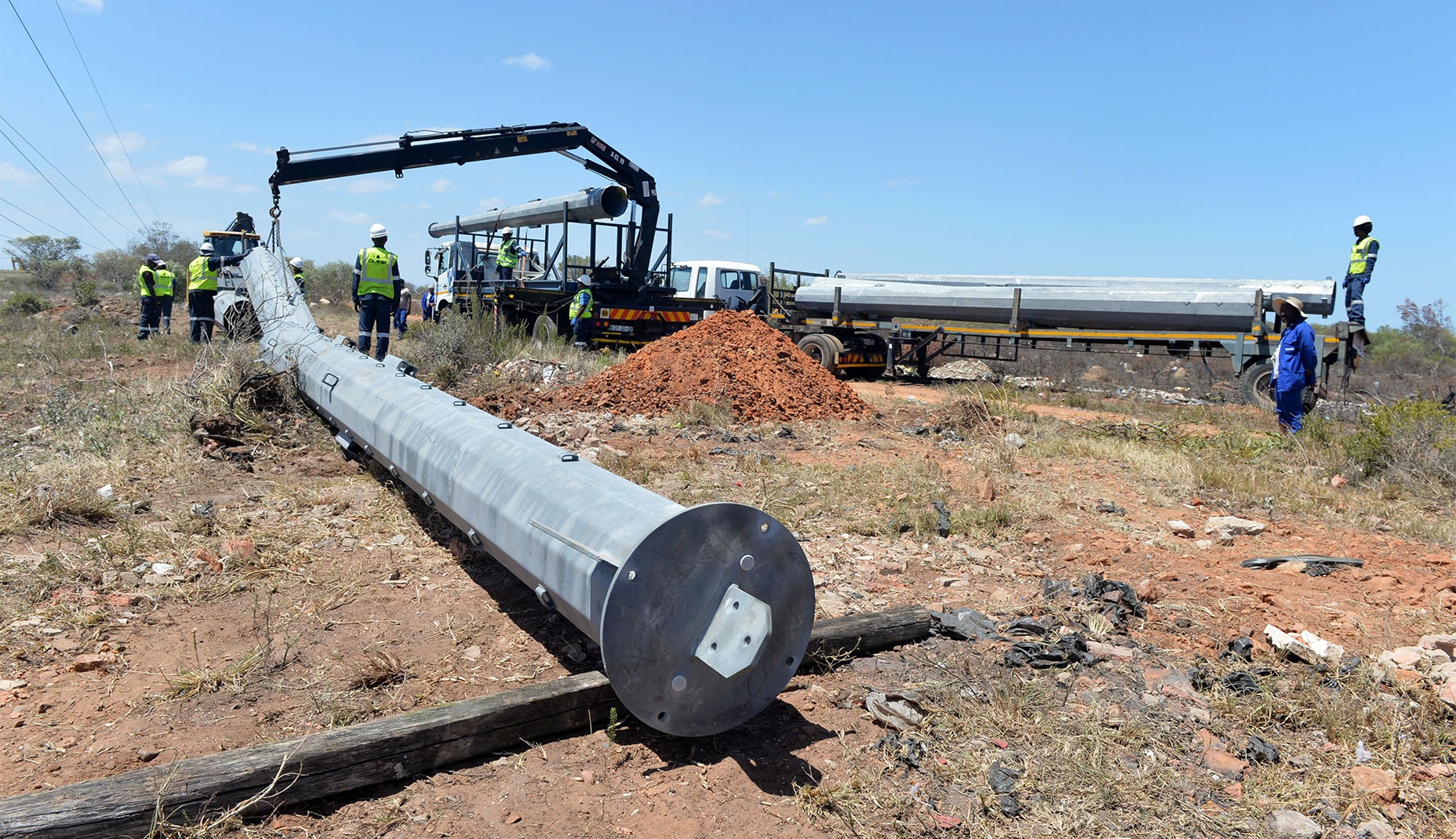
 One of the collapsed pylons that supported the Bethelsdorp-Greenbushes 132kv overhead powerline. (Photo: Deon Ferreira)
 The Nelson Mandela Bay metro will have to fork out an estimated R10-million to restore electricity to the many communities that were affected when the Bethelsdorp-Greenbushes 132kV powerline was knocked out of action by the collapse of two rusted pylons that supported the line.
The Bethelsdorp-Greenbushes line is one of several prioritised for replacement following a 2024/25 committee presentation that highlighted its precarious condition.
Ongoing power outages since the pylons collapsed on Thursday have crippled the water supply to dozens of communities. This is due to several municipal pump stations that lack backup generators, and remain entirely dependent on a stable electricity supply to function.
Tankers were delivering water to the affected communities as efforts continued to restore electricity to the affected pump stations.
The metro announced a rotational supply schedule, promising affected communities three hours of electricity followed by nine-hour outages. However, the roll-out was inconsistent: while some areas received their limited power quota, others remained entirely without electricity.
The appointed contractor spent the weekend excavating deep trenches and foundations for new pylons, which were anchored in concrete to allow the foundations to set before transmission cables are restrung.
By Sunday afternoon, four poles had been erected and two connected, with an estimated 10-day deadline to fully restore electricity set to be revised again as progress continues.
This was not the first time transmission towers in the metro collapsed. In 2024, four 132kV pylons collapsed, causing widespread blackouts.
Maintenance failures
Political figures in the city attributed last week’s collapse of the transmission towers to maintenance failures and a shortage of skilled staff, while metro officials said the collapse was largely due to vandalism, bad weather and rust.
/file/attachments/orphans/Rust-1_736396.jpg "Rusted infrastructure is said to have played a part in the collapse of the 132Kv Bethelsdorp–Greenbushes line. (Photo: Deon Ferreira)")
DA MPL Retief Odendaal commended the metro’s quick response in appointing a service provider to do the work and the improved communication regarding the matter.
/file/dailymaverick/wp-content/uploads/2025/10/Presentation-181.jpg "Retief Odendaal says the metro has not been honest about the real cause of the collapse of the pylons. (Photo: DA / Facebook)")
“The municipality reinstated the electricity at pump stations so that water from the Kromme line (Churchill and Impofu dams) could again be pumped into the city,” said Odendaal.
However, he added, the municipality had not been honest with the public about the real cause of the electricity issue.
“Yes, we experience acts of vandalism from time to time; this is a very serious problem. The pylons in question have been severely compromised due to a lack of maintenance,” he said.
“This is also not the first time this has happened, and it won’t be the last unless the city immediately commissions an electrical services master plan which informs repair and maintenance programmes.
“Not all areas can be put on a rotational electricity supply. This is because there is not enough electricity coming into the city (the main supply line is off), and some of our infrastructure is broken, making it difficult to feed electricity from other places in the ring circuit.”
ACDP councillor Lance Grootboom said the pylons collapsed because they had not been maintained.
/file/attachments/orphans/LanceGrootboom_133737.jpg "ACDP councillor Lance Grootboom criticised the Nelson Mandela Bay administrative wing for failing to maintain the pylons (Photo: Deon Ferreira)")
“The municipality has blamed vandalism and strong winds. While these factors may exist, they don’t explain why critical infrastructure was allowed to deteriorate, like the two pylons. This is a clear sign of neglect.”
Understaffing problem
Grootboom said the problem was exacerbated because the city had failed to replace skilled workers who had retired over the years with competent people.
“This means the administration is severely understaffed to carry out routine and proper maintenance, and this is why a service provider had to be urgently appointed to do the work.”
Grootboom said the administration was reactive when it came to maintaining critical infrastructure.
“This is the same type of transmission line that collapsed last year,” he said. “After that incident, I requested an investigation as to why a service provider was not appointed to maintain and refurbish high voltage lines. That warning was ignored, and now the residents are paying the price again.”
Several businesses were forced to shut their doors due to the ongoing water and power outages, including stores at the Moffett on Main Lifestyle Centre.
Nelson Mandela Bay Business Chamber chief executive officer Denise van Huyssteen said the organisation was deeply concerned about the lack of investment and maintenance of the metro’s electricity infrastructure.
/file/attachments/2986/Screenshot2025-12-15at145231_514674.png "Nelson Mandela Bay Business Chamber CEO Denise van Huyssteen has raised concerns about electricity infrastructure maintenance failures in the metro. (Photo: Facebook)")
“This has resulted in a high number of unplanned power outages and power dips impacting the metro over a sustained period of time. Moreover, the major power outage which happened in August 2024, affecting Summerstrand and related areas, should have been a wake-up call to address the ageing electricity infrastructure and the need to undertake routine preventative maintenance.”
Van Huyssteen said they had made repeated requests to the municipality to collaborate with Eskom through the active partnering initiatives.
“These expertise and resources are key in addressing root causes which are preventing the maintenance of the electricity infrastructure. The chamber has consistently ... flagged its concerns regarding the vulnerability of Chatty, the metro’s key feeder substation and its main lines, and the general lack of adequate security, CCTV surveillance and monitoring ... to protect the metro’s electricity infrastructure from vandalism.”
Hard for small businesses
Julie Coetzee and Briony Sparg, the owners of Sweet Thing Meringues, said ongoing electricity and water disruptions had made it increasingly difficult for small businesses to operate.
Their business was first affected by widespread outages in 2024, forcing the relocation of production to an industrial kitchen in Baakens Valley, which Coetzee said resulted in major unplanned costs.
For the next six months, the business experienced repeated electricity and water interruptions. Coetzee said there was “zero backup and zero support” from the municipality.
In April 2025, the bakery relocated again, this time to the Walmer Dunes Industrial Park, as Coetzee and Sparg hoped that an industrial zone would receive priority service delivery. Instead, the business endured a nine-day power outage after an electricity box outside the property was vandalised.
“The municipality took no urgency to reconnect us as a business property,” said Coetzee.
The repeated relocations and production downtime resulted in the retrenchment of four staff members last year. The bakery currently employs nine single mothers.
“Each move means downtime, retraining and huge reinvestment,” said Coetzee. “You can’t just move into a new space and start producing immediately.”
In an attempt to mitigate future outages, the bakery invested in a solar power system. However, the system does not produce enough power to run high-energy equipment such as ovens.
Since Thursday, the bakery had been operating with no municipal electricity and was producing at only 60% to 70% capacity, using solar power alone.
“We’re surviving purely because of solar, but that’s not sustainable for a bakery,” said Coetzee. “We’re now paying for municipal rates, electricity usage and the infrastructure to generate our own power. How is a small bakery expected to also become an electricity manufacturer?
“Our competitors in the Western Cape operate in industrial areas where electricity supply is prioritised. Here, there is no urgency, and it’s costing jobs.”
She said continued service delivery failures threatened small business sustainability and job creation in the metro.
“Small businesses are where jobs are created,” said Coetzee. “But this situation is bringing us to our knees. Basic services like water and electricity should not be optional extras — they are essential for businesses to survive and for communities to thrive.”
/file/attachments/orphans/DSC_3061-copy_908799.jpg "A contractor inspects one of the collapsed power pylons. (Photo: Deon Ferreira)")
Nelson Mandela Bay Mayor Babalwa Lobishe said they had dispatched 23 trucks to transport water to the affected areas.
“We are looking into the western areas of the city this afternoon [Sunday], as we started providing water in the township areas.
“We know that some private water suppliers have run out, hence we called on Gift of the Givers to come on board and assist with water provision.” DM