



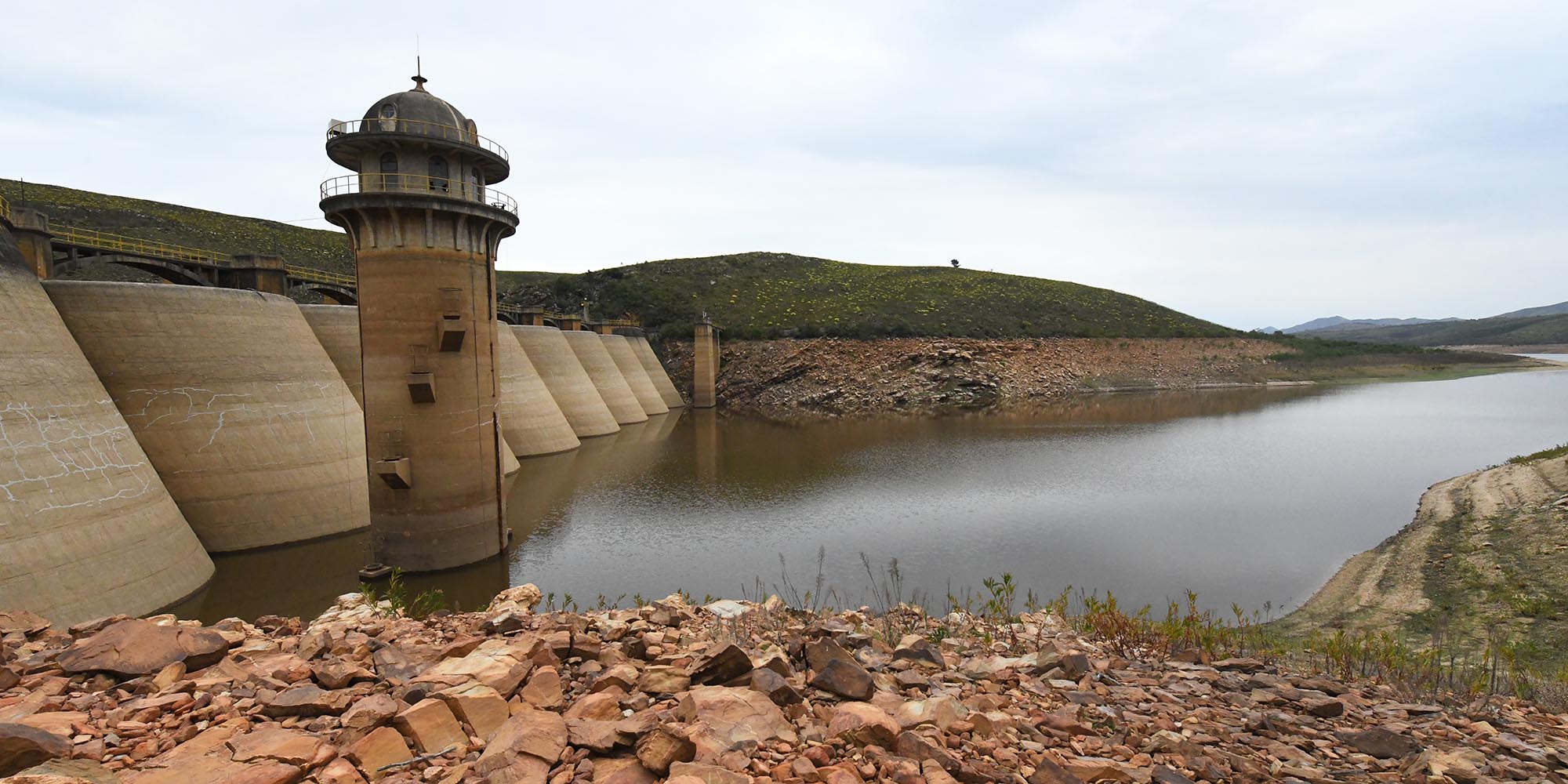
 The Churchill Dam is one of the dams supplying Nelson Mandela Bay that is drying up amid record water losses in the metro. (Photo: Lulama Zenzile / Gallo Images / Die Burger)
Nelson Mandela Bay must urgently replace about 4,700km of ageing water pipes — some more than 40 years old — after water losses surged to a record 60.39% in the first half of the 2025/26 financial year.
This was revealed by the metro’s water boss, Joseph Tsatsire, in a budget and treasury committee meeting on Tuesday, when he was prompted to explain the exorbitant losses at a time when dams supplying the municipality are drying up.
The metro recorded the water losses between July and November 2025.
This information is contained in the metro’s mid-term performance report, which also shows a woeful picture of electricity losses, which reached R840-million.
/file/dailymaverick/wp-content/uploads/2021/04/NMB-water_3.jpg "Nelson Mandela Bay director of water distribution Joseph Tsatsire. (Photo: Deon Ferreira)")
Tsatsire told councillors in the committee that the city’s water strategy was not working as it required funds to be properly implemented.
He said pipe replacement was one of the sustainable ways to curtail the losses.
“Dealing with losses to me is a no-brainer; we should be able to do it, it’s easy. The water and sanitation unit has prepared a 15-workstream intervention to deal with water losses, [with one of the interventions being] pipe replacement,” he said.
“Our infrastructure is probably more than 40 years old, and I’m talking about 4,700km of water pipeline in the city. Pipe replacement is required to deal with water losses.”
Tsatsire said the city had replaced less than 40km of the 4,7000km.
“To precisely address water losses, we have done peer reviews and benchmarking in other municipalities such as the City of Cape Town. Consistently investing in pipe replacement programmes, pressure management and others in the 15-workstream intervention, they managed to reduce their water losses from 30% to 70%, so it’s not a once-off intervention.
“We need to invest in our infrastructure by consistently replacing our water pipes over a long period. We won’t see changes in our water losses until we consistently invest in our assets.
“We know exactly where the faults are as we keep a track record of the complaints. The Auditor-General is very clear that the strategy is not working because there is no consistent investment towards it. We won’t see any changes until it is resourced, but there are no changes in the budget arrangements to fund the strategy.”
Tsatsire said the municipality had developed a 10-year water strategy, which had cost R1.3-billion over the past 10 years.
Losing battle
He said the more faults they repaired, the more complaints they received, and with a 38% staff vacancy rate, they were fighting a losing battle.
Because of a shortage of plumbers in the water services unit, the city takes between seven and 10 days to address water leaks, instead of the ideal three days.
The metro does not have a long-term contract in place to deal with the leaks but is in the process of hiring a temporary contractor while the contract is being finalised.
The municipality has a backlog of 4,000 water leaks, with an average of about 150 complaints received daily.
“Vandalism of infrastructure such as pipes and valves results in water leaks, which contribute to the losses, and there’s no efficiency in the protection of municipal assets,” said Tsatsire.
The water services unit is among the top four units with the highest overtime payments to staff — R21.8-million between July and December out of a budgeted R37-million for the entire financial year.
Over the same period, sanitation services racked up R14-million in overtime payments, electricity R25-million, safety and security R61-million, and public health R14-million.
“In relation to the overtime at the water and sanitation unit, we have a vacancy rate of 38%. We operate in our plants 24/7; we have about 16 water and wastewater treatment works that require 24/7 shifts," Tsatsire said.
“However, because of the vacancy rate and shortage of shift workers to be able to monitor the plants, we resorted to overtime work so the facilities function optimally.”
Service delivery
The mid-term financial report highlighted that the city achieved just 16.67% of its basic service delivery targets, while the overall achievement of all targets was 34.15%, compared to 51.28% in the same period in the last financial year.
The total capital expenditure on major infrastructure projects such as roads, electricity and water was 27.02%, while only 29.78% of the maintenance budget had been spent thus far.
The metro’s investment portfolio has been reduced by R318-million with 59 days of operation remaining, and the overdue debt increased by R3.2-billion.
The dwindling investment portfolio comes as the city battles to achieve the revised revenue collection rate of 75% (from an initial 85%), with the current average rate at 71.61%.
/file/attachments/2987/MC-NMB_11_729542.jpg "Nelson Mandela Bay is battling a water crisis. (Photo: Deon Ferreira)")
DA councillor Brendon Pegram said the underspending in the capital budget and other concerns were repeats of the offences that resulted in the metro getting a qualified audit opinion for the 2024/25 financial year.
“Nothing different has been done to avoid a qualified audit; we need to improve the capital spending,” he said.
Internal controls
DA councillor Werner Senekal asked whether the city had a budget monitoring committee to track progress and address bottlenecks.
Senekal said the electricity department was running at a loss.
“What is the acting city manager doing about the overtime? I see people planting trees along the streets on weekends, which can be done during the week. Internal controls on overtime are not taken seriously by senior management.”
ANC councillor Luzuko Peter said the metro’s capital budget spending had been discussed over the past four years, with no positive results.
“What can be done to prevent low expenditure on capital projects, because, for instance, there’s a contractor in my ward who constructed a road and completed the work, but he still has not been paid, [yet] the municipality is struggling to spend?”
ANC councillor Xolani Notshe said he was concerned about the revenue collection rate.
“We passed the budget based on a 75% revenue collection rate, and the trajectory we’re in is bad. What can we do this time? This report states that the strategies employed by the municipality are not working to place the municipality in a healthy financial status.”
CFO Jackson Ngcelwane said invoices from 2017/18 had not been paid by the municipality.
/file/attachments/2984/CFOJacksonNgcelwane_714366_b339ba66dc55599156315213a751123c.jpeg "CFO Jackson Ngcelwane (Photo: Nelson Mandela Bay municipality)")
“So you can imagine the problem we are sitting with. It may not be the issue with the current staff; it’s historical problems we are inheriting, where services may have been rendered, but documents are not sourced to process payments.”
Ngcelwane said the metro’s cash reserves were dwindling because of the low revenue collection rate.
“If the National Treasury doesn’t approve our roll-overs, the money is deducted from our equitable share. We have lost R241-million in unspent funds in the previous financial year, which could have been part of the reserves.
“The failure to appoint a permanent city manager is also a contributor. If we don’t appoint one by June, the National Treasury will not approve our roll-overs for the next financial year. We need to improve our revenue collection rate to an acceptable level and also deal with creditor payments to improve spending.”
The political head of the budget and treasury department, Khanya Ngqisha, said a council resolution on the overtime policy had to be implemented.
/file/attachments/orphans/Khanya1_552794.jpg "Khanya Ngqisha says a council resolution on overtime must be implemented. (Photo: Supplied / Nelson Mandela Bay metro).")
“The former acting city manager [Ted Pillay] met with the union leaders, and there was a different story which caused a lot of confusion, but there is a resolution.” DM