



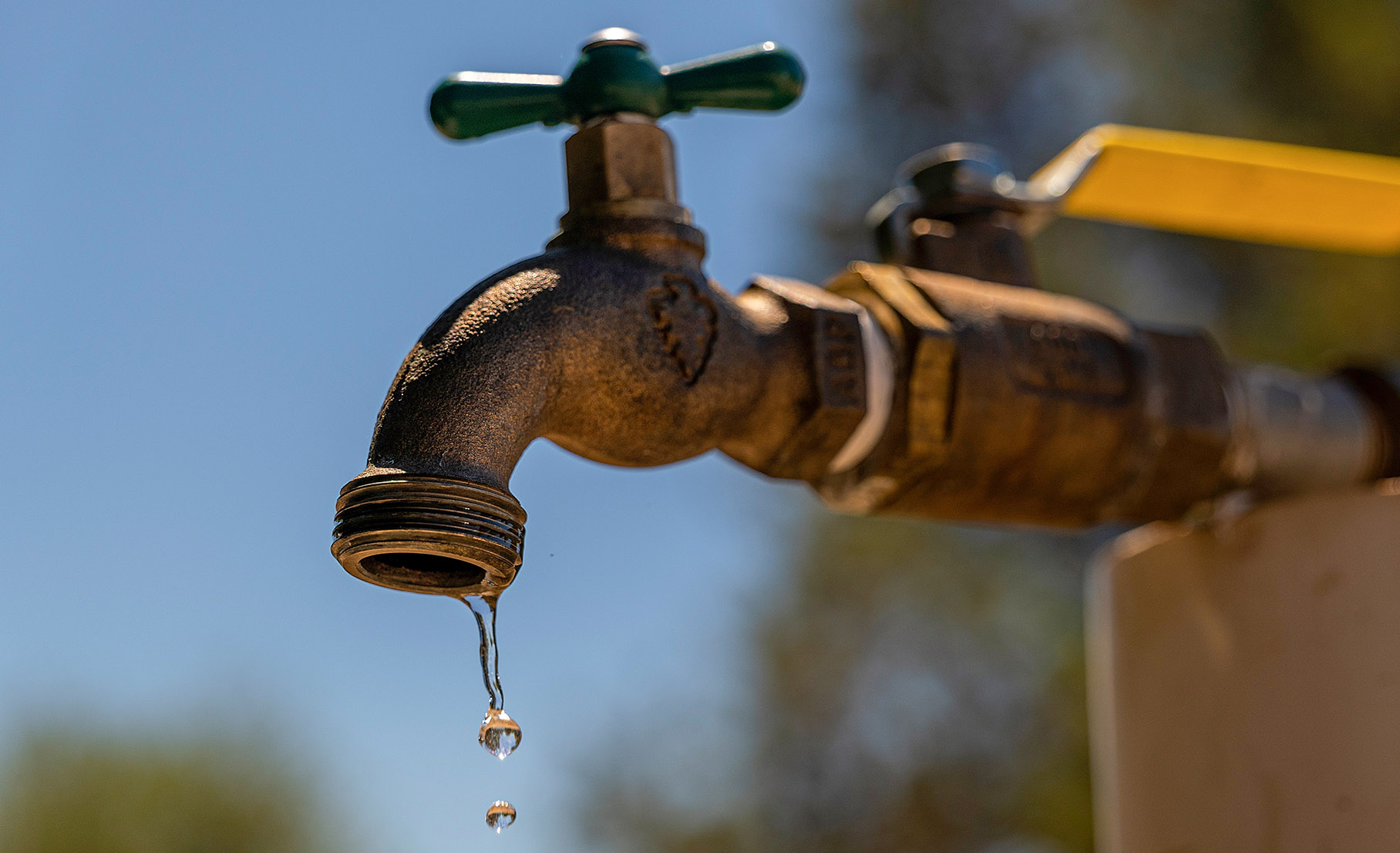
 With a looming water crisis, the Nelson Mandela Bay Business Chamber has urged businesses to become more water resilient. Meanwhile, residents say the municipality’s latest water-saving campaign misses the mark.(Photo: David Paul Morris / Bloomberg via Getty Images)
Likening the current water crisis to the height of load shedding, the Nelson Mandela Bay Business Chamber has urged local industry to implement water-saving measures to ease the load on the metro’s dwindling water supply.
Increasing water storage, implementing systems to reuse and recycle water and exploring possible alternative supplies were among the Business Chamber’s suggestions to businesses to make a noteworthy impact on the city’s water consumption.
Meanwhile, the public has poured cold water on the Nelson Mandela Bay (NMB) Municipality’s latest water-saving campaigns, which caution against the use of water pistols and water balloons.
Some residents took to social media, calling for a “water pistol amnesty period” and posting about pictures and videos of leaks that have not been repaired, as well lambasting the municipality for seemingly losing sight of better solutions to the crisis.
The combined level of NMB’s supply dams dropped below 37% in late January. While calls for lower consumption are warranted, with current use sitting at 378 million litres (ML) per day rather than the recommended 280ML, the municipality is struggling to cope with upwards of 6,000 reported leaks and 50% of the city’s use attributed to losses.
Read more: Save water, metro says — while Nelson Mandela Bay’s leaks run for months
“Water security underpins economic confidence and sustainable growth. By acting early and responsibly, businesses can help ensure that Nelson Mandela Bay remains resilient, competitive and well-positioned to manage future water challenges,” Business Chamber chief executive Denise Van Huyssteen said.
/file/dailymaverick/wp-content/uploads/2025/05/NMBBC-25May-0321-1.jpg "NMB Business Chamber CEO Denise van Huyssteen (Photo: Supplied)")
“Businesses should be looking at water security as carrying a similar level of risk to what was experienced during the height of load shedding in the 2023/24 period. This required that back-up solutions, such as solar power and generators, were in place to ensure business continuity during power disruptions.”
Van Huyssteen said a combination of factors increase the risk for potential water restrictions and even periods of water-shedding, such as decreasing dam levels, unaccounted water losses tracking at more than 50% and consumption trending well above target.
“Water remains a critical input into every sector of the local economy, from small businesses to large industries, and it is prudent for businesses to ensure they have reasonable contingency measures in place to manage potential interruptions,” she said.
The Business Chamber’s Water Task Team lead, Basil Mugwagwa, said the current water outlook presents a critical moment for coordinated and practical action, particularly from the business community.
“The chamber is advocating for a balanced and responsible approach – continued water efficiency, coupled with realistic preparedness measures that protect business continuity and economic stability.
“By encouraging businesses to assess their water risk exposure and invest in proportionate and compliant backup solutions, we are not shifting responsibility away from the municipality, but rather strengthening collective resilience.”
Mugwagwa said prepared businesses are better able to sustain operations and protect jobs while reducing the strain on municipal systems. He said forward planning is essential for the metro to remain economically competitive and resilient in the face of increasing water uncertainty.
Read more: Nelson Mandela Bay under the pump as critical water infrastructure crumbles
/file/attachments/orphans/riaan-ins1_347448.jpg "The Nelson Mandela Bay municipality has been roasted for some of their suggestions for saving water. (Photo: Nelson Mandela Bay municipality)
<br>")
And while the business sector is advocating solutions that could relieve significant pressure on the supply, the public did not take kindly to the municipality’s latest water saving tactics.
“Don’t use water-based toys like water guns, water balloons, etc,” read a poster, showing a water gun spraying a thin stream of water, which was posted on social media platforms last week.
/file/attachments/orphans/riaan-ins2_530764.jpg "As dam levels in Nelson Mandela Bay lower the municipality has come up with a number of water saving solutions. (Photo: Nelson Mandela Bay municipality)")
It was met with several unfriendly comments from the public.
“Is it April 1st?”– Barbara Minnie
“Please focus on the hundreds of leaks in the city first. I think that should take more priority than hand held water pistols?” – Sian van As
“Nah… this must be a joke… Everyone who has a water pistol take it to your nearest SAPS for safe keeping.” – Lidzia Kozakiewicz
“I don’t know whether to laugh or to cry.” – Jerome Ho Chung
The metro’s other campaign suggestions included refusing a refill of water at restaurants, steaming rather than boiling vegetables and setting lawnmowers higher because longer grass shades root systems and holds more water.
Dozens of residents called on the municipality to focus more on repairing leaks, adding pictures or reference numbers to reported leaks in their comments.
When asked about the critique of its water saving campaigns, municipal spokesperson Sithembiso Soyaya shrugged off the question and declined to comment.
Environmentalist and Eastern Cape chair of the Wildlife and Environmental Society of South Africa, Gary Koekemoer, agreed with the risks highlighted by the Business Chamber and said the latest municipal campaigns are missing the mark.
“The city is losing the battle against leaks. We are currently losing between 40% and 50% of our water between the dams and the taps. On top of that, large quantities are going to waste due to recycling systems not being operational, and residents are over consuming.”
/file/attachments/orphans/WhatsApp-Image-2026-01-18-at-1330_737822.jpg "A water leak that was reported in November last year was only fixed on 6 January with litres clean water wasted for over a month as Nelson Mandela Bay dams dwindle (Photo: Facebook)")
He said climate change means that the NMB region will face more frequent periods of drought, and putting systems in place to make the metro more resilient is essential now and for the future.
“While I agree that residents definitely need to become more water smart, I don’t think banning water pistols is the way to get the message across.
“I think the municipality is undermining its own campaign and detracting from the effectiveness of the message it is trying to get out there,” Koekemoer said. DM