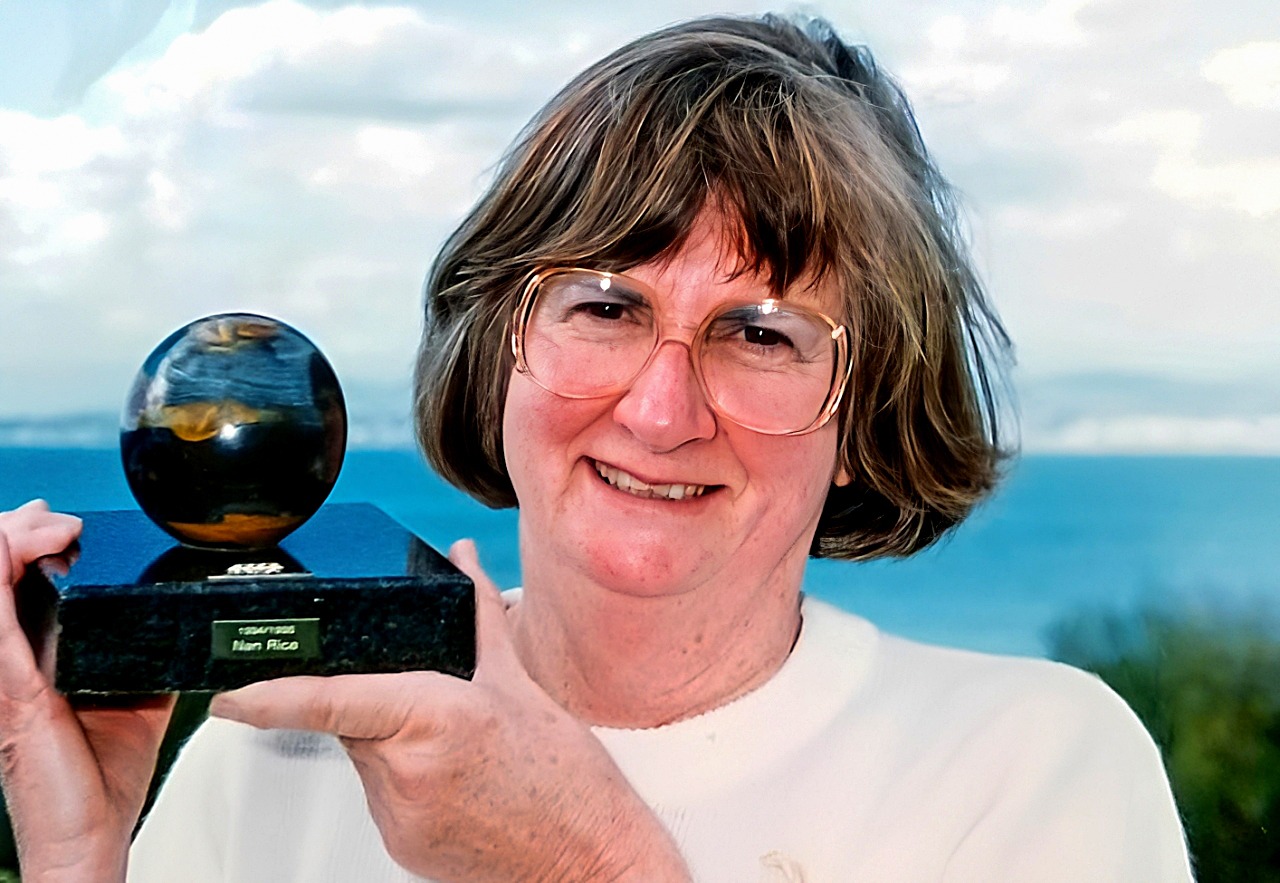
 A file picture from the late 1980s of veteran marine conservationist and lobbyist Nan Rice. (Photo: Dolphin Action &, Protection Group)
“To hear a whale blow is like hearing the breath of life”
(A quote by prominent South African marine conservationist Nan Rice during a 1990 interview with the Los Angeles Times. Rice died earlier this month in Cape Town, aged 93)
Early one December morning in 1969, a woman in her mid-thirties stood on the beach at Hout Bay and watched with growing horror and helpless fury as a school of about 200 panicking dusky dolphins tried desperately to escape the trek fishing net that surrounded them. Dolphins enjoyed no legal protection of any kind at that time, and word was that 10 of these animals were to be selected for a life of captivity in a pool at a Cape Town zoo.
While most of the trapped dolphins, many of them bleeding, were thrashing frantically against the sides of the net in a desperate effort to escape, several were hauled unceremoniously out of the water and flung onto foam mattresses on the beach where they were injected, presumably with a tranquilliser.
Four of the captured dolphins died on the beach, and when the rest of the school were eventually released from the net, they appeared too traumatised to swim away and had to be helped back into deeper water.
The shocked woman who witnessed this cruel episode was Nan Rice.
Until that moment “just a simple housewife” (as she later described herself), Rice’s life was instantly changed by that formative event at the beach. Over the next five decades or so, she worked tirelessly to protect cetaceans (marine mammals like dolphins, whales and porpoises) in particular but also many other creatures in the marine ecosystem that covers 71% of Earth’s surface. Driven by deep passion and unswayable conviction, and reinforced with tenacity, courage and chutzpah, she didn’t stop at just the oceans: beaches and shorelines, harbours, urban supermarkets with their multitudes of plastic packaging, and even the distant continent of Antarctica all came under Rice’s environmental scrutiny and, where appropriate, were gathered into her broad conservation embrace.
Her “simple housewife” epithet was transformed into “passionate marine conservationist” as she became a household name in the South African nongovernmental environmental organisation network through scores of campaigns, investigations and projects.
Sacrifice, and a very thick skin
Rice was born in Sea Point where she spent her early childhood and later attended Wynberg Girls High. By the late 1960s she was a divorced mother of three sons living in Hout Bay.
After witnessing the beach capture, she launched an intensive lobbying campaign for the legal protection for dolphins. Surprising as it seems now, she faced immediate disapproval and criticism, including from the media, and it quickly became apparent to her that her new life focus would require personal sacrifice and commitment – and a very thick skin.
Despite the lack of public enthusiasm for her new campaign, Rice enjoyed early success: just one month after the Hout Bay incident, the administrator of the then Cape Province adopted an ordinance protecting dolphins. And in 1973, a comprehensive new Sea Fisheries Act was introduced that inter alia provided extended legal protection for dolphins along the entire South African coastline as well as Namibia (then still South West Africa). But there were legal loopholes: dolphins could be, and were, captured under permit for display in oceanariums.
/file/attachments/orphans/DAPGlogo_879229.jpg "The famous blue logo of the Fish Hoek-based Dolphin Action and Protection Group, founded in 1977. (Image: Dolphin Action and Protection Group)</p>
<p>")
After some frustrating battles to stop these horrific captures and subsequent “life sentences” in captivity for the highly intelligent creatures, Rice realised that what was required was an organisation dedicated specifically to protecting and conserving dolphins and that could act as a watchdog to ensure that appropriate legislation was promulgated and enforced.
So, after wide consultation, Rice launched the nonprofit Dolphin Action and Protection Group (DAPG) on a stormy May night in 1977, with the motto “Dolphins should be free”.
She employed a part-time assistant from 1990, a part-time educational officer for 20-plus years and was guided by an executive committee of trustees. But in essence the DAPG remained a one-woman show throughout its formal 45-year history.
‘Save the Whales’ is born
Earlier, in 1975, Rice had become very involved in an international investigation into pirate whaling led by Nick Carter of the International Society for the Protection of Animals. A nongovernment observer at the International Whaling Commission (IWC), Carter was researching the operations of an infamous pirate whaling ship, the MV Sierra, that was suspected of operating outside IWC agreements and of taking protected whale species and undersized animals, and of whaling in agreed protected zones
It turned out that the MV Sierra’s owner lived in Hout Bay and was a neighbour of Rice. She was able to give Carter key information about the vessel and the owner’s activities that helped expose the illicit operation. In October 1975, Carter released his investigative report to IWC commissioners and observers as well as international news media.
Tapping into the success of this anti-pirate whaling operation, the DAPG extended its focus from dolphins to bigger cetaceans and in 1979 initiated an energetic “Save the Whales” campaign, characterised by intensive lobbying.
Again, there was immediate success. In December 1980, regulations were promulgated to protect whales in South African legal jurisdiction, although initially only during their breeding season. Rice and the DAPG again lobbied the authorities and in 1984, the legislation was amended to provide year-round protection for the giant marine mammals in local waters.
‘Walls of Death’ and white sharks
Many other DAPG campaigns, often in collaboration with like-minded individuals and organisations, followed.
One major success led to the banning of so-called Walls of Death – highly destructive drift-nets sometimes more than 100km long that were set on the high seas, indiscriminately entangling and drowning everything that came into contact with them.
Largely as a result of persuasive lobbying by a partnership of Rice and the Food and Allied Workers Union, the Sea Fisheries Act was amended in July 1989, making it illegal for any fishing vessel to use drift-nets in South African waters and to have such nets aboard even if they were not actively deployed.
Rice also became deeply concerned about the continued slaughter of great white sharks in South African waters. After a DAPG opinion poll produced an unexpectedly high return (81.22%) in favour of full protection for these much-maligned apex ocean predators, she instigated a lobbying campaign in association with shark researcher Dr Leonard Compagno of Iziko Museums and one-time shark hunter-turned-conservationist Theo Ferreira.
It was also successful and in May 1991, regulations were gazetted to protect these sharks and prohibit any trade in their products, such as teeth – a world first for the animal now called simply the white shark.
During 1992, the DAPG initiated a comprehensive educational campaign in all South African ports and harbours to raise awareness about, and ensure compliance with, the international convention to prevent pollution at sea: the MARPOL International Convention for the Prevention of Pollution from Ships that had come into force in October 1983.
The group’s local “Stow it, don’t throw it” campaign was aimed specifically at the effective implementation of Annex V of the convention: the Prevention of Pollution by Garbage from Ships. Its most important feature is a complete ban on the disposal into the sea of all forms of plastics.
Plastic pollution of any kind was an anathema to Rice, and she also led the charge that eventually resulted in a small charge being levied on plastic shopping bags and an immediate (albeit non-permanent) and substantial drop in the amount of “South African snow” on display – shredded plastic bags lining the veld outside urban areas.
Save Antarctica and cetacean rescue
In 1984, the DAPG worked closely with Greenpeace and the Antarctic & Southern Ocean Coalition, and launched the national Save Antarctica campaign in South Africa. This was in response to growing concern about ecological damage to the Antarctic ecosystem through the overexploitation of krill – the small marine crustacean that is the key food source of the great whales like southern rights and humpbacks that migrate to the deep Southern Ocean waters off Antarctica every summer to feed. Linked concerns included the massive poaching of Patagonian toothfish, also in the deep Southern Ocean, and the discarding of plastic and other polluting waste at various scientific bases on the frozen continent itself.
Their efforts included intensive lobbying for the adoption of the Antarctic Treaty’s environmental protocol which was eventually signed in Madrid, Spain in October 1991 and entered into force in 1998.
/file/attachments/orphans/DAPGSaveAntarctica_966031.jpg "The front page of an educational pamphlet published by the Dolphin Action and Protection Group as part of its ‘Save Antarctica’ campaign. (Image: Dolphin Action and Protection Group)<br>")
Another campaign, also in cooperation with other conservation groups, involved successful lobbying for the reversal of the apartheid government’s secret 1989 approval of a permit for a Taiwanese entrepreneur to slaughter up to 30,000 Cape fur seals a year – 20,000 of them pups – for an initial five years. The carcasses were to be processed at a dedicated factory to be built at Kleinzee on the Namaqualand coastline.
In 2005, the DAPG started working with the Marine and Coastal Management branch of the national environment department to develop a coordinated approach to rescuing whales and dolphins that had become trapped in fishing nets or ropes from rock lobster and octopus traps. One year later, the South African Whale Disentanglement Network (SAWDN) was formally established as the only officially credited cetacean rescue team for local waters. Still active and highly effective, it consists of a dedicated, trained network of volunteers from close to 20 member organisations and industries who undertake the always dangerous disentanglement operations.
/file/attachments/orphans/WhaleDisentanglementnetwork3_896408.jpg "A file picture of SA Whale Disentanglement Network volunteers work to release an entangled Humpback Whale in St Helena Bay.
<br>(Photo: National Sea Rescue Institute)
<br>")
(Photo: National Sea Rescue Institute)
/file/attachments/orphans/WhaleDisentanglementnetwork2_833968.jpg "A file picture of SA Whale Disentanglement Network volunteers busy with the highly dangerous task of cutting rope off an entangled Humpback Whale in St Helena Bay.
<br>(Photo: National Sea Rescue Institute)
<br>")
(Photo: National Sea Rescue Institute)
/file/attachments/orphans/WhaleDisentanglementnetwork1_817806.jpg "A file picture of a rescue team from the SA Whale Disentanglement Network aboard an NSRI boat approach a rope-entangled Humpback Whale in St Helena Bay.
<br>(Photo: National Sea Rescue Institute)")
(Photo: National Sea Rescue Institute)
‘You can’t be sentimental, you have to be serious’
Rice wore her heart on her sleeve and was especially outspoken in the early years of her activism. So, given her intense passion for, and fierce defence of, marine creatures, she sometimes took her supporters and the public at large by surprise when taking a position seemingly at odds with her conservation philosophy. This was particularly so in her stout defence of euthanasia, or mercy killing, for stranded whales and dolphins – and particularly of single animals – and her criticism of what she saw as well-meaning but ignorant volunteers and observers who interfered with official rescue efforts.
This was evident in her comments during the largely unsuccessful effort to rescue a pod of false killer whales that stranded on Long Beach, Kommetjie, in May 2009, and that ended with 44 of the stricken animals being shot. Rice was quoted by the South African Press Association as saying that the decision to euthanase the Long Beach whales had only been taken after it became clear they would not survive the night on the beach, and she lashed out at public criticism of that decision.
“You can’t be sentimental, you have to be serious,” she said. “I’ve seen it [euthanasia]. It’s quick… the whale dies in a few seconds. But they [the public] get hysterical and start acting like prima donnas and throw themselves on the beach and have to be carried away by the police.”
During the course of her work Rice became widely recognised and honoured for her tireless and forthright advocacy, education and campaigning that stretched over more than five decades.
/file/attachments/orphans/NanRiceandtrophy2_774445.jpg "A 1989 cutting from The Star newspaper reporting on its annual Woman of the Year award to marine conservationist and lobbyist Nan Rice.
<br>(Photo: The Star)
<br>")
(Photo: The Star)
In 1989 she was named Woman of the Year by The Star newspaper, and in the same year she also won the Cape Times Centenary Medal in recognition for “outstanding achievements” in the field of natural environment.
In 1995 she was nominated for an Audi Terra Nova Award that recognises “unsung heroes of conservation and individuals making significant contributions to environmental protection and game management”, and in 2006, she was awarded a Gold Medal for “lifetime contribution to the Environment” by the Cape Tercentenary Foundation.
DAPG fallout and failing health
Initially, Rice had worked as DAPG secretary on an honorary basis, using her own funds and small donations to support its work, and in 1984 she was forced to take on part-time outside work to keep it afloat financially. It was only after 1989, when the group started receiving a few bequests and sponsorships from companies – including giants like Pick n Pay and I&J – that she and Jean Fuggle, Rice’s friend who worked with her for more than 30 years as assistant and group treasurer, were able to take small salaries.
In 2014, Rice’s proposed use of the group’s financial resources to fund her retirement caused severe tension and a fallout with most of the DAPG executive committee, who rejected her proposal on legal grounds. Then exco chairperson Dave Hurwitz describes the dispute as “very unfortunate” but is adamant about the correctness of the committee’s decision. “We really regret what happened – the group had achieved such a huge amount over the years. It was a tough time for all of us, and especially for Nan, given her age,” he says.
Rice, who by this time was no longer in good health, continued receiving her small salary, but the issue appeared to have taken a severe toll on her and she no longer displayed the energy and interest of old. The work of the DAPG was effectively, if not yet officially, over.
Perseverance, principles, compassion
Fuggle speaks of Rice’s tenacity and perseverance – particularly in the early days when public sentiment about whales was not nearly as positive and acute as it is now.
“She really had to fight for everything, and as a lone female it was particularly difficult,” Fuggle remembers. “People would say ‘Why fight to save whales? So what?’ It wasn’t easy to battle like that in the face of a lot of opposition. But she just carried on persevering – not everyone would have done that. And Nan always stuck to her principles, she was a very ethical person.”
Mike Meÿer, SAWDN operations and training manager, describes Rice as “a true pioneer in the fight to protect our oceans’ most vulnerable mammals”.
“We remember and honour Nan Rice as a remarkable individual whose passion and commitment to marine conservation inspired countless others. Nan’s leadership was rooted in deep compassion and steadfast resolve. She not only raised public awareness about the plight of dolphins and whales but also worked tirelessly behind the scenes to unite scientists, volunteers and government officials in common purpose.
“Her ability to mobilise resources and inspire action ensured that every call for help, whether from a stranded whale or a distressed dolphin, was answered with urgency and expertise.”
Kim Buckley Wright, part-time educational officer and illustrator for the DAPG over three decades and currently owner of a Hoedspruit-based nature and bird guiding company, says Rice was an inspiration to her. “Nan and I built a strong friendship over the years. She was truly remarkable and dedicated to her cause. I identified with that and, like her, also followed my passion.”
DAPG disbanded
In October 2022 – by which stage Rice was requiring a full-time carer – all the group’s funds had been expended and the Dolphin Action and Protection Group was officially disbanded.
She was moved to a facility for the aged in Claremont where she died on 12 January this year.
A remembrance ceremony is planned for 12 March – a deferred date to accommodate a very good friend of hers who will be travelling from the UK.
Rice is survived by her only remaining son, Duncan, and three adult grandchildren. DM
Nan Rice, 23 April 1932 – January 12 2026