




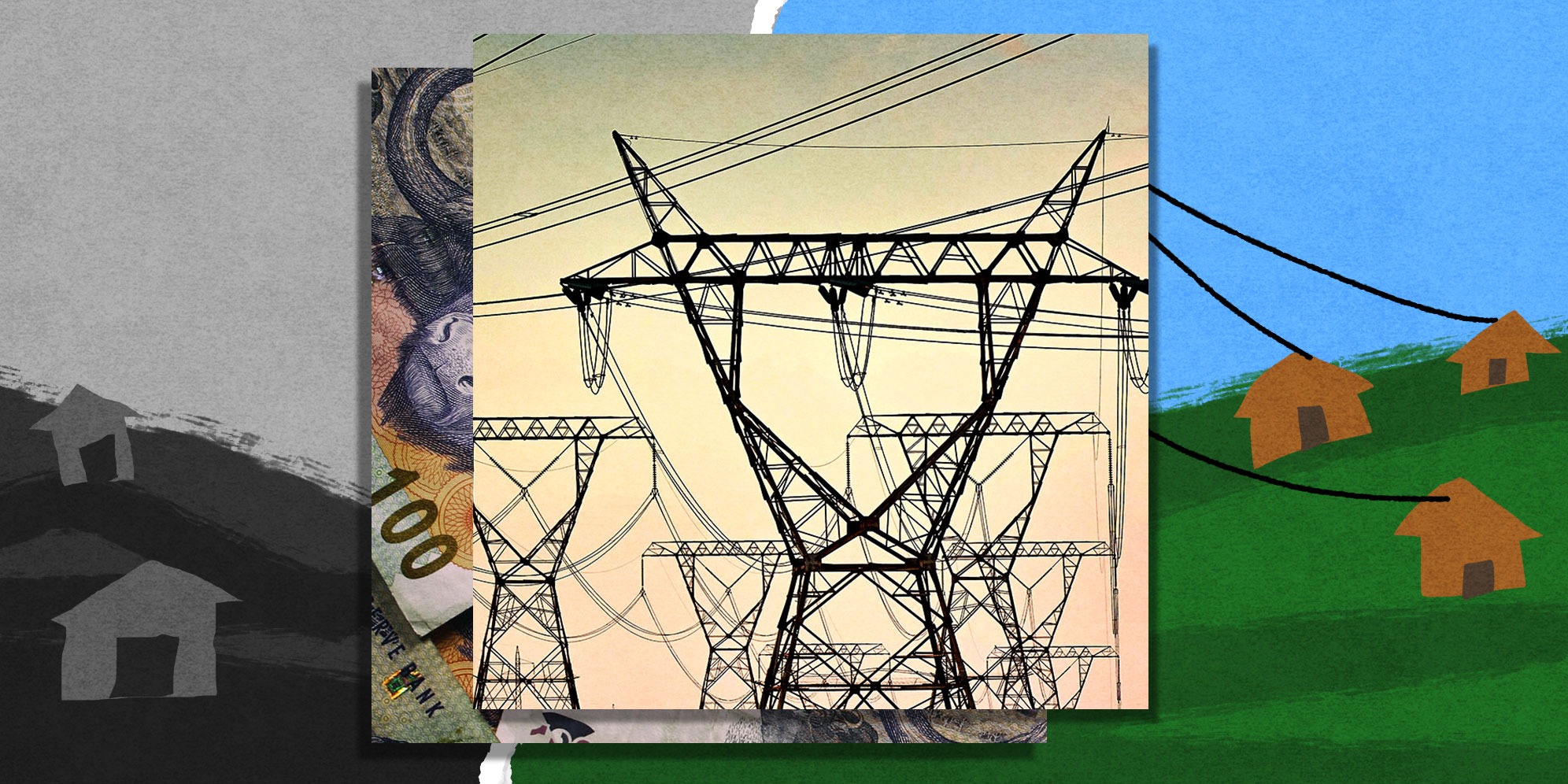
 Illustrative Image: A general view of power lines on 11 June 2021 in Cape Town, South Africa. (Photo: Gallo images/ER Lombard) | Money. (Photo: Istock) | (By Daniella Lee Ming Yesca)
 /file/dailymaverick/wp-content/uploads/2025/10/label-Op-Ed.jpg)
Municipal electricity debt has become a macroeconomic and industrial issue because electricity distribution is not a niche municipal service – it is a central artery of the economy. Municipal distributors supply households, malls, office parks, factories, hospitals and public infrastructure. When municipal electricity trading accounts collapse, the effects ripple outward: maintenance is deferred, outages multiply, network losses rise and investment decisions tilt away from municipal supply areas. The result is a slow degradation of reliability, affordability and competitiveness.
The uncomfortable implication is that municipal arrears are not simply a symptom of poor local governance. They are also the predictable outcome of an electricity distribution industry (EDI) structure that has, over time, placed municipal distributors in an increasingly untenable position – financially, operationally and politically. The crisis should properly be framed as a structural misalignment at the centre of South Africa’s EDI, with Eskom in the thick of it.
Structural lock-in: how municipalities became dependent on Eskom
Historically, many municipalities generated, transmitted and distributed their own power largely to “white” residents, businesses and services, with revenues aligned to local networks and local responsibilities. Over time, that model was dismantled. Eskom’s centralised generation expanded, while the municipal customer base grew and municipalities transitioned into bulk purchasers – effectively retailers and network operators – and no longer generators.
That shift created a dependency on Eskom that has proven extraordinarily difficult to escape. Most municipalities now source virtually all their electricity from Eskom under bulk supply agreements, while carrying expanded responsibility for operating, maintaining and growing their local distribution networks.
In theory, municipalities can diversify supply through independent power producers (IPPs). In practice, their ability to do so has been constrained by regulation, licensing and ministerial determinations, complex procurement rules, competency issues and unsettled wheeling and trading frameworks – even where network capacity exists. This “locked-in dependency” is such that municipalities do not have their own generation control or practical freedom to procure competitively at scale, but remain fully exposed to Eskom’s escalating tariffs and demand penalties.
This lock-in matters because it turns municipal electricity distribution into a pass-through business with a widening structural gap: the municipality must buy at whatever Eskom charges, but sell into a local economy with limited affordability, weak payment discipline and growing alternatives for better-resourced customers.
Tariffs and non-payment: the post-2007 affordability shock
In addition to governance issues, a driver for municipal failure is the escalation in Eskom’s bulk tariffs from about 2007 onward – not merely above inflation, but at levels that completely rewired the affordability of electricity for households and businesses.
The dramatic post-2007 electricity price trajectory indicates steep increases coinciding with the onset of load shedding and Eskom’s new-build programme. The core point is not the exact percentage in any single year – it is the compounding shock over more than a decade. Electricity moved from being a relatively cheap input to a hyper-inflating administered price.
For municipal electricity distributors, the tariff shock transmits downstream through a brutally simple mechanism: municipalities purchase bulk power at rapidly escalating tariffs and must resell it to end users. If they pass through the full increase, electricity becomes progressively unaffordable and payment drops. If they under-recover for political or affordability reasons, the trading account absorbs the loss. Either way, the financial gap widens.
Read more: Municipalities’ R107bn debt to Eskom threatens power utility’s financial sustainability
This is where “non-technical losses” become central – electricity consumed but unpaid due to payment default, illegal connections, meter bypassing, billing failures and fraud. Rising Eskom electricity tariffs to municipalities reduce affordability, drive higher non-technical losses, and rising municipal arrears – a cycle akin to a “death spiral”.
Eskom’s tariff trajectory was linked to its large generation capital programme, especially Medupi, Kusile and Ingula, as cost overruns and delays fed into higher tariffs under a regulated cost-recovery model. The downstream consequence is that municipal customers end up paying, via tariffs, for upstream mismanagement and inflated capital costs – while municipalities then carry the social and political fallout of affordability.
Unequal burden: municipal distributors carry costs that Eskom does not
A further driver for municipal failure is a structural unfairness that becomes clearest where Eskom and municipalities operate side-by-side as distributors.
Johannesburg is a case study. City Power supplies roughly 60% of the metro, while Eskom Distribution supplies the remaining 40% directly to end users within the same city. The arrangement is not unique. Across South Africa, Eskom supplies customers in areas outside municipal supply boundaries – including towns, rural regions, mines, industrial zones and developments.
Yet municipalities are charged tariffs that treat them effectively as end-user customers rather than peer network utilities. City Power, and every municipal distributor like it, must recover Eskom’s bulk tariff and fund and operate extensive local distribution infrastructure.
Municipalities absorb technical and non-technical losses, and cross-subsidise social and economic development tariffs, while trying to remain competitive with Eskom’s own direct retail supply next door, often under lighter obligations.
This isn’t “competition” in any meaningful sense. It is an arithmetic impossibility: one player carries layered costs and social mandates; the other supplies directly with a national tariff structure and different risk exposures.
The result is a predictable behavioural response: businesses and mobile loads seek cheaper supply options or reposition into Eskom-supplied zones, shrinking the municipal commercial and industrial base – the very segment that funds cross-subsidies and supports the grid.
Load shedding: how generation failure destroyed municipal finances
A third driver for municipal failure has been load shedding – not only as an interruption of supply, but as an uncompensated downstream shock imposed between 2008 and 2024, rooted in Eskom’s generation failures and maintenance collapse. In a properly regulated environment, persistent failure to meet demand would attract penalties and clawbacks. In South Africa, the costs and consequences were pushed downstream to municipalities without compensation or risk sharing.
Load shedding damaged municipal finances in various ways:
- Revenue losses and margin distortion: Load shedding reduces electricity volumes sold. But the financial impact is not uniform: for commercial and industrial customers on time-of-use tariffs, the highest margin energy is often at peak periods – precisely when load shedding tends to bite. Municipalities lose their most profitable sales first, collapsing trading surpluses;
- Operating cost escalation: Load shedding is labour intensive for municipal distributors. Frequent switching, staggered restorations to avoid inrush trips, and repeated fault responses drive overtime and reactive maintenance. Planned maintenance is displaced by emergency work, increasing long-run costs and accelerating asset deterioration;
- Artificial demand spikes and maximum demand charges: Because load shedding is often implemented at higher-voltage supply points rather than sectionalised feeders, large load blocks are restored simultaneously, producing restoration demand spikes. Those spikes can set maximum demand records and trigger 12-month demand charge ratchets – locking in higher bulk charges at the very moment energy sales are falling. Perversely, municipalities are financially penalised for peaks created by the operational reality of load shedding;
- Asset damage, failures and criminal opportunity: Repeated full load on-off cycling reduces transformer life and stresses medium-voltage cable joints and terminations, driving failures and prolonged outages that require costly excavation and emergency repairs. Extended outages can deplete DC battery tripping systems, undermining protection and leading to catastrophic equipment damage. Public load shedding schedules also create predictable windows for theft, vandalism and meter bypassing, expanding permanent non-technical losses.
Taken together, load shedding doesn’t merely reduce sales. It increases costs, destroys assets, erodes revenue integrity and undermines payment morality – all while municipalities remain responsible for quality of supply at street level.
Read more: Municipalities grab short end of Nersa electricity market liberalisation
Private escape routes vs municipal constraints
Over the past few years South Africa has effectively created two different pathways to manage Eskom tariff and reliability risks.
Large private-sector customers increasingly have tools to hedge, including self-generation, private power purchase agreements with IPPs and wheeling arrangements. Municipalities, though theoretically allowed to procure or generate, face legal, regulatory and procurement constraints that make such projects slow, risky and often unbankable. There is a deep structural asymmetry: large customers are increasingly enabled to escape high Eskom prices and poor reliability, while municipal distributors do not have equivalent tools and are left carrying stranded costs and social obligations.
This matters for municipal solvency because when large customers reduce municipal purchases – through self-generation, wheeling or moving to Eskom supply zones – municipalities lose the very loads that traditionally subsidised low-income service, network upkeep and system losses. Municipalities cannot respond symmetrically by quickly replacing Eskom bulk supply with cheaper IPP supply at scale. The result is another reinforcing feedback loop: customer flight shrinks the base; tariffs rise on those who remain; payment declines; and arrears grow.
Rooftop solar PV compounds the pressure as municipalities buy bulk power on time-of-use structures but sell to residential customers on flat tariffs, failing to recover peak demand and network capacity costs as network supply volumes shift.
Conclusion: a structural failure, not just poor governance
Municipal mismanagement exists, and in some cases it is severe. But focusing only on local governance failures misses the larger design flaw.
Eskom is insulated from commercial risk through tariff and regulatory mechanisms; selected large customers are protected through increasing access to alternative supply and negotiated price structures; national electrification priorities shape subsidy flows; and municipal electricity distributors absorb the residual financial, operational, political and social risk.
Municipalities carry tariff shock, cross-subsidy extraction, load shedding damage, theft, vandalism, business flight and revenue erosion – without structural price protection, compensation or a credible distribution industry reform pathway after the failure of the EDI restructuring efforts between 2001 and 2010.
Solutions cannot be limited to “better debt collection” or “stricter credit control”, important as these are. South Africa will need structural remedies that rebalance risk and cost across the electricity value chain. This includes fairer bulk pricing that recognises municipal distributors as network peers, workable municipal IPP procurement frameworks, coherent wheeling and trading rules, and a realistic pathway to restore distribution sustainability in an evolving market.
If the system is engineered to accumulate municipal electricity debt, it will keep doing so – until service quality, investment confidence and local economic competitiveness fail with it. DM
Chris Yelland, EE Business Intelligence, and Paul Vermeulen, energy consultant.
© Copyright 2026 – EE Business Intelligence (Pty) Ltd. All rights reserved. This article may not be published without the written permission of EE Business Intelligence.