




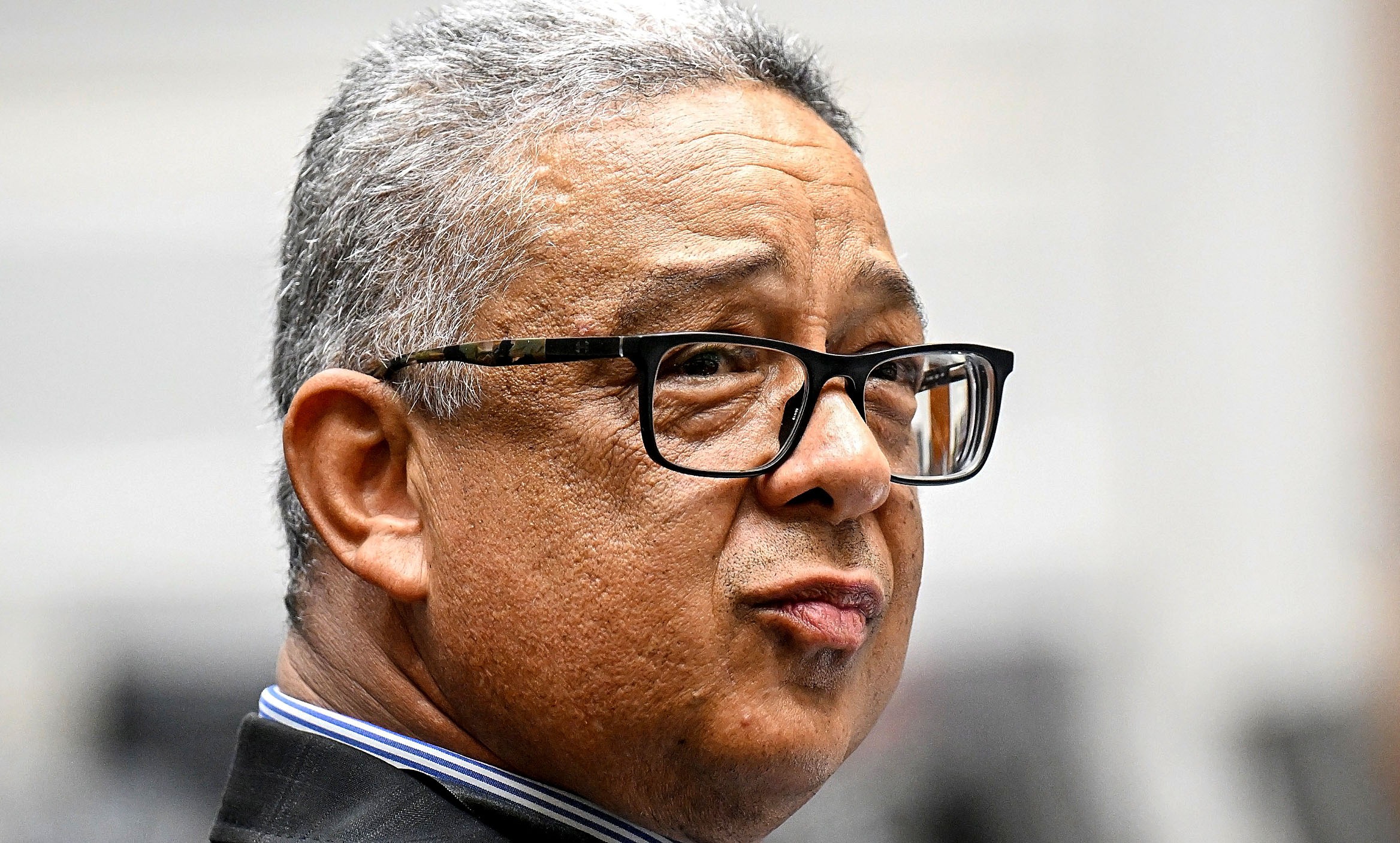
 Former Independent Police Investigative Directorate head Robert McBride testifies on 20 January 2026 before Parliament’s ad hoc committee investigating allegations made by KwaZulu-Natal police commissioner Lieutenant General Nhlanhla Mkhwanazi. (Photo: Phando Jikelo / RSA Parliament)
 Robert McBride, who heads the State Security Agency’s Foreign Branch, has accused KwaZulu-Natal police boss Nhlanhla Mkhwanazi of trying to torpedo a critical police watchdog investigation.
McBride was testifying on Tuesday, 20 January 2026, at Parliament’s ad hoc committee, and during these proceedings, he also alleged that Mkhwanazi understated his proximity to a murdered investigator.
The ad hoc committee is looking into accusations that Mkhwanazi initially made in July last year that a drug cartel has infiltrated South Africa’s criminal justice system, politics and private security.
Mkhwanazi, in making those accusations, appeared to portray himself as something of a whistleblower exposing alleged corruption that extended to state structures, including the South African Police Service (SAPS).
Now, McBride’s testimony to the ad hoc committee on Tuesday raises some questions around the KZN police commissioner.
/file/attachments/orphans/pic1_315814.jpeg "Former Independent Police Investigative Directorate head Robert McBride testifies before Parliament’s ad hoc committee established to investigate allegations made by KwaZulu-Natal police commissioner Lieutenant General Nhlanhla Mkhwanazi. (Photo: Phando Jikelo / RSA Parliament)")
He even said Mkhwanazi’s press conference last year, when the provincial commissioner first made accusations about cartel infiltration, was designed to intimidate.
McBride’s testimony underscores the rifts between various senior state law enforcement figures. His previous positions include Ekurhuleni Metro Police chief and Independent Police Investigative Directorate (Ipid) head.
Under McBride’s watch, Ipid investigated former acting national police commissioner Khomotso Phahlane, who faces charges in a corruption case and has countered that he is the target of an ongoing smear campaign.
Phahlane testified before the ad hoc committee last week and alleged that among those who targeted him were McBride and forensic investigator Paul O’Sullivan.
McBride on Tuesday described O’Sullivan as “eccentric, a little bit strange, but he does have good information”.
‘Mkhwanazi tried disrupting Phahlane probe’
Some of his testimony involved Mkhwanazi.
McBride testified that Mkhwanazi and Phahlane “are very close”.
Reading from a statement he submitted to the ad hoc committee, McBride said: “I do not know General Mkhwanazi, except, I have previously encountered him in a meeting when former Minister Nkosinathi Nhleko introduced himself to the SAPS senior management and the ‘entities’.
“From my memory, General Mkhwanazi was whining about not being given work and responsibility and his whining was directed at the [now-former] National Commissioner, Riah Phiyega.
“From my time at Ipid, I am aware of incidents [involving] General Mkhwanazi having played an undue and prosecutable role in trying to disrupt and scuttle the Ipid’s investigation into Phahlane.”
/file/dailymaverick/wp-content/uploads/2025/10/ED_577584.jpg "Lieutenant General Nhlanhla Mkhwanazi testifies at the parliamentary ad hoc committee’s inquiry on 7 October 2025. (Photo: Gallo Images / Brenton Geach)")
Murdered Ipid investigator
Some of the focus on Tuesday was on Mandla Mahlangu, an Ipid investigator who was murdered in 2020.
McBride said Mahlangu was killed “after making incriminating statements” about a person who had since testified before the ad hoc committee.
It has previously been reported that Mahlangu was investigating Phahlane.
Read more: Ipid investigator probing former police chief shot dead
On Tuesday, McBride testified that Mahlangu and Mkhwanazi had been friends. He said that when Mahlangu had once been shot at, and also following his murder, Mkhwanazi had been the first person on the scene.
McBride said that he had been to Mahlangu’s funeral, but Mkhwanazi had not been present. He added, “For me, it’s inconsistent and it needs to be looked at.”
In 2023, Khumbulani Sithole was reportedly convicted of Mahlangu's murder.
City Press had also reported that a hitman had alleged Mahlangu’s killing “was ordered and paid for by the police”, and that aside from investigating Phahlane, he had been “due to testify in a Crime Intelligence internal inquiry into an alleged jobs-for-favours scheme within the police service”.
About turn?
McBride also testified about Cedrick Nkabinde on Tuesday.
Nkabinde previously worked at Ipid and went on to become chief of staff for Senzo Mchunu, the police minister who was sidelined last year as part of the overall cartel infiltration scandal.
McBride testified on Tuesday that Nkabinde, while at Ipid, had been investigating Phahlane.
Late last year, Nkabinde testified at the ad hoc committee that around 2017, when he was still with Ipid, a team was allegedly assembled to ensure that Phahlane would not be appointed national police commissioner.
/file/dailymaverick/wp-content/uploads/2025/11/ED_585966.jpg "Cedrick Nkabinde, sidelined police minister Senzo Mchunu’s chief of staff, testifies at the Parliamentary ad hoc committee inquiry at Good Hope Chambers in Cape Town on 13 November 2025. (Photo: Gallo Images / Brenton Geach)")
According to Nkabinde, the aim of the team, which included O’Sullivan, was to ensure that McBride became national police commissioner.
McBride pointed out on Tuesday that Nkabinde had started out investigating Phahlane and then (via his ad hoc committee testimony) portrayed Phahlane as being unfairly targeted.
Of this, McBride said Nkabinde’s “180 degrees is a very strange setup”.
He described Nkabinde as having lied in the past and said he “is just a greedy person... he likes money”.
“We are aware of him buying 10 suits at a time... He likes the flashy style, the money,” McBride said.
Accusations and a court ruling
McBride was appointed Ipid boss in 2014, but the following year, the police minister at the time, Nathi Nhleko, placed him on precautionary suspension over a saga involving rendition allegations.
/file/attachments/orphans/0000090681_301941.jpg "Anwa Dramat, who previously headed the Directorate of Priority Crime Investigation, better known as the Hawks. (Photo: Gallo Images / Foto24)")
Of this, McBride's affidavit said: “The rendition case was regarding the planning and execution of [a] 2010 operation.
“Five Zimbabweans were alleged to have killed a colonel in Zimbabwe. As a result, they were on the run in South Africa and alleged to have been assisted by Dramat and Sibiya.”
“Dramat” and “Sibiya” referred to former Hawks officers Anwa Dramat and Shadrack Sibiya.
Read more: Robert McBride: ‘Werksmans law firm got Zimbabwean renditions case wrong’
McBride told the ad hoc committee he believed they were framed.
Sibiya subsequently became the police’s deputy national commissioner of crime detection, but he was suspended last year as part of the scandal involving Mkhwanazi’s drug cartel infiltration allegations.
Meanwhile, the Constitutional Court set McBride’s suspension aside in 2016, and he resumed his role as Ipid boss, remaining in this position until February 2019.
‘Crime Intelligence infiltrated cop watchdog’
During Tuesday’s ad hoc committee proceedings, McBride referred to another section of his affidavit that related to Crime Intelligence.
“Upon my return from suspension in October 2016, I was alerted to irregularities on how investigations had been conducted, during the time when I was on suspension,” it said.
“There were allegations that certain cases [that] were being investigated by the Ipid had been prematurely closed without carrying out proper investigation processes as contained in the standard operating procedures.
“Part of the problem was due to infiltration by Crime Intelligence in the form of Brigadier Tlou Kgomo… who had been appointed at Ipid as Director: Investigations… He left Ipid soon after my return.”
Read more: Zuma’s legacy: The build-up to breaking down Crime Intelligence
McBride rhetorically asked “what business” Crime Intelligence officers had, spying on politicians or doing their bidding.
He said the “control of that fund” – presumably the secret service account, which for years has been the source of looting accusations – “makes people invincible”.
‘It should’ve been a national emergency’
During Tuesday’s proceedings, the committee’s evidence leader, advocate Norman Arendse SC, put it to McBride that during his time at Ipid, he had tackled corruption in the police service.
/file/attachments/orphans/WhatsAppImage2026-01-14at131930_148765.jpeg "Former acting national police commissioner Khomotso Phahlane appears before Parliament’s ad hoc committee. (Photo: Phando Jikelo / RSA Parliament)")
McBride responded: “It was the first time it was taken on, corruption and systemic corruption in SAPS.
“In fact, at the end of my tenure, there were between eight and 13 generals and about 10 brigadiers who were on trial for corruption…
“[It had] never been done before, [it] should have been a national emergency, and no new cases since I left Ipid have been taken up again.”
McBride was referring to corruption, including systemic corruption, cases.
He said that he had previously spoken about police corruption in Parliament.
“I even stated that it is the greatest security threat to this country. I spoke out about prosecutors who were protecting criminals in uniform.”
McBride said South Africa was “reeling from what looks like an ineffective criminal justice system”.
Gesticulations and smiling
Tuesday marked the first time McBride testified about the law enforcement scandal that Mkhwanazi sparked last year, and some of the incidents that preceded it.
The proceedings got off to a rough start.
McBride did not provide an up-to-date affidavit to the ad hoc committee, and its members were unimpressed with his demeanour – he appeared as very relaxed and casual.
/file/attachments/orphans/WhatsAppImage2026-01-20at115707_169584.jpeg "Former Independent Police Investigative Directorate head Robert McBride appears before Parliament’s ad hoc committee on 20 January 2026. (Photo: Phando Jikelo / RSA Parliament)")
The EFF’s Leigh-Ann Matthys said he appeared “indifferent” and “is not taking the committee seriously”.
Ad hoc committee chair Soviet Lekganyane told McBride his “gesticulations” had caused concern among MPs and asked that he “withhold such conduct”.
McBride explained that when he conversed, he smiled “quite easily”.
Ad hoc committee members are expected to question McBride on Wednesday. DM