



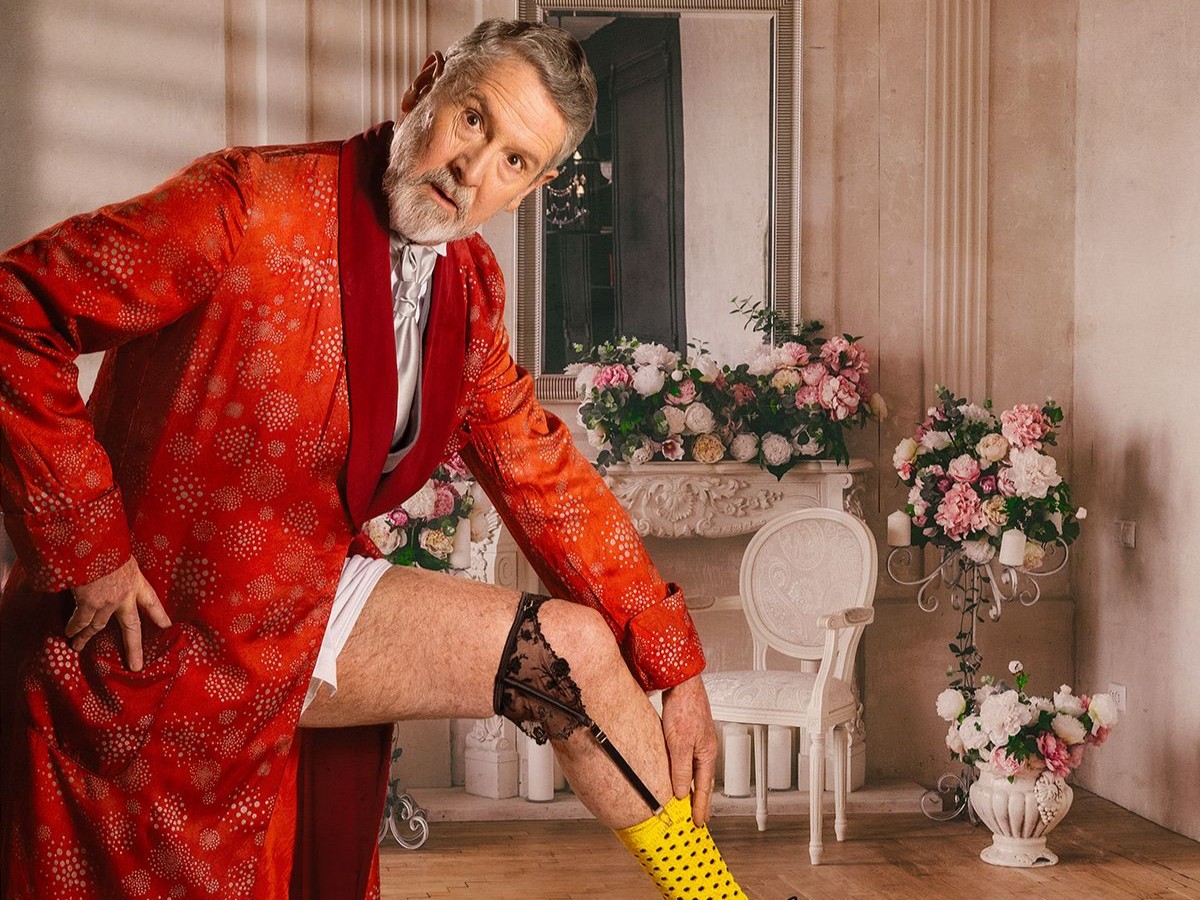
 Graham Hopkins is Malvolio in Maynardville's Twelfth Night. (Photo: Maynardville Open-Air Festival)
Staggering, swaying, dancing on the furniture and being shushed by the maid for creating a humungous racket somewhere on the far side of midnight, the characters in front of us had not in fact been drinking.
Nonetheless, the pair of them were decidedly out-of-their-minds drunk – hilariously so, in fact. Yet not so entirely far gone that they’d forgotten their lines, nor forsaken their ability to say them beautifully.
Aidan Scott, giving naughty schoolboy vibes, had no sooner stumbled into the space than he turned towards what appeared to be a flower pot and kotched (Shakespeare might be rolling in his grave at my word choice, but I’m afraid there’s no more appropriate term for it – this was no dry heave, no polite vomit, this was a full night’s ale spewed into the shrubbery).
The other stumbling, staggering late-night reveller, this one played by the magnificent Michael Richard, had more than a hint of scallywag about him, too. He managed – despite all the imaginary beer and wine and whatever else – to spew mellifluous lines of dialogue, the cleverness of the language barely disguised by the slurring and burping of someone who was, in that moment, “professionally” drunk.
The place, if you can believe it, was not in fact outside some tawdry Sea Point bar, but a makeshift rendition of an aristocratic home in a fictional land called Illyria, a romanticised coastal region somewhere on the Adriatic seaboard.
/file/attachments/orphans/ThecastofTwelfthNightinrehearsal_NickyNewman_107502.jpg "The cast of Twelfth Night in rehearsal. (Photo: Nicky Newman)")
In reality, it was a large, unflatteringly-lit, windowless room in the Artscape theatre complex, and also where all the hard work that’s gone into shaping this year’s Maynardville production of Twelfth Night had been happening over several weeks of intensive rehearsals. We, a small entourage of outsiders, had gathered there to watch actors Scott and Richard perform extracts from the show, precisely one week before it opened on 30 January.
None of what was happening looked like “hard work”, of course.
As the two consummate performers fell about with mischievous abandon, hamming it up with justifiable intent, it struck me that, if they were in fact working, they were having an absolute blast in the process. This was the Bard at his most whimsical, bawdy and irreverent, his dialogue full of double entendres and jokes you know are filthy and would probably have seemed even dirtier 400 years ago.
Director Steven Stead, who calls the actors he’s working with “a Rolls-Royce cast”, has gone for a seriously unhinged take on the comic dimensions of one of Shakespeare’s funniest plays.
Stead says he and his creative team, which includes costume designer Maritha Visagie and set designer Greg King, have opted for an atmosphere of glamour and sexiness, channelling a look that’s inspired by filmmaker Federico Fellini and especially his 1960s favourite, La Dolce Vita. They’ve created dashing costumes and a slick set that cleverly works for a variety of interior and exterior scenes.
And while Stead has, where appropriate, steered the actors towards full-tilt slapstick, he’s also given incredible consideration to the deeper, more shadowy aspects of the play. It is, of course, a play of tremendous emotional dexterity.
“Twelfth Night is wonderfully textured,” Stead says, “so audiences get a bittersweet glimpse of human fragility against a backdrop of laugh-out-loud fun.”
Certainly, during the scenes we witnessed in that rehearsal room, hilarity was persistent. But there was also plenty of insight – it is, after all, a play that opens with that famous line: “If music be the food of love, play on.”
Evergreen nuggets
And it contains plenty of evergreen nuggets alluding to humankind’s penchant for folly. Gems such as: “Foolery, sir, does walk about the orb like the sun, it shines everywhere,” a line that’s spoken by Feste, one of the play’s key figures.
Soon after those two drunken louts had made their appearance after a night on the town, they were joined – around a conveniently placed piano – by a far more restrained (and sober) David Viviers, who is cast as Feste, described in the text as a clown or fool, but played here as a kind of distinctly dapper take on Noël Coward.
Stead says he developed the idea of a Cowardesque Feste by thinking of what a 20th-century correlative for a clown might be.
“I thought, who is this guy who can move from one wealthy household to another and say exactly what he likes to the lord or the lady of the house? I thought an artist or a raconteur would usually be very welcome in those kinds of grand homes. Someone like Coward, who can move easily from one space to another, who plays the piano, who sings, who entertains and, because he’s such easy company and quick with a bitchy line and a quick put-down, is welcome at a dinner party with both the hoi polloi and the toffs. So we created this Cowardesque version of Feste.”
In the tradition of so many clown-like characters, his jokey, always ready-with-a-quip exterior is a kind of mask for his own inner tragedy, however.
“Because he can move freely between the houses and sees much more than anyone else sees, Feste, the jester, can honestly say what he thinks,” Stead explains. “He possesses an inner sadness because of how much of humanity he can see. He is one thing when he has an audience, but the minute there’s no audience, we get to see his pain.”
He also has a way of delivering great wisdom, and even placating the people around him.
/file/attachments/orphans/TwelfthNightsdirectorStevenStead_NickyNewman_771540.jpg "Twelfth Night's director, Steven Stead. (Photo: Nicky Newman)")
In the scene we were watching, Feste managed to soothe and temporarily quieten the pair of drunks with a song, tinkling at the piano while crooning about the nature of love. The music, created for the production by local composer Wessel Odendaal, in fact seemed to send Scott’s character, Sir Andrew Aguecheek, momentarily into a fugue state, while Richard’s Sir Toby Belch looked as though he was on the edge of tears.
“Among all these crazy mistaken identities and clowning and confusion, we have these moments where Feste sings,” explains Stead. “And in those songs there are reflections on the fragility of life, the inevitability of death, and the pain of love. So we get this beautiful picture of the complexity of what it is to be human.”
The singing and drunken ribaldry did, however, wake others in the house.
First, it was the maid, Maria, who entered to give the three men a piece of her mind, and then arrived the steward, Malvolio, who is played with increasing degrees of unhinged ridiculousness by Graham Hopkins.
For the time being, though, Malvolio retained a sufficiently stiff upper lip to solemnly and sternly rebuke the noise-makers and threaten to report their behaviour, before retreating back to bed.
Later, however, in another scene we watched, Malvolio returned singing a very different tune.
This time he was more akin to the Graham Hopkins who can be seen on the play’s poster: wearing boxers and a pair of cross-gartered yellow stockings under a plush red velvet robe. It’s precisely the risqué get-up described by Shakespeare, an opportunity to show a very different aspect of Malvolio – this time a kind of lovestruck (and horny) fool, and a radical departure from the starched, pompous grump he’d initially presented himself as.
“The play’s humour comes from the supreme discomfort of its characters as they wrestle with the difference between who they think they are and who they really are,” says Stead. “They present themselves as pompous, melancholy, lovesick or vain, yet their carefully polished images are constantly tripped up by their truer, more vulnerable or unpredictable selves. That collision creates comedy that feels both recognisable and deeply human.”
Topsy-turvy universe
And while it’s the characters that make it tick, the play’s entertainment value owes much to the topsy-turvy universe Shakespeare fashioned in which its shenanigans transpire.
Illyria is a place where social conventions are torn asunder – the cross-dressing and servants acting like their masters are among the sparks that set the stage alight with what were for their time pretty radical ideas (some of which continue to stoke social and political debate), reminders that the playwright was as much a deep thinker as he was an astonishing crafter of dialogue.
And there is, beneath all the mistaken identities, donned disguises and gender reversals, a layer of deep-felt emotional weight and poignancy, Stead says.
“As much as it’s a comedy with slapstick, misadventure, confusion and everyone thinking that someone is in fact somebody different, it also has these real moments of emotional plangency. And so the comedy is offset by real tragedy and loss.” DM
Twelfth Night plays at Maynardville Open-Air Theatre from 30 January through 7 March.