




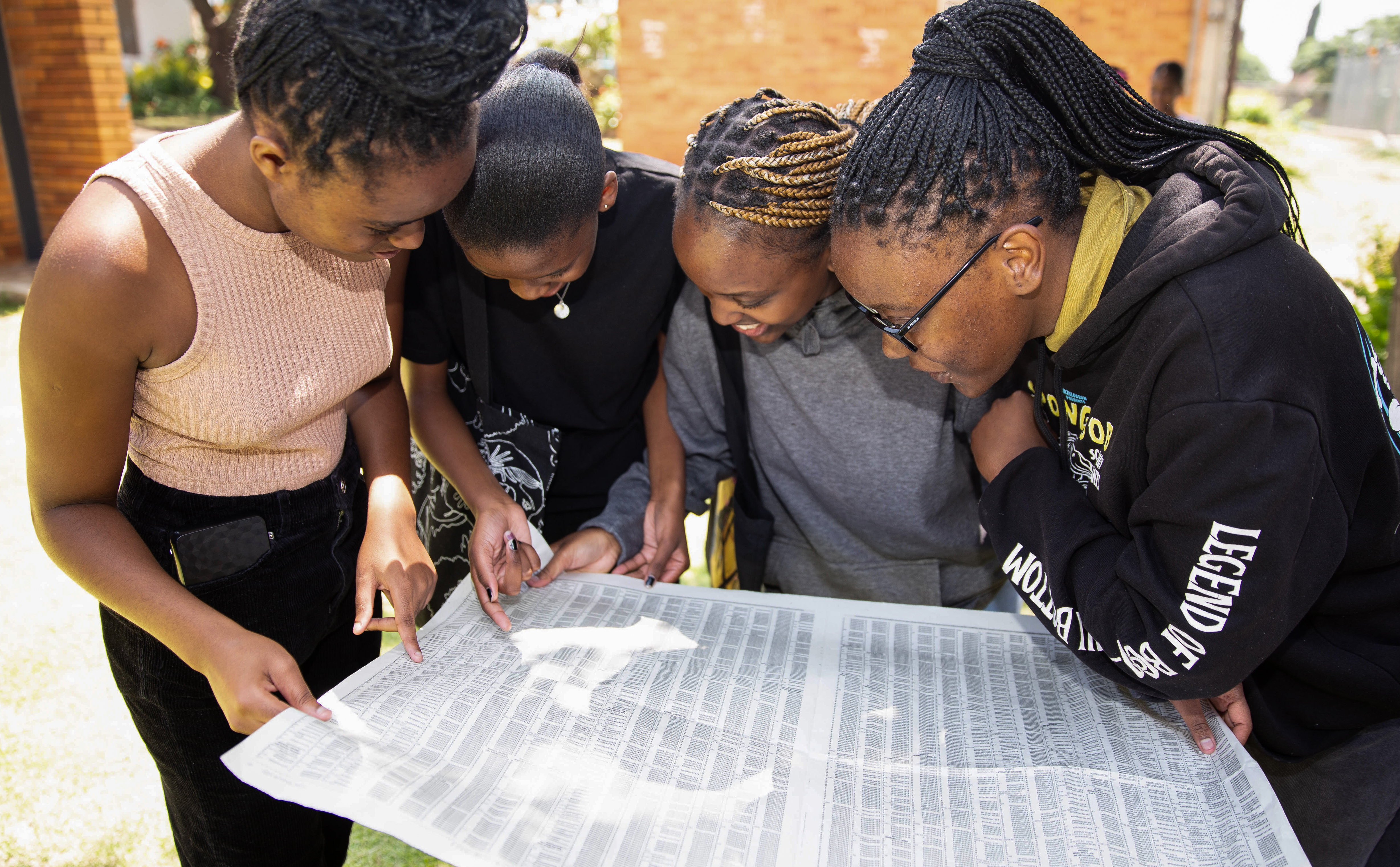
 Matriculants receive their results at Letsibogo Girls Secondary School in Soweto on 19 January 2024. (Photo: Gallo Images / Papi Morake)
 The scripts are marked and the tension is high for the matric Class of 2025. The release of last year’s National Senior Certificate (NSC) results is just days away. With nearly 900,000 candidates awaiting the outcomes, we’ve got your back with this helpful guide covering key dates, access methods, pass requirements, re-mark options, rewrite details and back-up paths.
When will the results be released?
Minister of Basic Education Siviwe Gwarube will announce the overall results on the evening of 12 January 2026. Individual results become available from the morning of 13 January 2026 via:
- Your school or exam centre (strongly recommended); or
- SMS, USSD (Unstructured Supplementary Service Data) or the Department of Basic Education (DBE) website from 6am.
The DBE confirmed on Wednesday, 7 January that the NSC exam results will be released to accredited newspapers for publication on 13 January 2026. They will appear in a pseudonymised format, showing only examination numbers and marks, without names, surnames or ID numbers, as has been standard in recent years.
This approach aligns with a court order issued on 18 January 2022, which the department says legally obliges it to protect pupils’ personal information. Publishing NSC results in newspapers remains a vital, accessible way for pupils and parents to access them promptly. The department emphasised that this court-endorsed method strikes a balance between transparency and privacy protection.
The department will oppose an application for leave to appeal by the Information Regulator. It argued the appeal had “no reasonable prospects of success” due to existing court clarity, adding that its opposition to the move was in the best interests of pupils, families and the education sector. The department stressed its continued respect for the regulator’s constitutional role.
It is important to note that some online results may be unavailable initially due to technical issues – don’t panic, it’s normal. Remember to:
- Collect your statement of results from your school/exam centre;
- Ensure names and ID numbers are correct;
- Report corrections to the DBE before 20 February 2026; and
- Submit result queries within 30 days of release.
What are the NSC pass levels?
Earning your National Senior Certificate means meeting a structured set of benchmarks across seven subjects, designed to prove readiness for further study or work.
You must pass at least six subjects overall, with specific thresholds depending on your goal: bachelor degree, diploma or higher certificate. Use this guide to see where you stand:
/file/attachments/orphans/Frame-43_126629.jpg "(Graphic by Daniella Lee Ming Yesca)")
Not happy with your results? Re-mark, re-check or view scripts
If your matric results fall short of your hard work or seem off, take a breath – you can request a review to set things right.
A candidate may apply at the prescribed fee for the re-mark (full re-evaluation) or re-check (verification of marks/totals) of their examination scripts. Registration is straightforward: do it at your school or provincial district office, or online. Full instructions will be available on the reverse side of your statement of results.
Action | Opening Date | Closing Date | Fee | Notes |
| Re-mark | 13 January 2026 | 27 January 2026 | R120 | Full re-evaluation; results from 13 March 2026 at school/exam centre. |
| Re-check | 13 January 2026 | 27 January 2026 | R30 | Mark/total verification only. |
| View scripts | After re-mark/re-check results | 7 days after those results | R230 | Only available after-re-mark/re-check. |
Apply early to avoid missing deadlines!
Can you improve your results with a rewrite?
The May/June 2026 supplementary NSC exams offer a valuable second chance to enhance your overall performance, lift individual subject marks or finish incomplete results. Candidates can only register for subjects for which they were registered in any previous November examinations. The closing date for applications is 6 February 2026.
Who can apply?
- Any NSC candidate (from November 2008 exams onwards) looking to boost overall achievement or a single subject;
- Candidates absent with a valid reason (e.g. medical unfitness, death in the immediate family or other special reasons) from one or more external papers, provided you have valid internal marks (practical assessment tasks/PAT, oral, school-based assessments/SBA);
- Candidates who did not write or complete one or more November papers for reasons other than illness/injury or family death – provided you have valid internal marks (PAT, oral, SBA);
- Provisional entry if an irregularity is under investigation (pending outcome);
- Result queries should be submitted for investigation within 30 days after the release of results.
What if my examination results are withheld?
Candidates’ results are normally withheld due to irregularities, but those candidates whose results have been blocked or withheld have the right to appeal. When a candidate is informed that the results are withheld, they can do the following:
- Enquire, preferably in writing, and request the reasons for withholding the results. Candidates may also contact the district office or their school for assistance; or
- Candidates can visit the nearest office of the Department of Basic Education in their area to enquire about their results or ask any other examination-related questions.
What are the alternative pathways?
Not achieving your matric exam targets or June rewrite eligibility isn’t a dead end. The South African education system offers solid pathways to keep moving forward, whether through repeating the school year, qualifying differently or switching to practical training. Alternative options include:
- Full-time school repeater: Re-enrol at a school right away (must be under 21). You’ll take all seven subjects (including life orientation) and meet full SBA requirements for a fresh NSC shot;
- Part-time repeater: Register at a Public Adult Education Centre to redo specific subjects flexibly, alongside work or life;
- Senior Certificate (SC): For adults/out-of-school students over 21, this is an official school-leaving qualification – register for the next exam cycle via the DBE; and
Vocational training: Skip traditional routes and build job-ready skills at one of 50 public Further Education and Training colleges (more than 300 campuses nationwide). Programmes in trades, tech and more lead to diplomas or certificates. Explore these on the DBE website. DM