



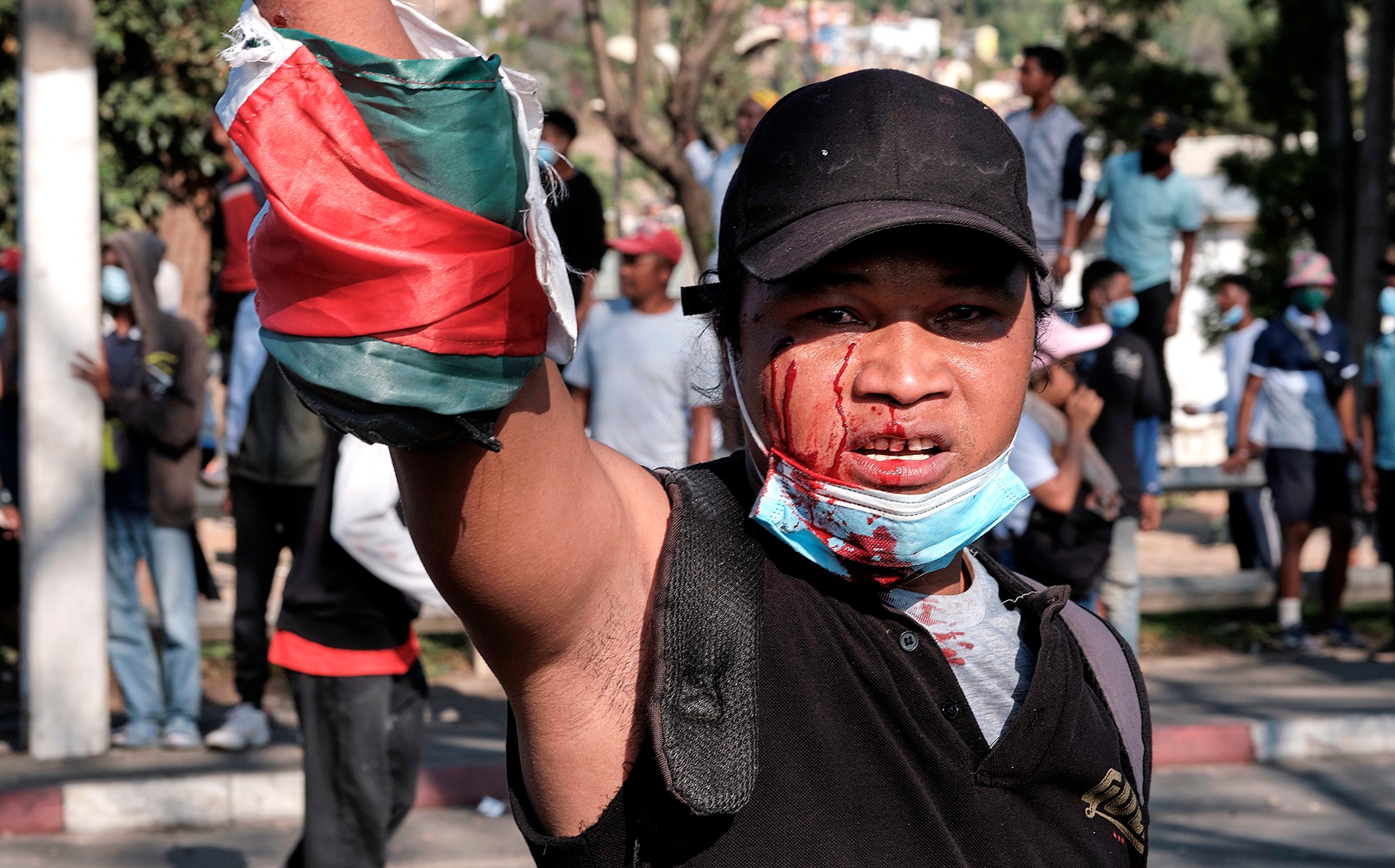
 An injured man bleeds during an anti-government protest in Antananarivo, Madagascar, on 11 October 2025. Some Madagascar soldiers joined the so-called Gen Z protests, saying they would refuse any orders to shoot demonstrators. (Photo: EPA / Razafindrakoto Mamy)
/file/dailymaverick/wp-content/uploads/2025/10/label-Op-Ed.jpg)
On 25 September 2025, young people in Madagascar (the Gen Z Collective) launched a peaceful protest to challenge years of power and water shortages caused by decade-long mismanagement at the national Water and Electricity Company. This act of civic resistance was met with severe police violence, which persisted for several weeks, highlighting both the state’s repressive response and the protest’s significance as a catalyst for social change.
/file/dailymaverick/wp-content/uploads/2025/10/13430162.jpg "Protesters welcome members of the military during a rally in Antananarivo, Madagascar, 14 October 2025. (Photo: EPA/HENITSOA RAFALIA)")
In response to the movement’s growing visibility, the government allegedly tried to undermine its legitimacy by orchestrating riots and attempting to make protesters disappear. However, these efforts were quickly countered. Witnesses systematically documented and shared arrests and instances of brutality on social media, thereby exposing government abuses and generating new momentum for the protest.
As the Gen Z movement advanced, citizens organised a range of supportive initiatives, such as the formation of a bona fide lawyers’ association to guarantee immediate legal representation for those captured, as well as the establishment of crowdfunding campaigns, food and water distribution points, health checkpoints and safe houses for those fleeing police violence.
Despite these acts of solidarity, in three weeks, the protest was marked by significant tragedy: at least 22 people, including children, were reportedly killed, hundreds injured and dozens detained.
/file/dailymaverick/wp-content/uploads/2023/11/11554757.jpg "Now ousted Madagascar President Andry Rajoelina arrives at the Elysee Palace for an official dinner, on the sidelines of the New Global Financial Pact Summit in Paris, France, 22 June 2023. (Photo: EPA-EFE /YOAN VALAT)")
The president flees
After three weeks of manifestation, the president’s stronghold collapsed as the military sided with the people. Soon enough, Andry Rajoelina, the president of Madagascar, left the country, exfiltrated by the French army with their military plane.
Consequently, he was impeached by the house of representatives, with 130 of 131 voting in favour of his destitution.
/file/attachments/orphans/13420257_742130.jpg "A man holds a signs next to a police vehicle set alight by protesters during an anti-government protest in Antananarivo, Madagascar, on 11 October 2025. (Photo: EPA / Razafindrakoto Mamy)")
The military seized power and said it intends to build a military-civil society coalition government while organising the next elections. The supreme court deemed the act constitutional.
On the other hand, parts of the international community called it a coup and unconstitutional, and called for the ousted government to be restored.
/file/dailymaverick/wp-content/uploads/2025/09/13375466.jpg "A protester kicks away a tear gas canister during a rally in Antananarivo, Madagascar, 25 September 2025. (Photo: EPA/HENITSOA RAFALIA)")
The United Nations was among the first to condemn the military seizure of power. The Southern African Development Community also condemned it as a coup and sent an envoy to Madagascar to evaluate the situation and mediate talks. Then the African Union suspended Madagascar’s membership.
By contrast, Russia was among the first to welcome the new government, marking a new era of alleged rapprochement between the two countries. The first diplomatic body to meet with the new head of state, Colonel Michael Randrianirina, was the Russian ambassador, while the leader of the opposition, Siteny Randrianasoloniaiko, known for his strong ties with Russia, became the president of the lower house.
Many wondered if Russia played a role in the shift of power following the Gen Z movement.
Aftermath: The new government and shared disappointment
The appointment of individuals with longstanding affiliations to the former president and their influential financial backers to key governmental positions has generated significant concern within civil society, particularly among supporters of the Gen Z movement. Many claimed that these nominations contradicted the movement’s call for systemic change, raising doubts about the new government's commitment to breaking with entrenched networks of corruption.
Civil society organisations working in democracy and citizen participation sectors called for transparent justifications of the selection process, questioning whether the new appointees possess the integrity demanded by the public. Many talked about “recycling old crooks”.
/file/attachments/orphans/13420258_868622.jpg "A police vehicle set alight by protesters burns during an anti-government protest in Antananarivo, Madagascar, o 11 October 2025. (Photo: EPA / Razafindrakoto Mamy)")
Fragmentation of the Gen Z movement
When the old government was dismantled, a new one was formed. There was a wave of opportunists claiming to be affiliated with the Gen Z movement and asking to be given a seat/role in the government.
Even some highly controversial politicians claimed to be associated with the movement.
This has led the movement’s precursor to dissociate itself from the Gen Z movement collective. Soon, each group became a simple association of citizens and individual members of the civil society.
The initial Gen Z movement continues to regularly issue statements on how the new government is driving the eagerly awaited reform. However, their positions aren’t as popular as they used to be and sometimes are heavily criticised by citizens online.
Challenging the immunity of those involved with high-level corruption
The new government appointed a former judge and former political exile as the new minister of justice. She vowed to catch white-collar criminals from the former government and to confiscate ill-earned incomes and wealth. This is one of the most significant outcomes from the Gen Z movement.
Madagascar has begun prosecuting corrupt officials.
It has managed to destabilise a few of the old government’s corruption funders, especially one billionaire Mamy Ravatomanga (the most powerful man in Madagascar during Rajoelina’s presidential tenure), who tried to escape to Mauritius and allegedly planned to launder his money there. More cases of corruption were tackled. Investigations are led, and some protected obvious criminals are now investigated, prosecuted or incarcerated for various motives linked to high bribery, abuse of power and embezzlement.
The former president has also had his and his family’s Malagasy citizenship revoked.
A much-needed movement
The Gen Z movement was both powerful and necessary, fostering a sense of national solidarity that resulted in remarkable change within just three weeks.
This transformation is widely regarded by Malagasy people as both beneficial and imperative. There is a sense of hope and relief among civil society groups, including journalists and former political prisoners who have regained their freedom.
The success of the Gen Z movement can be attributed to several key factors:
- The role of social media in ensuring transparency by documenting abuses in real time;
- Rapid communication that facilitated immediate citizen mobilisation;
- A strong display of solidarity driven by a shared goal, use of common language and united resistance against a common adversary;
- Intergenerational cooperation, as experienced leaders from previous movements supported the youth;
- Extensive volunteering, shown by support from legal, medical, academic and diaspora networks, along with ordinary citizens offering shelter to those fleeing police violence;
- Increased visibility brought by influencers and artists who joined the protests both physically and online; and
- The decisive intervention of the army, which ultimately ensured the movement’s victory.
/file/attachments/orphans/PXL_20251013_094848959MP_951843.jpg "Protesters celebrate on Liberty Square, Antananarivo, on 13 October 2025 following the overthrow of Andry Rajoelina as president and the nomination of Colonel Michael Randrianirina as the new head of state, marking a huge victory for the Gen Z movement after weeks of protest and violent repressions by the Malagasy police force. (Photo: Aina Zo R)")
New challenges
If political power appears to be a little more respectful of civil society, a new form of power abuse has emerged: corporate control over the people. When individuals start openly criticising corporate power, consumer abuse and high corruption, the latter swiftly press charges, especially those allegedly associated with the former president. This seems to be a new attempt to re-silence the democratic space using intimidation and corporate names.
Indeed, corporate mega-influence has been a growing concern in Madagascar’s political life since 2002 at least. Recently, the new minister of justice proposed that “State Capture” by corporate power should be a basis for prosecution under the Rome Statute of the International Criminal Court.
Ultimately, while the initial chapter of Rajoelina’s authoritarian rule has closed, Malagasy civil society now faces the complex, long-term task of ensuring this hard-won democratic space is not exploited by a new corrosive combination of political and corporate interests. The true measure of the Gen Z movement’s success will certainly be its sustained ability to hold power in all its forms accountable in the years to come. DM
Daniel Rakotoarison is a civil society activist working in the sphere of child and youth care and protection in Madagascar. He is the founder and president of a grassroots nonprofit, Hay Kanto, which seeks to support and develop resilience among children and young people from vulnerable backgrounds.